Zuckerberg is one of the least-liked people in the U.S.
As Meta CEO Mark Zuckerberg continues to tout his grand vision for artificial intelligence, the indicators continue to show that Zuckerberg and Meta are going to find it a very hard sell.
Zuckerberg’s idea is that all people will eventually be able to access their own personal AI superintelligence agent, which will help to guide them throughout all aspects of their daily life, including health and financial decisions. In order to that, however, Meta will also need people to grant it access to a lot more of their personal info. And given Zuckerberg’s current standing with the public, that’s going to be a challenge.
According to a new survey conducted by UMass Lowell’s Center for Public Opinion, in partnership with YouGov, Zuckerberg is the least-liked public figure in the U.S. among both Republicans and Democrats.
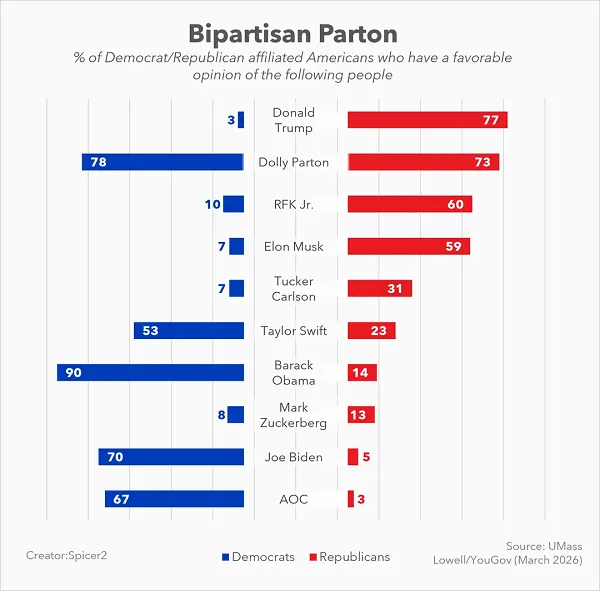
As shown in this image, which was posted on r/DataisBeautiful on Reddit in the wake of singer Dolly Parton’s death, Zuckerberg has low favorability on both sides of the political spectrum.
Which could end up being a major hurdle for Zuckerberg’s AI ambitions.
As noted, earlier this month, Zuckerberg published a 6,500-word manifesto outlining his vision for an AI-led future, in which everybody will have an always-on AI assistant.
As explained by Zuckerberg: “Everyone will have an exceptionally capable personal agent that understands you, your goals, and everything you care about. Your agent will work 24/7 on your behalf to improve your relationships, health, career, finances, home management, hobbies, and more. It will free up time for the things you enjoy, and help you accomplish more than you could otherwise.”
For some, this sounds like a valuable and beneficial future, where people make smarter decisions and fewer mistakes, and generally live a better life.
But in order to facilitate this, Meta will need more personal data. A lot more.
Meta’s AI tools will need to be able to access a broad range of sensitive data in order to facilitate this level of guidance.
As such, trust in Zuckerberg, and by extension Meta, which has been so eroded by the company’s past actions, could now become a deciding factor in the next stage of the company.
This survey further underlines the company’s trust deficit. And while Meta is trying to improve its standing by establishing a huge new agreement on restricting teenage social media usage, the company is still suffering on other fronts.
For example, its AI-powered, camera-equipped glasses are now being labeled “perve glasses” due to the propensity wearers have for recording people without consent.
It remains to be seen whether Meta and Zuckerberg can turn this around, and convince more people that the company is actually working for the public good, and not just for profit.