Black Friday Ecommerce Strategy: Your 2026 Playbook
Key takeaways
Black Friday shoppers are led by impulse and deals, but Cyber Monday shoppers look for value and plan their purchases more
A Black Friday ecommerce strategy has four parts: readiness, acquisition, conversion, and retention
Some of the best ways to protect your margins during Black Week are to use minimum-spend thresholds and smart bundling
The brands that see the most benefit from a well-planned Black Friday strategy focus on acquiring new customers and turning them into repeat buyers
To build a well-structured Black Friday strategy, businesses should start preparing at least three months before the event
An effective Black Friday strategy combines readiness, customer acquisition, conversion, and the shift from impulse shopping to repeat purchases. Black Friday is a major event in ecommerce, as Omnisend’s newest Black Week research found that almost 10% of brands generated half or more of their yearly orders, and 31% generated at least 15% of their yearly orders.
That’s why this guide will walk you through the entire four-part strategy and give you real-life tips to help increase profits this Black Friday.
Plan your whole Black Friday with Omnisend
Quick sign up | No credit card required
Eager to learn even more about BFCM strategies? Visit our Black Friday hub to find everything from how to generate sales to tips on collecting subscribers.
What is a Black Friday ecommerce strategy and why 2026 raises the stakes
A Black Friday strategy is an interconnected set of actions that businesses take before, during, and after the BF event to increase revenue. According to Omnisend’s newest research, the average order value during Black Week continues to increase, from $164 to $215 in 2025, with orders themselves growing 36% year-over-year (YoY).
Four main stages shape a Black Friday strategy:
- Preparation: Preparing your web and physical store to handle an increased volume of customers and sales.
- Acquisition: Attracting new customers by investing in brand awareness and targeted Black Friday marketing campaigns.
- Conversion: Turning customer interest into completed purchase orders without damaging your margins.
- Retention: Building relationships with newly acquired customers to encourage repeat purchases.
When Black Friday first started in the 1950s, it was nothing more than a single in-store shopping day. But in 2026, it’s a significant weeklong event that generates the majority of annual revenue for many businesses.
To put this in perspective, the same Black Week 2025 report shows that 16.6% of brands generated 30% or more of their entire year’s orders in a single week. No matter how you look at this, since Black Week helps brands earn significant revenue, businesses need a strategy that covers the entire event.
Black Friday vs. Cyber Monday: what’s the difference?
The difference is that Black Friday is more focused on impulse purchases, with buyers expecting large discounts with a heavy mobile-first emphasis, while Cyber Monday brings in more focused, planned spending.
As the name suggests, common items of interest during Cyber Monday are more expensive and revolve around electronics. During Black Friday, on the other hand, most shoppers look to buy fashion items, skincare, clothes, or home decorations.
| Factor | Black Friday | Cyber Monday |
|---|---|---|
| 2026 date | November 27 | November 30 |
| 2025 U.S. online sales | $11.8B (Adobe Analytics) | $14.25B (Adobe Analytics) |
| Devices | Focus on mobile devices | Focus on mobile and desktop devices |
| Deepest discounts (by category) | Home goods, appliances, jewelry, toys, fast fashion | Electronics, computers, apparel (more expensive, designer items) |
| Shopper focus | Impulse-driven | More deliberate purchases |
| Channel emphasis | Social commerce and in-app/mobile deal-hunting | Email marketing and desktop/workplace browsing |
| Average order value (AOV) | Lower, influenced by steep discounting | Higher electronics purchases increase order values |
Sources: Consumer Affairs, Omnisend, Forbes, Adobe Analytics
Don’t plan for one or the other, but consider both as part of a larger Black Week strategy. Use the extended period to gradually introduce different offers with tiered deals and personalized offers to protect margins and generate more revenue.
Expert tip
Get your ads approved early: To avoid spending all your budget on the two most competitive days, Black Friday and Cyber Monday, consider running them a day or two early. If you want to focus solely on Black Friday, pause the ads after approval until Black Friday so you’ll be prepared.
Black Friday 2026 ecommerce trends to plan around
In 2026, Black Friday trends indicate that strategies are now shaped by a shift in shopping behavior towards more conscious buying, preferring mobile-first interactions with brands and using AI to research deals much earlier than the actual Black Week event.
Here’s a quick list of the main ecommerce trends to be aware of, especially before drafting your 2026 Black Friday strategy:
- Shoppers are spending more but ordering less: Consider consolidating your offers, giving shoppers more value with a single purchase. Buyers are more informed than ever, and with ecommerce becoming saturated, they’re taking their time to weigh the pros and cons.
- Mobile remains the most popular device for interacting with brand deals: Prepare your Black Friday strategy so that it covers mobile optimization. Whether it’s brand awareness or Black Friday deal launch, most customers will learn about your brand from an ad on their phone.
- First-party data and personalization continue to deliver the best results: Use accurate data-gathering methods to segment your audiences. As detailed in our 2026 Ecommerce Marketing report, the right customer segmentation and personalization can lead to results such as a 53% year-over-year increase in click-to-conversion rates.
- AI is now actively driving brand discovery and merchandising: Customers are increasingly using AI to research deals, brands, and products online, so make sure you’re discoverable by AI engines. Omnisend’s AI features include segment building, product recommendations based on historical data, customer lifecycle value (CLV) prediction, copywriting, and running Recency, Frequency, and Monetary Value (RFM) analysis. Moreover, through the Omnisend MCP integration, brands can query their store’s performance data directly in ChatGPT or Claude.
- The Black Week period keeps extending: Include early-bird Black Friday campaigns to attract loyal customers and more considerate shoppers. While most businesses benefit from the extended window stretching earlier into October and November, this also means investing more in well-built strategies to gain or keep a competitive edge.
Your Black Friday preparation timeline
3+ months before Black Week
Research the best margin retention strategies and decide how you want to protect your margins during Black Week. In addition to that, focus on running a full audit of your store’s infrastructure, both physical and digital, to make sure you’re ready and stocked.
If you’re operating on Shopify, you might want to check out our Black Friday prep for Shopify stores, which details platform-specific setup.
6–8 weeks before Black Week
Analyze your audience and segment your Black Friday audience so your high-value customers get a different offer than window-shoppers. Consider using Black Friday popups for list building early on and pair it with early-bird Black Friday campaigns to reach shoppers before they’re bombarded with offers from multiple brands.
2–3 weeks before Black Week
This is the time to start drafting and testing your campaigns. To make this process smoother, leaving you more time to test and see what works, consider using Black Friday email examples and templates and Black Friday email subject lines.
Keep in mind that the most effective strategies utilize email and Black Friday SMS marketing to unify communication across channels. Also, this window can be the perfect time to introduce holiday gift guides before the winter holidays roll in.
Black Week launch
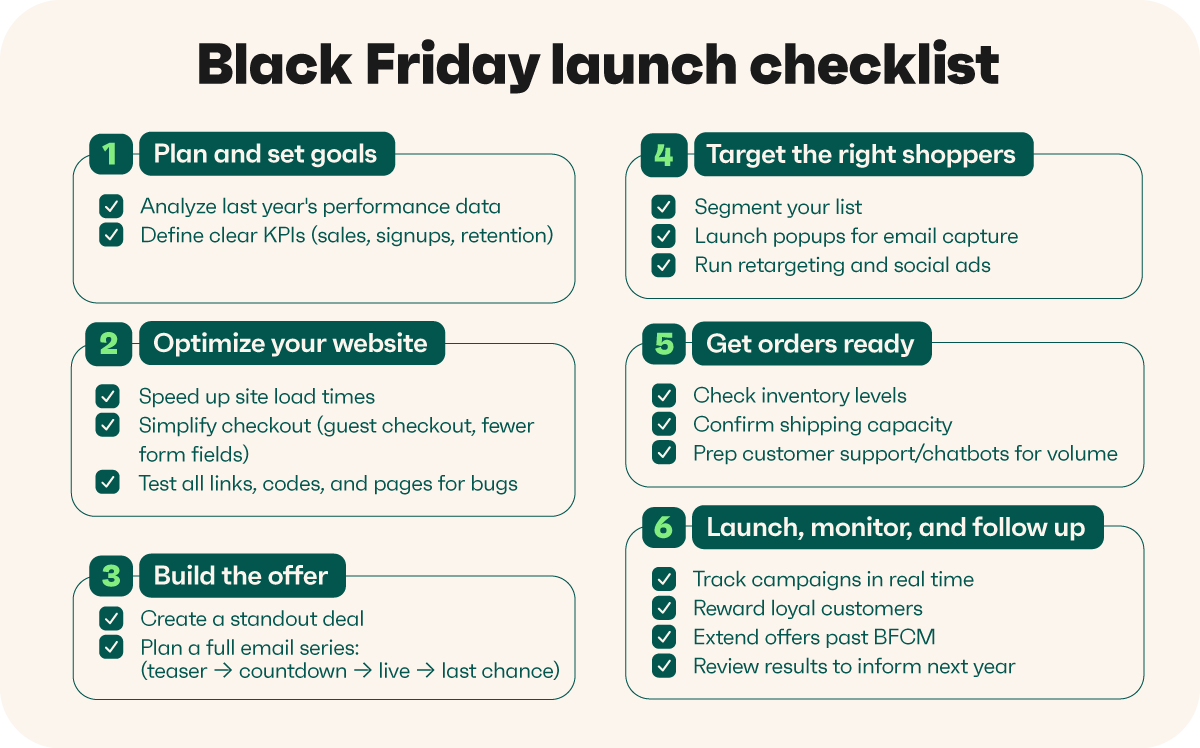
The preparation work should be completed by now, so the final step is to run an all-round check to see how every action performs. Requirements are much the same for any store, so there’s no need to build your own from scratch. All you have to do is go through our Black Friday launch checklist to confirm your landing pages are in place and automations are set up using the right triggers.
During Black Week
Start by timing your email sends based on our research on the best time to send Black Friday emails and run paid BFCM Facebook ad campaigns to expand your audience reach.
Don’t forget to prepare abandoned cart recovery via email, SMS, and push notification. It’s a fairly common occurrence during massive sales events like Black Week.
After Black Week
Shopper interest and revenue spikes are great results, but it’s honestly just a beginning. When done right, customer retention can become a new revenue stream. B*WEAR generated 40% of its sales through email marketing using Omnisend. Their retention-focused automations, like the welcome series, reached a 66% conversion rate.
Design offers that protect your margins
Set minimum purchase thresholds for discounts
Minimum price thresholds for larger discounts will help make large purchases seem more appealing to customers. For example, if you put a 10% discount on purchases above $30 and a 20% discount on purchases above $50, the extra 10% encourages additional spending.
You can always do the same with free shipping, although that may be expected as part of any deal during Black Friday.
If a customer has $45 worth of products in their cart, they’re likely to look for an item to lift them over the threshold. This will lead to larger purchases, improving your profits and raising order value.
You can also view our Black Friday coupon and discount code ideas to build your discount strategy in a way that doesn’t hurt margins.
Bundle lower-margin discounted items with higher-margin products
Bundling lower-margin discounted items with higher-margin products is a way to increase your store’s average order value. This will lead to higher revenue, as customers will be tempted to buy multiple products rather than just one.
The products you bundle should be related in some way. Otherwise, the customer is less likely to be interested in making the extra purchase. For example:
- Shoes and shoe cleaning products: If a customer is buying a pair of shoes, they will also be interested in shoe polish/brushes/protection spray to keep their new purchase looking fresh
- Razors and razor blades: If a product has replaceable parts, such as a razor blade, customers are likely to want to stock up within the same purchase
Implement stricter return policies for heavily discounted items
Return fees can be an issue for your business if someone wants to send back an item they bought in the sale. You can counteract this by implementing stricter return policies on heavily discounted items.
However, if you go down this route, you’ll need to communicate it clearly with your customers beforehand. Without upfront transparency, customers may feel as though they have been tricked by your sale.
Add a gift to every order
Adding a gift to each order will offer an extra incentive to customers considering buying a product from you. For smaller businesses during Black Friday, this may be a challenge due to costs, so you’ll need to attach a spending threshold for the deal.
Here is how you should operate a gift-giving deal:
- Choose free gifts that cost between 10-15% of the order value
- Improve the gifts when customers spend more
- Give new customers introductory products to encourage category exploration
Try out these spending thresholds:
| Purchase amount | Gift value | Example |
|---|---|---|
| $50-$99 | $5-$10 | Sample-sized product |
| $100-$199 | $15-$25 | Full-sized complementary item |
| $200+ | $30-$50 | Premium gift or gift set |
“Focus on value if you can’t give big discounts. If your discounts don’t go higher than 10-15%, it’s totally fine. You can also consider things like extended warranties, free shipping, future purchase credit, exclusive early access, and loyalty bonuses to entice customers.”
— Evaldas Mockus, VP of Growth at Omnisend
Offer free shipping on carts with a full-price or non-discounted item
While customers usually browse for discounts during Black Friday, you could improve margins by offering free shipping when a non-discounted item is purchased. This will also create a psychological trigger, making customers feel compelled to add a non-discounted item to their order to get free shipping.
If you’re thinking about implementing this offer, bear these tips in mind:
- Communicate it clearly to customers by advertising it in emails and popups
- A/B test it with earlier sales before you try it on Black Friday
- Include full-price items alongside deals
- Create pre-made bundles mixing discounted items with full-price items
Regardless of the offer, it’s recommended to keep a single dedicated Black Friday landing page instead of splitting them across several. One page keeps your ad spend, email, and SMS pointing at the same place, and it gives you one clean set of numbers to judge the offer on afterward.
Get your store ready: speed, checkout, and traffic resilience
Brands need to prepare for increased interest and traffic to their websites before Black Week. Here’s a breakdown of the most important elements to go through:
- Check your site speed and Core Web Vitals: A slow-loading page can lose shoppers before they even see your offer, which poses a real compounding risk as Black Friday means more traffic
- Optimize for mobile experience: Make sure your mobile app or website is fully capable of handling increased traffic and offers a good mobile shopping experience
- Ensure a frictionless, guest-first checkout: Your focus should be on creating a smooth customer experience that attracts, retains, and converts customers
- Include wallet selections and Buy Now, Pay Later: Alternative payment methods mean that more customers will be willing to buy from you using payments they already know and trust
- Use real-time inventory sync: Introduce methods to help track your inventory at all times because a sold-out item during Black Week can deter customers from revisiting your brand in the future
- Introduce load testing, autoscaling, and waiting rooms: Simulate your expected peak traffic ahead of time, and have a queuing mechanism to help ease the burden on your servers without the risk of them crashing entirely
If your webstore runs on Shopify, WooCommerce, or BigCommerce, Omnisend connects natively to keep customer and order data flowing into your marketing without complex or custom setup. Again, we highly recommend reading our guide on how to prep for Black Friday on Shopify.
After Black Friday: turn one-time buyers into repeat customers
The second part of the Black Week should focus on turning buyers into loyal and repeat customers. Start with post-purchase email flows, like a welcome-style sequence that follows a Black Friday order, rather than a first-time signup. It should acknowledge their deal purchase and introduce the rest of your catalog at full price.
Timing matters more than the size of the offer here. A time-limited offer two to three weeks after Black Friday can outperform a generic ‘come back’ email sent in January.
Finally, spend time segmenting your Black Friday audience by what they bought and at what discount depth, so your Q4 and Q1 winback campaigns show precisely what actually motivated their purchase in the first place.
 |
Turning email and SMS into CLV powerhouses
CLVmaxers, a boutique retention agency, grew their welcome automation open rate by 52% and conversion rate by 7.5%. This resulted in 1,000+ first-time orders in the last 12 months. Read the full CLVmaxers case study. |
Run a responsible Black Friday sale
A truly responsible Black Friday sale means discounting honestly. This means no inflated ‘was’ prices that make a modest markdown look dramatic, and clear communication about real stock levels and shipping timelines.
Black Friday can be used for more than just selling your products for a reduced price. From running a charity drive to encouraging mindful shopping, these unconventional approaches can serve a purpose beyond sales. Starting a charity campaign will be great for public relations and highlight your brand’s commitment to making a meaningful impact.
A great example of purpose-driven tactics is from Allbirds, which raised its prices on Black Friday only to donate the extra money to climate-related causes. Or the outdoor brand Amundsen, which offered free waffles at live locations.
Summary
An effective Black Friday ecommerce strategy in 2026 relies on the four main pillars of readiness, acquisition, conversion, and retention. Instead of treating Black Friday as an isolated event, the four-part strategy covers the entire Black Week, helping brands stand out in an already overcrowded market, build lasting relationships with customers, and increase revenue.
Frequently asked questions
What is the difference between Black Friday and Cyber Monday for online stores?
Black Friday deals focus on home, fashion, and gift categories, with most shoppers using mobile devices. However, Cyber Monday is more focused on electronics items, which are usually more expensive and lead to shoppers using mobile and desktop devices to consider and finalize purchases.
When should I start planning my Black Friday ecommerce strategy?
The best time to start planning your Black Friday marketing strategy is around three months before the event. This gives most brands ample time to prepare and test their strategies, while six to eight weeks before Black Friday is the best time to identify and segment your audience.
How do I protect profit margins during Black Friday?
To protect your profit margins, use minimum purchase thresholds, bundle lower-margin items with higher-margin ones, and consider stricter return policies on your deepest discounts rather than discounting everything equally. Check out our Black Friday coupon and discount code ideas for more ways to structure your offers.
What strategies do stores use to attract customers on Black Friday?
Most businesses now combine early-bird offers with segmented email/SMS campaigns, and paid social ads timed around the Black Week period. For a more in-depth strategy, check out our Black Friday marketing guide.
How should I prepare my store’s technical setup for Black Friday?
To make sure your webstore is fully equipped to handle traffic spikes during the Black Week event, start by testing how your digital store holds up under sudden traffic increases. After that, review your checkout process both on desktop and mobile, as this is where most shoppers drop off otherwise.
What should I do after Black Friday to keep new customers?
After Black Friday, you should set up post-purchase automations built for the different segments you specified earlier. Offer limited-time-only deals to encourage second purchases two to three weeks after the Black Friday event while the interest is still there, but slightly faded.