Social Media Marketing for Car Dealerships That Converts
My firm works with auto repair shops, not dealerships, but the numbers people obsess over, and the ones that actually pay the bills, look the same regardless of what’s parked on the lot. That’s the lens I’m bringing to social media strategy for car dealerships, not as someone who has sold a car, but as someone who has spent years watching automotive businesses confuse activity with results.
My co-founder, Saurav Kumar, and I also sit on the board of the ITAC Foundation, which funds career pipelines for the next generation of automotive workers, so the industry itself isn’t unfamiliar. The specific problem of moving someone from a scrolling thumb to a test drive is.
Here’s the fact that should anchor everything below. Cox Automotive’s long-running Car Buyer Journey Study found that the share of buyers who contact a dealership before ever walking in went from 20% in 2009 to 65% in 2024. Whatever a dealership posts, ignores, or outsources to whoever’s free that week, it’s shaping that first contact. The question isn’t whether to be on social media. It’s whether what you’re posting is doing anything before that contact happens.
Most advice on this topic leads with reach: more followers, more impressions, more eyes on the lot. I’d push back on that as the starting metric, and not because reach is worthless. It’s because reach measures whether people saw something, not whether they trusted it enough to act.
BrightLocal’s 2025 Local Consumer Review Survey, run against just over 1,000 US consumers, found that 74% of people check two or more review sources before deciding whether to trust a local business, and Google (81%) and Facebook (48%) are the two they check most. A dealership’s Facebook page isn’t competing with other dealerships’ Facebook pages. It’s competing with a review a stranger left eight months ago, and the post has to hold its own against that.
I spent 14 years in technical program management before this, which means I have a low tolerance for a metric that doesn’t tie to an outcome. When a dealership tells me their post “did great” because it got a lot of likes, my first question is always the same one I’d ask an engineering team about a dashboard: did it get anyone to raise a hand and say they wanted to see the car. If the answer is no, the number is a vanity metric wearing a business-outcome costume.
What social media can actually do for a dealership, in order of how much it matters:
- Build the trust a buyer checks before they’ll answer your call. Real delivery photos, honest reviews, and a page that looks staffed by a person, not a template.
- Shorten the research phase, not replace the visit. Buyers still want to sit in the car. Social media decides which lot they drive to first.
- Catch problems before they become a one-star review. A page you actually monitor gives an unhappy customer somewhere to go besides a public review.
- Everything else, including follower count and posting streaks, is a distant fourth.
Most “strategy” sections on this topic read the same whether the business sells cars, fixes them, or has nothing to do with either. They shouldn’t. Here’s how the pieces actually fit together for a dealership, and where I’d spend the least time even though the standard checklist tells you to spend more.
Set Goals You Can Actually Defend in a Report
Most goal-setting advice for this topic tells you to pick something SMART: specific, measurable, achievable, relevant, time-bound. That’s fine as a checklist, but it skips the part that actually matters, which is picking the right measurable thing.
A few social media goals worth picking from, depending on where your dealership actually is right now:
- Increase traffic to your new and used inventory pages
- Generate a set number of test drive requests every month
- Build brand awareness specifically among buyers in your local market
- Get your response time on comments and messages under an hour
- Increase the share of leads you can actually trace back to a social channel
In my experience, picking the goal is the easy part. Measuring it honestly is where most of this falls apart. Here’s how I’d rank the usual metrics, from most defensible in a report to least:
- Test drive requests tied to a social channel. The closest thing to proof any of this worked.
- Form submissions from a social link. One step removed, but still tied to a real action.
- Cost per lead, if you’re running any paid spend. Tells you whether the math holds up.
- Referral traffic. Useful context, easy to read as success when it isn’t.
- Engagement rate. The easiest number to hit and the easiest one to be wrong about.
If a metric can’t be traced to a person who asked about a car, it’s a vanity number with better math behind it.
For a lean firm like ours, every client report has to answer one question: Did this turn into a pipeline? That’s the filter we run every account through in SocialPilot’s analytics before we talk about whether a strategy is working, because a client doesn’t pay us to explain reach, they pay us to explain revenue.
Whether a dealership needs that level of reporting depends on volume. A single rooftop moving forty cars a month can track this by hand for a while. A group running five locations can’t, and pretending otherwise just means nobody’s actually looking at the numbers.
Decide Which Content Pillars Earn the Post
There’s a version of this advice that lists seven social media content pillars, treats them as equally valuable, and leaves you to figure out the order yourself. I don’t think they’re equal, and neither would anyone who’s actually run an account for money.
Here’s how I’d actually rank them:
- Vehicle showcases. The highest-value pillar on this list. It’s the one thing a buyer can’t get anywhere else but your page.
- Customer delivery stories. Right behind it. Proof someone else had a good experience.
- Educational content (financing basics, EV range questions, plain maintenance advice). Answers a question instead of making a pitch, and buyers trust answers more than pitches.
- Local and community content. Fine in small doses, not a reason anyone converts.
- Interactive content like polls. Same as above: keep it light.
- Behind-the-scenes content. Good for personality, doesn’t move a buyer forward on its own.
- Service-related content. Undervalued if you actually have a service department, since it reaches people who already bought from you.
Treat the bottom half of that list as the 10% of your calendar that keeps the page from feeling like a brochure, not the strategy itself.
Handle More Than One Rooftop Without Losing the Thread
I’ve seen the same failure mode play out across every multi-location account I’ve managed, and it’s never creative, it’s operational: nobody can agree on who’s allowed to post what, so everything either bottlenecks through one overworked person or every location goes rogue with its own voice.
The specific failure modes are always the same, whatever’s parked on the lot:
- Keeping one consistent brand voice on social media across locations while still letting each one sound local
- Local details (hours, current offers, inventory) going stale on one profile while the others stay current
- Logins and access piling up until nobody remembers who’s allowed to post where
- Content calendars living in five different people’s heads instead of one shared one
- A newly acquired location’s accounts sitting untouched for months because nobody owns bringing them online
I’ve watched this exact problem play out with clients who have nothing to do with cars, because it’s not a car problem, it’s a more-than-one-account problem. We run every client’s accounts, across however many locations or brand pages they have, through one system so nobody’s juggling logins, and so a manager can approve a post from a location they’ve never physically visited.
Saurav’s take is that this matters more for staffing than for branding, since the real risk isn’t inconsistent tone, it’s a location going quiet for three weeks because whoever used to post left. I think the branding risk is real too, just slower to show up. We don’t fully agree on which failure mode is worse, but we agree it’s the same fix either way: centralize the account, decentralize who’s allowed to contribute to it. Whether that’s worth setting up depends on whether you’re running two locations or twenty.
Know When Paid Budget Earns Its Keep
Paid social for a dealership is not a yes-or-no decision, it’s a threshold decision, and we have learned it a hard way. Below a certain volume of organic reach, a boosted post promoting a trade-in event or a limited-time rate is cheap insurance. Above a certain ad spend, it needs someone actually watching cost per lead, or it becomes a line item nobody questions because it’s always been there.
If you’re going to test paid social, these are the campaign types worth trying first, not the only ones that exist:
- Retargeting people who already visited your site or viewed a vehicle page, the closest thing to a warm lead you’ll find
- A trade-in or limited-time financing offer, boosted to your local radius
- A direct push to book a test drive, not just “browse our inventory”
- New vehicle launches, timed to when there’s actually something new to say
- Service or seasonal maintenance offers, which usually cost less to convert than chasing a stranger
Our rule of thumb, carried over from how we set budgets for clients in a completely different vertical: if you can’t say what a lead costs you from a given campaign within a week of it running, you’re not ready to scale the spend, you’re ready to fix the tracking first.
Show Up Consistently, Not Just Loudly
Consistency gets treated as a virtue in most guides on this topic. It’s mostly table stakes. Posting on a schedule matters less than what happens after someone comments, because a dealership that answers a question in twenty minutes reads as a business that’s actually open, and one that answers in three days reads as one that isn’t paying attention.
Ranked by how much they actually move the needle:
- Answering comments and messages fast. The one that gets ignored most and matters most.
- Posting on a schedule you can actually sustain, not a burst-and-vanish pattern
- Asking a real question often enough that people expect to be asked
- Highlighting a good customer comment or review instead of letting it sit unseen
- Polls, Q&As, and live video, when you have the time for them. Nice to have, not the foundation.
Saurav and I don’t disagree on this one: response time is the metric that gets ignored most and matters most.
Create Content That Car Buyers Actually Want to See
Everything below maps to one of seven formats. I’d weight some of them far higher than others, and I’ll say so as we go, but the mistake here isn’t skipping straight to your favorite. It’s ignoring the ones you’re bad at because they’re less fun to shoot.
1. Inventory Showcase Posts
This is the highest-value format on the list, and it’s not close. Walkaround videos and feature-highlight reels answer a question a static photo can’t: what does this actually sound and feel like.
Formats worth building a habit around:
- Quick walkaround videos
- A recurring “car of the week” post
- Short reels highlighting one standout feature at a time
- New arrivals, posted the day they land on the lot
Vehicle videos an important part of the car-shopping process for any individual. Motor Cars of Chicago often runs inventory clips, like the one shown below.
2. Customer Delivery Stories
I haven’t found anything that builds social proof faster than a real customer driving away happy. A delivery photo or short video does two things at once for me: it celebrates the moment, and it works as proof for the next buyer trying to picture themselves in the same spot.
I like how CarXNow shows what that same moment-first framing looks like outside car sales entirely.
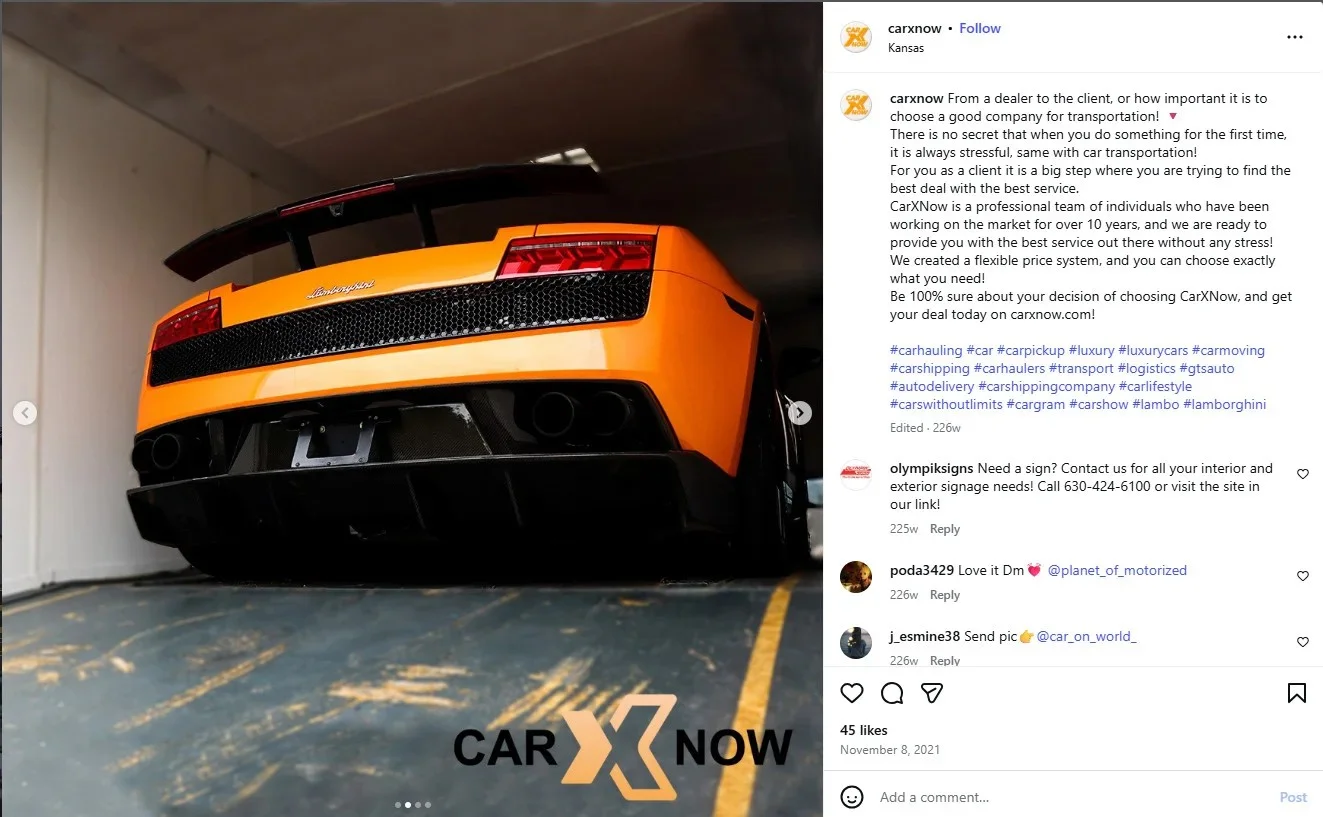
Keep it unscripted. A stiff, posed shot reads as an ad. A real one reads as a review. Here are some more surefire ways to build trust on social media that brands must know about.
3. Car Tips and Educational Posts
In my opinion, not every post needs to sell a car. I have seen that the ones that don’t often perform better, because they answer a real question instead of making a pitch.
These are the social media post ideas I’ve seen consistently earn their place:
- Early warning signs a car battery is failing
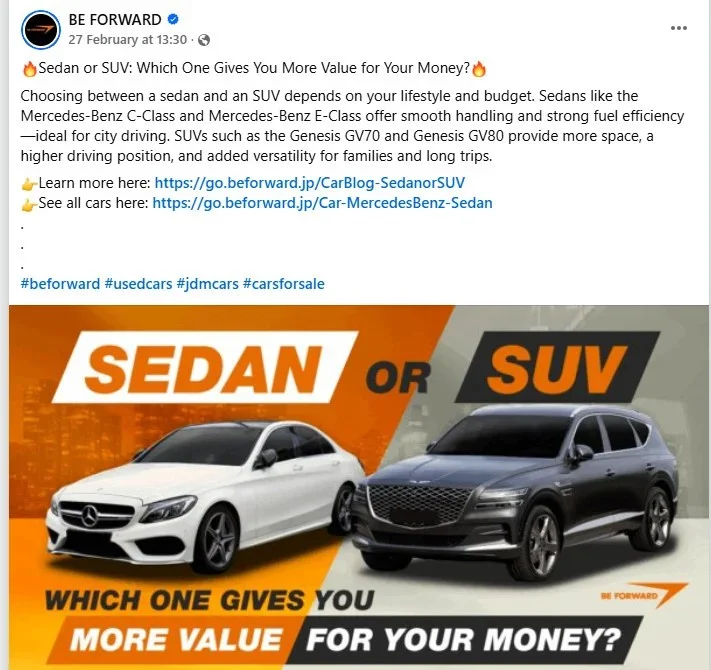
- Sedan versus SUV, framed around a specific use case like a family of four
- Three ways to actually improve fuel efficiency, not general tips
I’ve watched posts like these turn a dealership into a trusted automotive expert in a reader’s mind, not just a place that sells cars. BE FORWARD runs exactly this kind of sedan-versus-SUV comparison on their Facebook page, naming real models on both sides instead of speaking in generalities.
4. Behind-the-scenes Dealership Content
People trust businesses they can picture actual humans running. This pillar does that, and it’s also the one I’d budget the least time against, since it builds personality without moving anyone closer to a test drive on its own.
Ideas that work without eating a full production day:
- Introduce your sales team, not just the cars
- Show a technician mid-repair in the service bay
- A vehicle being prepped right before delivery
- A short “day in the life” at the dealership
Barrie Subaru does this well on TikTok, letting a technician named Gianni walk through what a pre-delivery inspection actually involves.
5. Interactive Posts to Boost Conversations
I treat these as a break from selling, not a replacement for it. I keep them light, and I keep them occasional.
The prompts I’ve seen reliably get replies:
- “Which color for this SUV, black or white?”
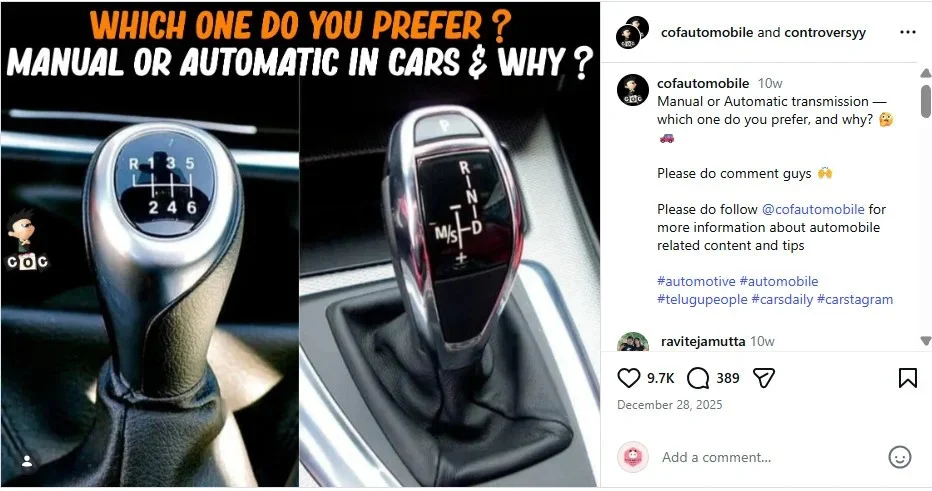
- “Manual or automatic, what’s your pick?”
- “What was your first car?”
Cof Automobile runs this exact manual-versus-automatic prompt on Instagram and as you can see, there below post pulled in 389 comments. It’s a proof that such posts encourage comments and discussions, helping you reach more people.
6. Local and Community Content
For a local dealership specifically, this pillar does real work on trust, even though it’s not the reason anyone converts on its own.
Ideas worth rotating through:
- Best local road trip destinations
- Sponsoring a local sports team
- Supporting a community charity event
- Photos from a dealership event or local car meet
Motor Cars of Chicago pulled this off in the real world too, with their Cars & Coffee 2025 meetup drawing enough of a crowd to fill an entire lot.
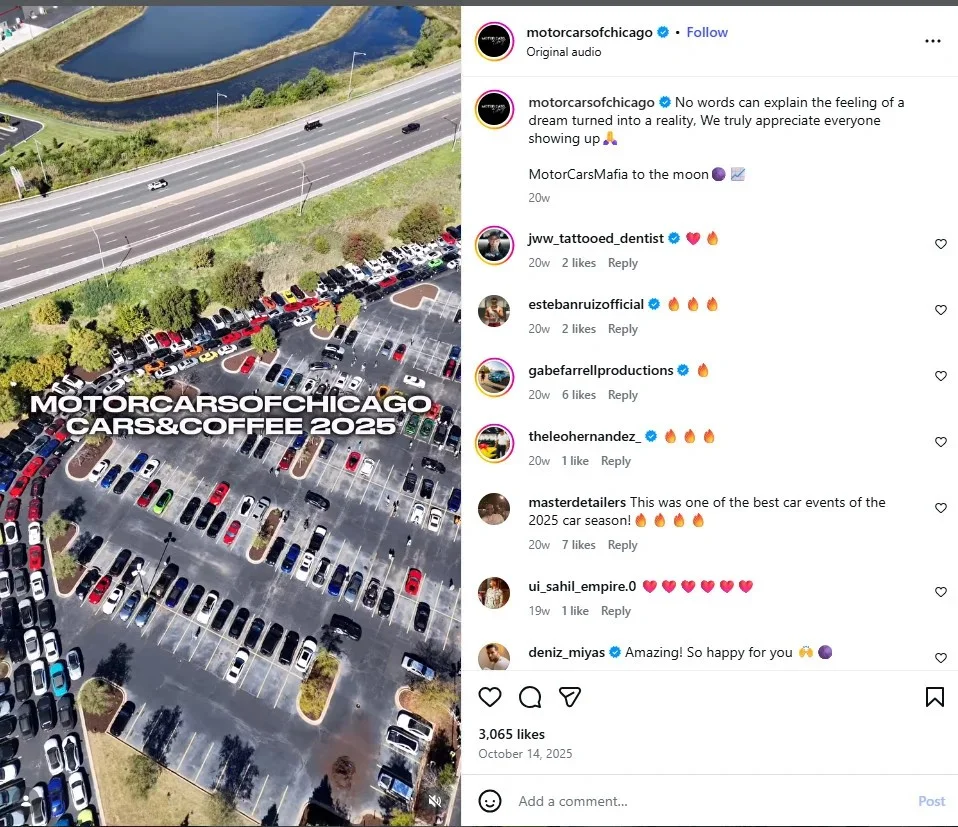
This type of content builds local businesses’ recognition and trust.
If you have a service department, this pillar reaches people who already bought from you, which makes it cheaper to earn attention from than almost anything else on this list.
Posts worth running on a rotation:
- When to change your engine oil, stated plainly, not as a vague rule of thumb
- Dashboard warning lights people ignore until they can’t
- Seasonal reminders, like an AC check before summer or a tire inspection before a rainy season
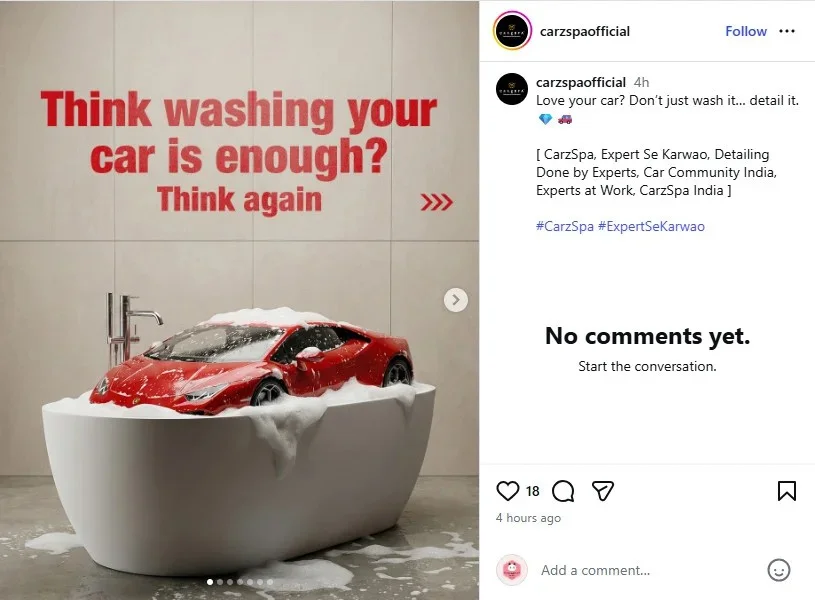
CarzSpa, makes a version of this same point in one bold panel on their Instagram: washing your car isn’t the same as taking care of it.
For a lean team like ours, trying to keep all seven of these running requires content batching. Early on, we didn’t start on SocialPilot, we ran everything off a shared spreadsheet, and it worked for a while until this one time, when two people posted the same slot on the same day.
That’s when we started looking for better ways to manage content calendars and stumbled upon SocialPilot’s content calendar. Now we build two to three weeks of posts across all seven formats in one sitting, drop them into the calendar, and the trust-building posts and the lower-priority ones both go out on schedule without anyone remembering to do it live every morning.
Here’s a short walkthrough of their social media calendar
Whether it’s worth setting up depends on how many people are already touching your accounts. If it’s one person doing it between customers, a shared calendar might genuinely be enough.
Adtaxi’s 2024 consumer survey (1,021 US adults) found Facebook is the platform most likely to influence a vehicle purchase, cited by 38% of all respondents and 53% of people who’d bought a car in the past year. That number alone tells me not to ignore everything else, just to stop treating every platform as an equal claim on my time, or yours.
1. Facebook
Even after two decades, I still put Facebook at the top for local dealerships, because reviews, groups, and Marketplace listings all live in the same place a buyer’s already checking.
Here’s what I’d actually use Facebook marketing for:
- Posting about special offers, discounts, and sales events
- Posting customer delivery photos and success stories
- Providing fast responses to questions and messages from potential buyers
- Building a local community through groups and reviews
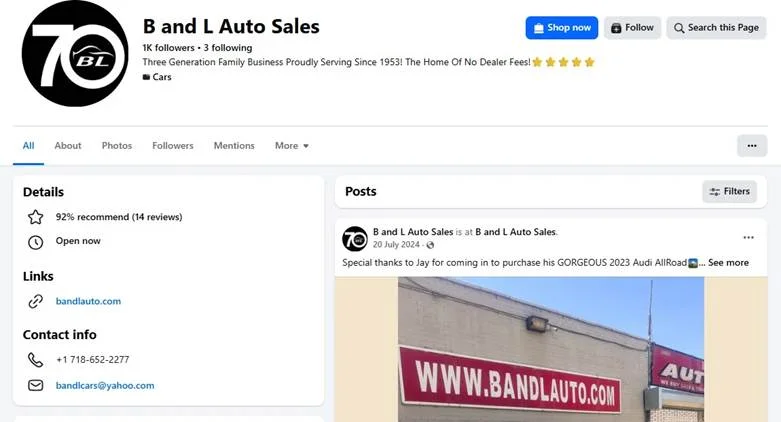
You don’t need a marketing team to pull this off. I like how B and L Auto Sales, a three-generation family dealership running on 1K Facebook followers, posts customer callouts on Facebook.
2. Instagram
I think of Instagram as a visual-first platform, which makes it a natural fit for showcasing inventory, as long as the quality holds up. In my experience, a dealership posting blurry photos twice a day does worse than one posting three sharp reels a week.
What I’ve seen perform here:
- High-quality photos of vehicles
- Business related Reels featuring quick walkarounds or single-feature highlights
- Customer delivery moments and celebration posts
I’ll point to George Saliba here: he built @georgejsaliba into a 396K-follower account by making himself the face of vehicle acquisition, not just the inventory he’s moving.
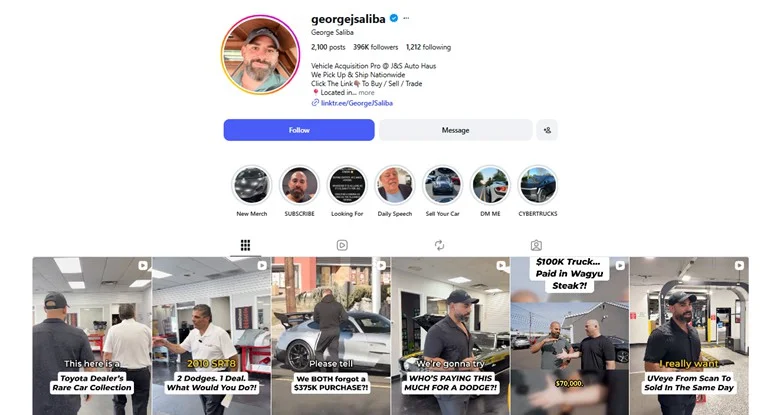
What I’d take from that: consistent branding, creative visuals, and engaging captions are what help a business stand out in a crowded feed.
3. YouTube
I treat YouTube as the right platform for long-form content that actually helps someone decide. In my experience, it’s easier to make well than to get seen, since it depends on search and recommendations, not a feed people scroll every day.
Here’s what I’d actually build a YouTube marketing calendar around:
- Detailed vehicle reviews and full walkthroughs
- Feature demonstrations and technology highlights
- Side-by-side model comparisons
- Service and maintenance tips
CarEdge is a channel I point to a lot: they post videos built entirely on long, detailed conversations about how car deals actually work, and it’s earned them trust along with millions of views.
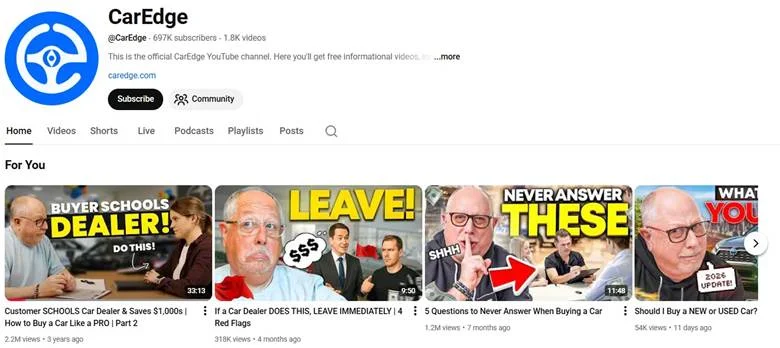
What I like about that format is it keeps attracting viewers and potential buyers long after it’s published.
4. TikTok
I think of TikTok as reaching a younger, earlier-stage audience, people who aren’t buying this month but will be in a few years. I’d skip it entirely if the honest answer is nobody on staff wants to be on camera. A stiff, reluctant account does more harm in my experience than no account at all.
Here’s what I’ve seen actually work for TikTok marketing:
- Fun, unpolished behind-the-scenes clips
- Quick car tips or single-feature highlights
- Trend-based videos built around a specific vehicle
Art Moehn Chevrolet Honda is the example I keep coming back to: a dealership in Jackson, Michigan that’s built 18.3K followers and 2.4M likes by posting BTS clips like coworker pranks, key roulette in the used lot, and sales team small talk.
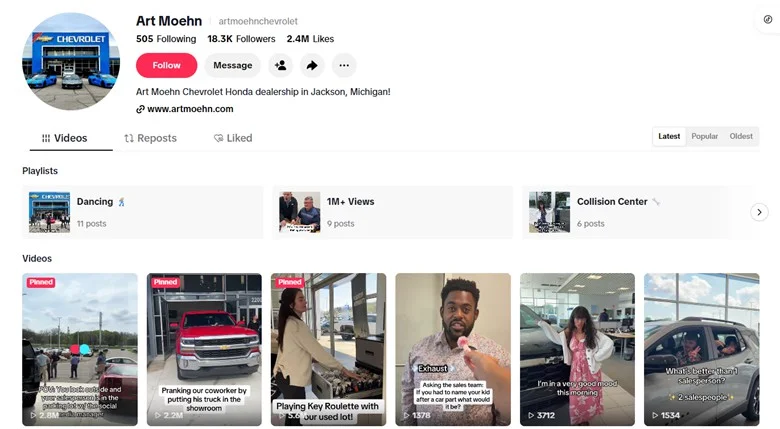
In my experience, authentic and creative videos usually perform better on TikTok than overly polished marketing content. If you want a starting point, I’d read this guide on how to make TikTok videos for your business.
5. Google Business Profile (Google My Business)
I don’t count this as technically social media, but I still put it in the same conversation, since it’s often the first thing a local buyer sees. BrightLocal found that in 2025, Google was the review source people check most, at 81%. I’d keep this current before spending another hour on a platform with a smaller local footprint.
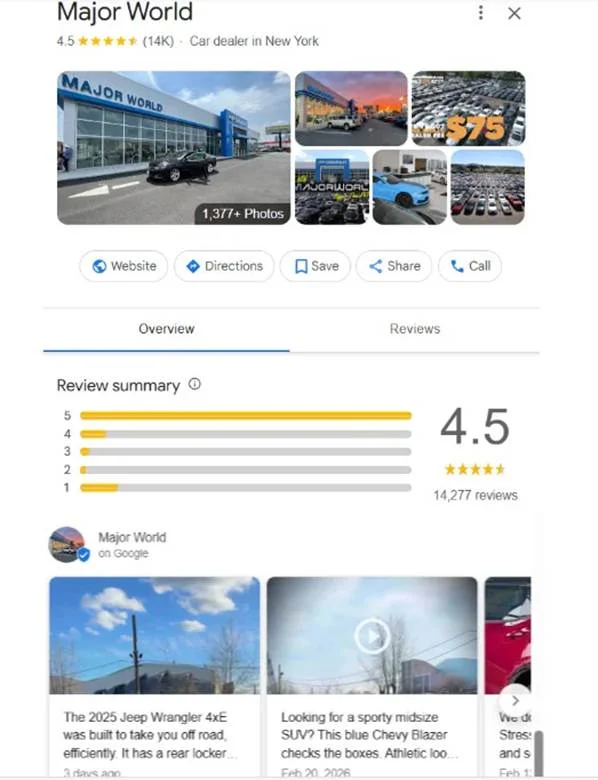
Posting updates on your Google Business Profile can help drive local traffic, phone calls, and direction requests, and I’ve seen it work at real scale. Major World in New York keeps its profile active enough to hold a 4.5 average across 14,277 reviews, proof to me that treating this like a real channel pays off.
Whatever tool you end up using to run all of this, here are the three things I’d actually check:
- Whether it can schedule across every account you manage without you keeping ten browser tabs open,
- Whether its reporting gets past likes and shows you something closer to a lead.
- Whether someone else on your team can review and approve a post without waiting on you specifically.
That’s the actual test. It happens to be what we use SocialPilot for at 47 Consulting, but the criteria matter more than the name on the login screen, and a tool that fails against any of these three isn’t worth the subscription regardless of what it’s called.
Where I Started With No Team and No Budget
At 47 Consulting, we didn’t start with a tool. We started with two formats, vehicle video and delivery stories, and watched closely to see if either one moved anything at all. Only once we could point to exactly where the manual grind was breaking down did we bring in something to run it, and even then we were picky: it had to show us more than a like count.
That’s the whole reason SocialPilot is still what we run every account through, not because it was the flashiest option on the list, but because it was the one that could answer the only question that ever mattered to us, did this turn into pipeline. Skip straight to a tool if you want to. Just know the discipline behind picking one matters more than the tool itself. Prove the work first.