Netflix Advertising: Specs & Tactics for Marketers
The Skinny
Netflix’s ad-supported tier now reaches more than 250 million monthly active viewers globally, with about 60% of new signups in ad markets choosing the ad plan. As a premium streaming channel backed by a growing Ads Suite, Netflix offers programmatic access, and light, unskippable ad pods.
- Netflix’s ad business is on track for roughly 3 billion dollars in 2026 revenue, with 15 new ad-supported markets coming online.
- 250 million-plus monthly active users (MAUs) are on the ad tier; and over 80% of ad-plan members watch weekly.
- The unskippable, low-clutter ad experience supports CPMs about 41% above traditional streaming averages.
Netflix has gone from “will they or won’t they” to a fully scaled ad business, with its ad-supported plan now reaching tens of millions of viewers and an expanding Netflix Ads Suite that spans formats, buying paths, and measurement partners. For marketers, Netflix has become a core streaming channel that needs to be evaluated alongside Prime Video, YouTube, and traditional TV as part of an integrated media strategy.
In this guide, we’ll walk through how Netflix advertising works today, what’s changed since launch, and how Tinuiti helps brands buy, measure, and scale Netflix as part of a broader TV and streaming mix.
The State Of Netflix Advertising In 2026
Launched in November 2022, Nexflix’s ad plan began as a single, Microsoft-powered entry point and has since evolved into a broader Netflix Ads Suite with expanded formats, targeting, and programmatic access.
Today, Netflix’s ad tier reaches roughly 250 million monthly active viewers globally, according to the company’s reporting. In markets where the ad plan is available, more than 60% of new sign-ups choose the ad-supported option, making this the default for many households rather than a niche offering.
On the revenue side, Netflix generated about $1.5 billion in ad revenue in 2025 and is targeting around $3 billion in 2026 as it scales the Netflix Ads Suite, adds more inventory through live events and new content, deepens measurement integrations, and broadens programmatic access. Over the same period, Tinuiti’s benchmarks show that streaming video ad spend outside YouTube continues to grow, with Netflix among the key premium contributors.
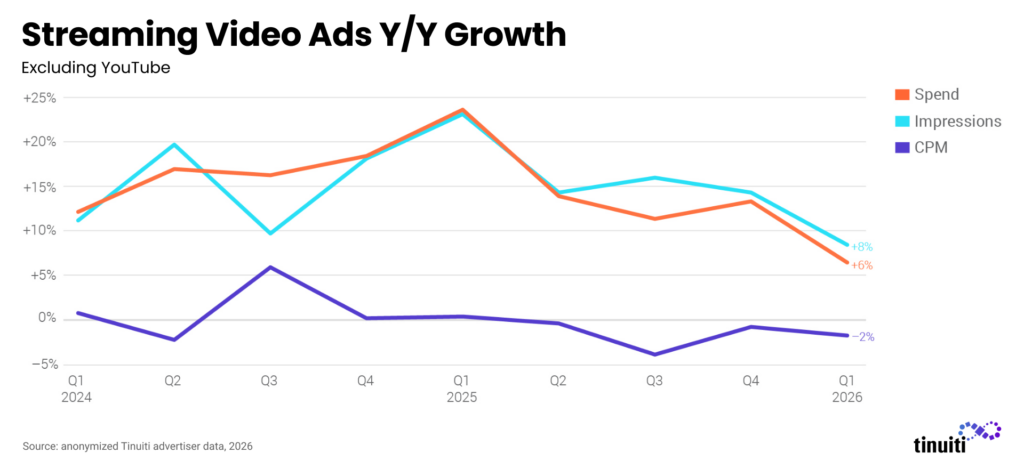
That growth trajectory isn’t just visible in the data; it’s now core to how Netflix positions its ad business and future ambitions to the market. At the Netflix Upfront 2026 “Get Closer” event, Netflix announced:
- In ad-supported markets, around 60% of new sign-ups choose the ad tier, making it the default way people experience Netflix.
- Over 80% of ad-plan members watch weekly, underscoring that ad-supported viewing is highly engaged, not just trial behavior.
- The ad business is on track to reach roughly 3 billion dollars in revenue in 2026, with a longer-term ambition of around $9 billion by 2030.
- Netflix will add 15 new ad-supported markets, expanding beyond the initial 12 and further globalizing its ads footprint.
- The platform now works with more than 4,000 advertisers, a roughly 70% year-over-year increase, as the Netflix Ads Suite and partner ecosystem continue to expand.
Throughout this evolution, Netflix has kept its ad load deliberately light, with all ads delivered as unskippable units within curated pods that are inserted at natural breaks in the content. That balance between scale, attention, and viewer experience is a major reason advertisers treat Netflix as a premium streaming partner rather than just another video line item.
Why Netflix Offers Ads (And What That Means Now)
Netflix’s move into advertising started as a way to introduce price flexibility without abandoning its ad-free promise altogether. When the ad-supported plan launched in November 2022, the primary goal was to offer a lower-priced entry point for cost-conscious households and to blunt competitive pressure from AVOD services like Hulu and Peacock.
What has changed since then is the role advertising plays in Netflix’s business model. The ad tier has shifted from a defensive response to a core growth lever, giving Netflix a second major revenue stream and more ways to fund big-budget content, live rights, and international expansion. Advertising is no longer positioned as a compromise; it is one of the default ways viewers experience Netflix in markets where the plan is available.
That origin story matters for marketers because it explains Netflix’s posture toward ad quality, load, and control. The company built its ad product with a “viewer first” mandate, keeping ad loads light and formats curated so the business doesn’t undermine the subscription product that came first. This DNA continues to shape how Netflix rolls out new formats, chooses partners, and manages inventory today.
How To Start Advertising On Netflix
The mechanics of buying Netflix inventory have evolved since launch. What started as Netflix Ads Manager, powered by Microsoft, has grown into the broader Netflix Ads Suite: a combination of direct tools, API connections, and programmatic access points.
Today, there are three primary paths into Netflix:
Netflix Ads Suite (Direct Buying And Tools)
Netflix Ads Suite is the platform and toolset that advertisers and agencies use to plan, buy, and manage campaigns directly with Netflix. Built initially with Microsoft as a foundational partner, the suite now includes upgraded workflows, improved reporting, and deeper integrations with measurement partners. Direct buyers typically include larger brands and advanced in-house teams that want tight control over placements, frequency, and budget allocation.
Partnering With A Streaming-Focused Agency
Agencies that specialize in streaming and CTV can help brands architect Netflix within a broader TV, audio, and digital strategy. Tinuiti consolidates cross-platform streaming data across Netflix, Prime Video, YouTube, and more into a unified, incrementality-focused view, using the Bliss Point Marketing Operating System to connect brand and performance outcomes. This approach helps determine Netflix’s role in the mix, negotiate deals, and ensure measurement frameworks stay consistent across channels.
Ad Tech Partners and DSPs
Programmatic access to Netflix inventory has expanded significantly. Nearly half of non-live Netflix inventory is now transacted programmatically across select DSP partners, including The Trade Desk, Google Display & Video 360, Yahoo DSP, and more. Netflix has also added Amazon DSP as a buying path, with availability rolling out in Q2 2026, giving advertisers another way to activate Netflix alongside commerce and display campaigns.
Most brands will use a combination of these paths over time, starting with agency-led or direct buys for initial tests and sponsorships, then layering in programmatic as they scale spend and integrate Netflix into always-on streaming strategies.
Ad Types And Specs For Netflix Ads
Netflix’s ad product has matured from simple pre-rolls to a fuller portfolio of formats designed to balance impact with user experience.
Core Ad Types
- Pre-Roll Ads: Traditional ads that run before a movie or episode begins, similar to linear TV pods but delivered in a streaming environment.
- Mid-Roll Ads: Ads inserted at natural narrative breaks during a program, with Netflix carefully controlling pod size and placement to avoid overloading viewers.
- Pause Ads: Custom units that appear when a viewer pauses content, creating a high-attention moment without interrupting the story.
- Binge Ads: A reward-style format that offers viewers an ad-free fourth episode after watching three episodes with ads.
- Sponsorships: Title, Moment, and Live Sponsorships that allow brands to align with specific series, genres, events, or seasonal moments.
- Live Event Ads: Inventory around live programming like WWE Raw and NFL Christmas games, reaching both ad-plan and ad-free members in a live viewing environment using dynamic ad insertion.
Key Specs
Netflix enforces strict technical specs to ensure quality and consistency.
- Durations: 10, 15, 20, 30, and 60 seconds.
- File formats: MP4 or MOV.
- Aspect ratio and resolution: 16:9 aspect ratio, with 1920×1080 or 1280×720 HD resolution.
- Audio and quality: Creatives must meet Netflix standards for audio levels, closed captioning, and overall quality to be approved.
- QR codes and interactivity: Netflix supports QR code overlays within creatives, as well as interactive elements that connect viewers to second-screen experiences like product pages or brand microsites.
Because Netflix continues to evolve its ad units, it’s important to stay close to the latest spec documentation and rely on partners who are actively trafficking on the platform.
Why Advertise On Netflix?
Netflix brings a combination of reach, attention, and brand safety that is difficult to replicate elsewhere in streaming.
Massive, engaged audience
Netflix serves roughly 278 million paid subscribers worldwide, with ad-plan members logging more than 10 hours of viewing per month in many markets, according to Nielsen-cited Netflix data. That level of time spent gives brands room to tell richer stories, not just chase short-term clicks.
Unskippable, low-clutter pods
All Netflix ads are unskippable, and the platform maintains a deliberately light ad load that avoids overstuffed breaks and limits repetition within a single episode. In Tinuiti’s streaming benchmarks, Netflix has consistently commanded one of the highest CPM premiums, about 41% above traditional streaming averages according to our Q1 2026 Digital Ads Benchmark, precisely because those impressions are scarce, high-attention, and delivered in a premium environment.
Server-side delivery and brand safety
Ads are delivered server-side, which makes them effectively immune to browser-based ad blockers and reduces the risk of technical failures or mismatched creative. Combined with content controls and the fact that kids’ profiles remain ad-free, Netflix offers a level of predictability and brand safety that many marketers now expect from their connected TV (CTV) partners.
Cultural relevance across screens
Netflix’s Top 10 lists, global premieres, and live events give brands a way to show up in cultural moments, not just in generic inventory buckets. Our Q1 2026 Digital Ads Benchmark data shows streaming video ad spend outside YouTube up 6% year over year, with TV screens accounting for 67% of traditional streaming video ad spend, exactly where Netflix excels.
For marketers, these characteristics make Netflix particularly compelling for upper-funnel brand building, reach extension, and attention-focused campaigns, and, when planned correctly, for driving incremental sales as part of a broader TV and streaming portfolio. Tinuiti’s role is to quantify that value, using incrementality testing and Bliss Point models to determine how Netflix impressions contribute to business outcomes versus other channels.
How do your campaigns stack up?
Get ad spend benchmarks for top channels, from marketplaces to social media.

Audience Targeting On Netflix
Netflix has expanded its targeting capabilities since launch, giving advertisers more control over who sees which message without relying on third-party cookies.
Key levers include:
- Demographic targeting: Age cohorts, gender, and geography down to the country and state level in the U.S.
- Viewing behavior: Genres, content categories, and engagement with certain types of titles.
- Contextual and top 10 placements: Ads aligned with Netflix’s daily Top 10 titles and specific content environments.
- Exclusions and brand safety: Controls to avoid content categories that may not fit your brand.
These capabilities lean heavily on Netflix’s first-party data and are designed to help advertisers reach the right audience without sacrificing scale.
How To Buy Netflix Ads Programmatically
Programmatic buying has moved from “on the roadmap” to a central way brands access Netflix inventory, especially for always-on and multi-publisher streaming strategies.
Programmatic access today focuses primarily on non-live, on-demand inventory, with live-event inventory (such as WWE Raw and NFL holiday games) often reserved for direct deals and sponsorships. Streaming video ad spend outside YouTube continues to grow in Tinuiti’s benchmarks, with platforms like Netflix and Prime Video increasingly bought alongside other CTV partners through DSPs.
How Netflix Is Using AI in Its Ad Business
AI is becoming a larger part of how Netflix designs and operates its ad products, with a focus on making planning and buying more effective rather than simply adding another buzzword.
- At the 2026 “Get Closer” Upfront, Netflix highlighted AI-driven media buying agents intended to help advertisers and agencies plan and optimize campaigns across the Netflix Ads Suite. These tools are designed to make it easier to match campaigns to the right titles, audiences, and moments while still allowing for human control and oversight.
- Netflix also emphasized more automated and programmatic capabilities, such as programmatic pause ads and expanded DSP integrations, so AI can support both direct and programmatic buying workflows.
- The broader framing from Netflix is that AI should help brands “get closer” to stories and attention by improving matching, forecasting, and optimization, rather than simply driving CPMs down.
The implication is that AI on Netflix primarily shows up in smarter recommendations, more efficient campaign setup, and improved optimization within the platform, while broader budget allocation and cross-channel strategy still depend on the advertiser’s own measurement and planning framework.
How Programmatic Access Works Today
Programmatic access focuses primarily on non-live, on-demand inventory, with live-event inventory (like WWE Raw and NFL holiday games) often reserved for direct deals and sponsorships. Tinuiti’s Q1 2026 benchmarks show streaming video ad spending outside YouTube up 6% year over year, with most of the growth driven by platforms like Netflix and Prime Video, which can be bought alongside other CTV partners through DSPs.
Available DSPs and Netflix’s Partner Strategy
Netflix maintains a curated DSP list to balance buyer flexibility with control over quality and measurement.
- Core partners include The Trade Desk, Google Display & Video 360, Yahoo DSP, and other major platforms focused on brand and CTV buying.
- Netflix has expanded the Netflix Ads Suite with deeper integrations into Amazon DSP and Yahoo DSP, allowing advertisers to tap new audience segments and manage frequency more consistently across streamers starting in Q2 2026 in the U.S., with other ad-supported markets to follow.
- Access remains limited to approved demand sources and strategies; Netflix is still intentional about how and where its inventory appears in programmatic pipes.
For media buyers, this means Netflix can be planned and optimized within existing DSP workflows, but it does not behave like an open exchange, inventory is curated and controlled.
What Advertisers Can Control Programmatically
Within supported DSPs, advertisers can typically control:
- Audience Strategy: Combine Netflix’s first-party segments (demographics, viewing behavior, content context) with DSP-level audiences, including Amazon Audiences and Yahoo data where supported.
- Frequency and Reach: Apply cross-publisher frequency caps so Netflix impressions fit into broader CTV frequency strategy, rather than overserving the same households relative to other partners.
- Budgeting and Pacing: Set flight dates, pacing rules, and bid strategies that align with broader TV and streaming plans, keeping Netflix inside the same planning rails as other CTV channels.
- Creative Rotation: Traffic multiple creatives and lengths, then optimize toward completion, attention, or downstream performance metrics depending on campaign goals.
Programmatic Netflix works best as an extension of an existing streaming strategy, not as a replacement for direct or sponsorship deals, especially for brands that want both tentpole moments and efficient, ongoing reach.
tv, audio, and display advertising
Find out what’s coming in 2026 and beyond, and what marketers can do to be ready.

How Programmatic Netflix Fits In Your Mix
Programmatic access makes it easier to see how Netflix contributes to incremental reach, attention, and outcomes alongside the rest of the video portfolio. For advertisers already orchestrating cross-channel video through DSPs, the key benefit is being able to:
- Run Netflix inside the same buying and optimization environment as other CTV partners, using shared audience, pacing, and reporting tools.
- Use Amazon DSP and Yahoo DSP integrations to align audience strategies across Netflix, Prime Video, and other surfaces, including commerce-focused and offsite inventory.
- Manage cross-streamer frequency more deliberately as Ads Suite capabilities expand to “better manage how often ads appear across streamers.”
Netflix’s programmatic evolution is less about making it a cheap impression source and more about making a premium, controlled environment easier to slot into existing programmatic practice.
Measurement and Optimization Considerations
Programmatic access does not replace the need for rigorous measurement; it simply makes it easier to standardize how Netflix is evaluated alongside the rest of the streaming portfolio. Tinuiti draws on DSP data, Netflix’s own reporting, and third-party partners such as Nielsen, Kantar, iSpot.tv, DoubleVerify, and IAS to validate delivery, viewability, brand safety, and brand lift.
Conversion API And Full-Funnel Measurement
Recent Netflix Ads Suite updates introduced a Conversion API (CAPI) to help advertisers demonstrate outcomes and optimize campaigns with real-time signals. CAPI gives brands a server-to-server path to connect impression-level exposure on Netflix with downstream events such as website visits, sign-ups, or sales closing a key gap in connected TV attribution.
By piping these outcome signals back into Netflix and DSP environments, advertisers can move beyond pure reach and completion metrics and treat Netflix as part of a full-funnel mix, not just an awareness play. Paired with expanded audience and DSP integrations through Amazon DSP and Yahoo DSP, CAPI is central to Netflix’s push to position the Netflix Ads Suite as a full-funnel platform that supports brand, mid-funnel, and outcome-focused campaigns.
Netflix has already called out Tinuiti’s role in proving what CAPI can do. As Netflix notes in its March announcement:
“Earlier this year, we partnered with Tinuiti, the largest independent full-funnel marketing agency in the U.S., on early testing and saw great attribution results. The campaigns outperformed benchmarks by more than 75% across financial services, ed tech, and retail clients. We’re encouraged by the early results and are committed to expanding our first-party solutions even further, with more updates to come in the months ahead.”
The takeaway is clear: Netflix is actively building toward deterministic, outcome-based measurement on streaming, and early CAPI results suggest that well-architected campaigns can significantly outperform traditional attribution benchmarks. And by partnering with Tinuiti, advertisers get access to these cutting edge developments.
Learn more about our partnership with Netflix. →
Optimizing In A Premium CPM Environment
Our Q1 2026 DABR data show Netflix CPMs running at about 141% of traditional streaming averages, reflecting advertiser demand for scarce, high-attention impressions. In that context:
- Optimization centers on maximizing incremental reach, attention, and outcomes per dollar invested, rather than solely driving CPMs down.
- Netflix is evaluated alongside other CTV partners with an emphasis on marginal reach and sales lift, so budget allocation decisions reflect Netflix’s unique contribution rather than treating it as interchangeable with lower-cost video.
The practical implication: Netflix can now be planned, bought, and optimized within the same DSP rails used for other CTV inventory, supported by expanded Ads Suite capabilities and a dedicated Conversion API, while still warranting a more strategic, brand-first approach than typical display video.
stay in the know
Subscribe to our Paid Media Newsletter for weekly updates on media and advertising.

Best Practices For Netflix Campaigns
Netflix performs best when it is treated as a strategic component of the TV and streaming portfolio, not a standalone experiment.
Define Netflix’s Job In The Plan
Every Netflix campaign should start with a clear role in the broader media strategy.
- Use Netflix to extend reach beyond linear tv and other CTV partners, especially among younger and cord-cutting audiences.
- Lean on Netflix for high-attention, big-screen storytelling around brand launches, new product lines, or key seasonal moments.
- Treat Netflix as a single node in the system, then use incrementality testing to determine whether it is driving unique reach and sales or merely reinforcing exposure from existing TV and streaming investments.
We typically frame Netflix’s “job” in terms of marginal reach, attention, and contribution to total business outcomes, rather than as an isolated GRP or CPM buy.
Build Creative For a Premium, Big-Screen Context
Netflix viewers expect high production value, even from ads, and most impressions are still delivered on TV screens.
- Lead with brand quickly without sacrificing story; Netflix’s environment supports narrative, but branding still needs to be clear in the opening seconds.
- Design for TV-first viewing but ensure creative holds up on secondary devices, given that a meaningful minority of streaming impressions still occur on phones and tablets.
- Use QR codes and interactive elements when they genuinely add value, for example, to drive to a launch page, offer, or configurator, and ensure the landing experience mirrors the tone and promise of the creative.
- Test multiple lengths (15, 30, and 60 seconds) to understand how attention, completion, and downstream engagement vary by format, then standardize on the length that best balances impact and efficiency.
Use Targeting To Enhance Relevance, Not Over-Segment
Netflix’s first-party data and contextual controls are powerful, but the biggest wins come from smart, not hyper-narrow, targeting.
- Start with broad but relevant demo and genre combinations to preserve scale; then refine based on performance and brand lift results.
- Use Top 10 and contextual placements when alignment with specific shows or moments matters more than pure reach.
- Apply exclusion rules thoughtfully to avoid environments that are out of bounds for the brand without overly constraining delivery.
Our view is that Netflix should generally be set up to maximize high-quality reach within guardrails, not to replicate lower-funnel, one-to-one targeting tactics better suited to other channels.
Test, Learn, and Iterate With Structured Measurement
Netflix’s premium CPMs make disciplined testing and measurement essential.
- Run structured creative tests with clear hypotheses (e.g., emotional vs. product-forward messaging, different calls to action, or alternate offers).
- Pair platform reporting with third-party measurement, Nielsen or iSpot.tv for reach and frequency, Kantar or Lucid for brand lift, DoubleVerify or IAS for quality and safety.
- Feed those insights back into the Bliss Point Marketing Operating System so Netflix’s impact on awareness, consideration, and sales is evaluated alongside other TV, streaming, and digital channels.
Over time, campaigns that combine strong creative, thoughtful targeting, and clear measurement frameworks tend to earn a durable place in the media mix, even when CPMs are at a premium compared with many other streaming options.
Netflix Vs. Other Major Streamers
Netflix is one of several major ad-supported streaming platforms, alongside Amazon Prime Video, Disney+, and others. In our 2025 Q4 Digital Ads Benchmark survey, streaming video ad spending outside YouTube grew 13% year over year in Q4 2025 and 6% in Q1 2026, with platforms like Netflix and Prime Video driving much of that growth.
Netflix also commanded a roughly 41% CPM premium over traditional streaming averages in Q1 2026, reinforcing its positioning as a premium, high-attention environment. Prime Video, meanwhile, has been especially aggressive, with ad spending up more than 70% year over year in early 2026 across Tinuiti advertisers.
For many brands, the strongest approach is to assign distinct roles in the mix:
- Netflix for broad, premium reach and brand storytelling.
- Prime Video and other commerce-oriented platforms for more shoppable formats and retail-focused outcomes.
We access inventory across the streaming waterfall… whether that’s reach media and a tentpole event or biddable buys with bespoke audience targeting, everything is mapped into how we negotiate and how we execute for our clients so that we can transcend these different types of inventory and really build the most effective buy knowing that cost is also going to be best-in-class.
Shasta Cafarelli, SVP Media Investment, Tinuiti

Is Netflix Advertising Right For Your Brand?
Netflix tends to be a strong fit if your brand needs national or global reach against broad, entertainment-driven audiences. It’s also a strong option for advertisers that want to build awareness, consideration, or favorability in environments where viewers are leaning in on large screens.
Tinuiti’s role is to help quantify where Netflix fits. By leveraging the Bliss Point Operating System, Netflix can be evaluated alongside other TV, audio, and streaming investments to measure incrementality, improve cross-channel efficiency, and connect media investment to business outcomes.
spend smarter with bliss point by tinuiti
Measurement tech that shows what’s driving growth—and exposes what’s holding it back.
