Better marketing starts after the results come in
A campaign goes out. The results come in. They’re good; better than expected. Everyone celebrates (as they should), the numbers make their way into a report or dashboard, and the team moves on to the next campaign.
Or maybe the results aren’t good. There’s discussion about what might have gone wrong, the numbers still make their way into a report or dashboard, and the team moves on.
See the problem? In both cases, there’s a critical step missing: Why?
Why did this campaign outperform? Why did that one fall short? What might explain the result? And perhaps most importantly, what could we do next to find out if our explanation is right?
You don’t need an advanced degree in statistics to ask those questions, nor do you need the latest martech platform or AI tool. You need curiosity, one of the most underrated skills in marketing.
We talk a lot about marketing skills
Marketing plenty of skills to master: analytics, automation, SEO, paid media, email, content, social media, conversion optimization, and now AI. Technical skills matter—a lot.
But being able to execute a campaign isn’t the same as being able to improve one. Tools can tell you what happened, help you execute the next campaign, and even surface patterns or recommendations. But someone still needs to wonder: Why did that happen? What else could explain it? What should we test next?
10X your SEO with Semrush for Enterprise.
The world’s most powerful SEO platform, purpose-built for Enterprise.
Request demo
That’s the difference between routine campaign execution and continuous optimization. Execution gets the campaign out the door; curiosity makes the next campaign better. And as the tools we use become more sophisticated, I’d argue that curiosity is becoming more important, not less.
Curiosity is what turns data into insight
Marketers have access to more data than ever before. Opens, clicks, conversions, traffic, engagement, revenue, attribution… there’s no shortage of numbers to review. But data tells us what happened. Insight begins when we get curious about why it happened.
Let’s say the conversion rate drops 18%. That’s useful information, but it isn’t an insight. A curious marketer starts digging: Did conversion decline across the board or only for certain audiences? Did traffic quality change? Was there a change on the landing page or in the offer?
That’s how curiosity turns reporting into optimization. We start with an observation, ask what might have caused it, develop a hypothesis, and test it. Then we look at what we learned and use that learning to shape the next question.
Observation → Question → Hypothesis → Test → Learning → Next question
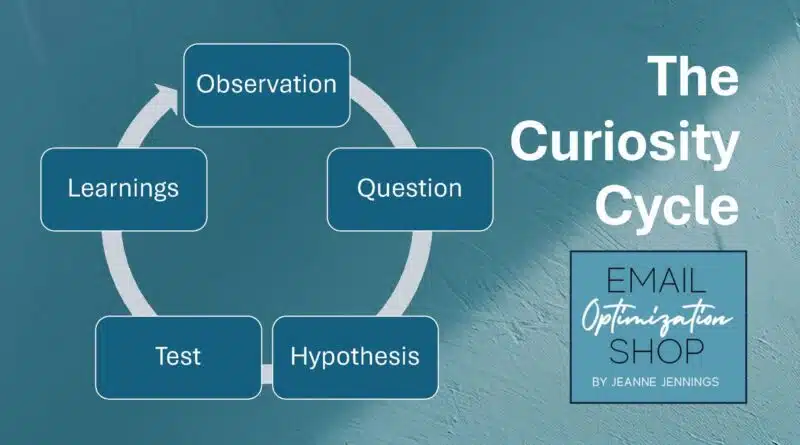
There’s no real endpoint to this process, and that’s a good thing. Optimization is about continually learning what motivates your audience and using that knowledge to improve results. The value isn’t simply in having the data. It’s in being curious enough to act on it.
Don’t only investigate what went wrong
When results disappoint, curiosity often kicks in naturally. We want to know what happened so we can fix it. But strong results deserve the same scrutiny.
If a campaign beats expectations by 40%, it’s time to start asking questions: Why did it perform so well? Was it the offer, the audience, the creative, or the timing? Did something change in the market? Or was it simply an anomaly?
If we don’t understand why something worked, we can’t confidently reproduce the result. Curiosity isn’t just about troubleshooting problems; it’s also about understanding success well enough to build on it. Some of your best optimization opportunities may be hiding in the campaign you already consider a win.
Curiosity keeps best practices from becoming bad habits
Marketing is full of received wisdom that’s called best practices. Keep forms as short as possible. Put your primary call to action above the fold. Limit the number of calls to action on a landing page. Follow the recommended posting frequency.
Best practices can be useful starting points, but don’t treat them as universal truths. They ask a few more questions: Best for whom? Under what circumstances? Based on whose data?
What works for one audience, brand, or channel may not work nearly as well for another. Benchmarks can provide context, but they can’t tell you exactly how your audience will respond.
I’m a big believer in testing with your own audience whenever you can. Use best practices to generate ideas, not to shut down questions. If conventional wisdom says one approach should work better, test it. Win or lose, you’ll learn something more useful than the best practice itself.
Curiosity requires being comfortable with being wrong
There’s another side to curiosity that marketers don’t always talk about: You have to be willing to discover that your hypothesis was wrong.
That is harder than it sounds. We get attached to our ideas. We want the campaign we recommended to perform well, the test cell we championed to beat the control, and the data to confirm our beliefs.
But a hypothesis isn’t something to defend; it’s something to investigate. If the test disproves it, that doesn’t mean the test failed. It means you learned something.
Some of the most useful marketing lessons come from results we didn’t expect. A “losing” test can challenge an assumption about your audience, eliminate an idea that isn’t worth pursuing, or point you toward a better question.
Curiosity shifts the goal from proving you’re right to finding out what’s true. And “I don’t know, let’s find out” can be a remarkably productive place for a marketer to start.
Build curiosity into the process
Telling marketers to “be more curious” isn’t particularly helpful. Curiosity becomes useful when you build it into the way campaigns and tests are reviewed.
To do that, ask these five questions after every meaningful campaign or test:
- What happened? Start with the facts, not the explanations.
- Why do we think it happened? Separate what you know from what you’re assuming.
- What surprised us? Unexpected results are often where the most useful learning begins.
- What hypothesis does this suggest? Turn the questions into something you can investigate.
- What should we test next? Don’t let the learning stop with the campaign report.

Make these questions part of campaign recaps, testing briefs, or regular performance reviews. The goal is to make curiosity a habit rather than something that surfaces only when results are unusually good or bad.
Over time, that habit changes the conversation. Instead of simply reporting performance, the team starts looking at what the results can teach them and what they should do differently as a result.
Curiosity is a competitive advantage
Most marketers have access to many of the same tools, platforms, and increasingly, the same AI capabilities. The advantage isn’t access. It’s what you do with it.
Curious marketers keep learning. They question assumptions, investigate unexpected results, test ideas, and use what they learn to improve the next campaign. Over time, those improvements add up.
So the next time you look at your marketing results, don’t stop at whether they were good or bad. Ask why. Ask what else might explain them. Then figure out how you can test it.
Technical skills will help you execute the marketing you have today. Curiosity is what will make tomorrow’s marketing better.
Stay curious. Keep testing. Keep learning.
Author’s Note
I used ChatGPT as a thought partner in developing this article, including helping me organize the outline, pressure-test ideas, and tighten the draft. The point of view, examples, conclusions, and final copy are mine, and I reviewed and edited everything before publication.
Transparency about AI use matters. I’ve previously written about a practical framework for AI disclosure in marketing, and I try to follow the same principle in my own work. If AI played a meaningful role in creating the content, readers should know about it.