An effective email marketing strategy is a data-driven plan that uses email as the main channel to accomplish a business goal that’s specific to your brand. A well-crafted email strategy has been shown to deliver at least a 76x return.
Regardless of what business you’re running, email marketing strategy rests on four main pillars: a clear goal, an active opt-in list, behavior-based segmentation, and continuous A/B testing to maintain performance.
This guide covers all four pillars, plus additional sub-pillars, designed to help you build a strong strategy. If you’re new to this, you can also watch our getting-started video, which covers the essentials in just a few minutes.
Use the email marketing strategy tips you learn to build your first campaign and automation with Omnisend
Quick sign up | No credit card required
How to create an email marketing strategy
- Set one to three clear goals
- Build a high-quality email list
- Know your audience, then segment it
- Balance value and selling with the 80/20 rule
- Automate the customer journey
- Combine automations with campaigns
- Write effective subject lines
- Send emails at the right time
- Reach subscribers across email, SMS, and push
- Land in the inbox: deliverability and compliance
- Design for mobile
- Track the metrics that matter
- Test and improve with A/B testing
1. Set one to three clear goals
Start building or updating your email marketing strategy by identifying one to three goals for the upcoming three months. Every goal you pick will have its own associated tactic, which should be understood as a precisely defined action, like picking a higher revenue number and prioritizing automations and segmentation. Alternatively, if you’re after list growth, focus on capture and value.
Some common goals to use as examples for your email marketing strategy:
| Goal | Where to focus | How to track |
|---|---|---|
| Grow revenue | Automations and segmentation | Revenue per recipient and total email revenue |
| Grow your list | Capture forms and lead magnets | Net new subscribers after unsubscribes |
| Improve retention | Post-purchase and win-back automations | Repeat-purchase rate and returning-customer revenue |
| Reactivate lapsed buyers | Win-back and sunset automations | Win-back rate and win-back revenue |
2. Build a high-quality email list
An engaged, permission-based list protects your sender reputation for long-term deliverability. A smaller list of opted-in subscribers will always outperform a large, unverified one because people are more likely to open emails and purchase from brands they trust. That’s why it’s important to build a healthy email list for your email marketing strategy and not buy it off the shelf.
Consider these tips for your email capture campaigns to convert the same traffic better:
- Trigger on intent: Activate pop-ups on exit or after a few seconds of browsing, not the moment someone lands on your page
- Gather data without overwhelming your audience: A simplified multi-step form that’s broken down into smaller parts is easier to follow than a lengthy single-step form, allowing you to collect valuable information without multiple forms
- Match the offer to the page: Add the target page URLs to the pop-up’s targeting, so the discount shows only on product pages and the guide only on the blog
- Reserve gamified formats like spin-to-win for launches and BFCM: When used well, gamified formats can reach up to 11% conversion against 6.5% for a standard form, but year-round they lose their effect
- Keep the email list clean: Include a double opt-in sign-up and a quarterly inactive contact cleaning, as 5,000 engaged subscribers can generate more than a mixed-bag 50,000 email list
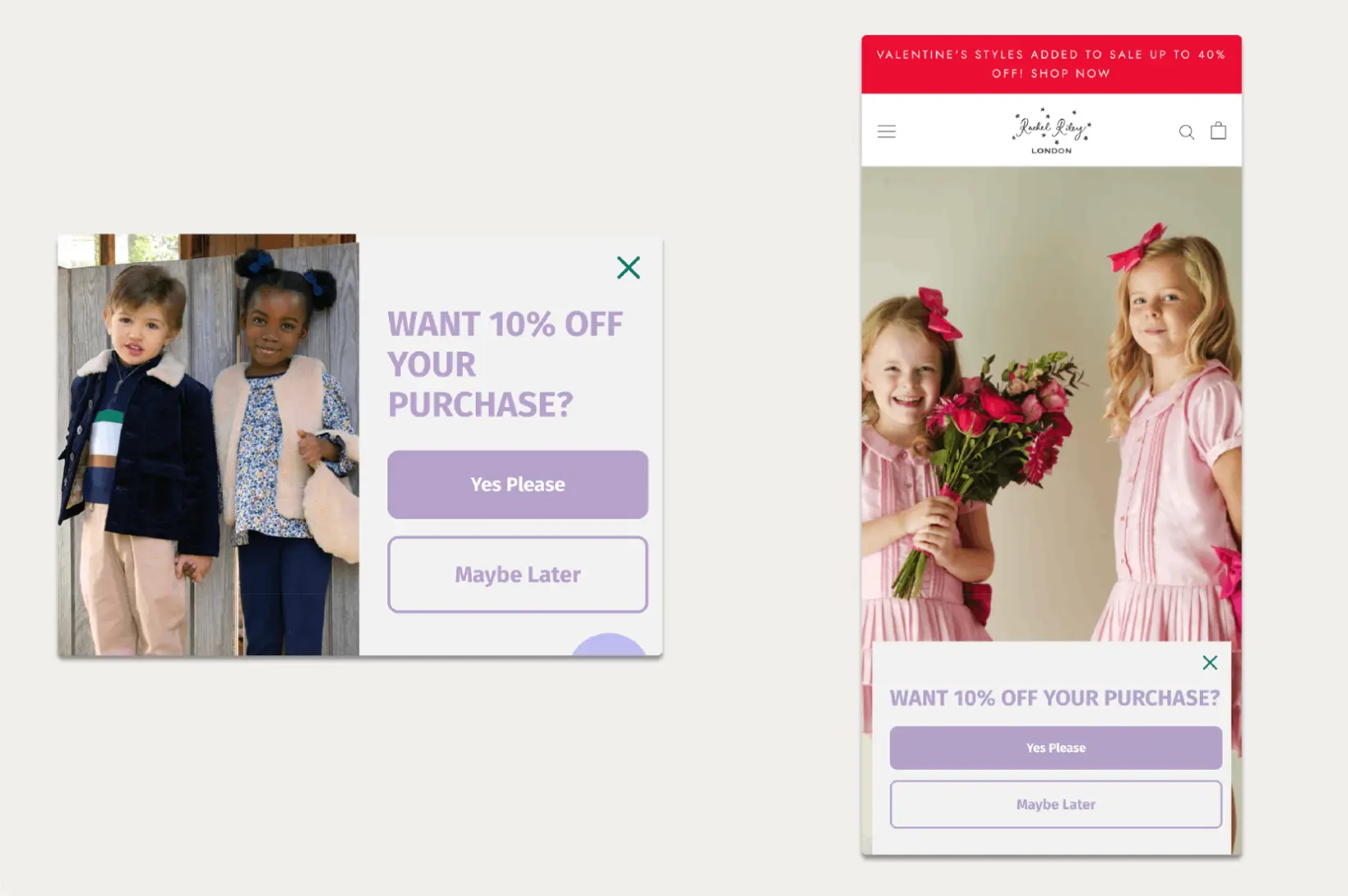
Rachel Riley London uses a multi-step mobile and desktop pop-up capture. The yes/no first step increases conversions and adds another layer of verification to ensure subscribers want to stay in touch. If you’re looking for ideas, we have a large free template library for emails, forms, pop-ups, and more.
Omnisend features a built-in List Cleaning tool that analyzes your contacts and flags invalid, disposable, or low-quality addresses to improve your email deliverability. Keep your list clean automatically.
Learn more
3. Know your audience, then segment it
Behavior predicts what someone does next better than age or location. According to a 2025 article published in the Journal of Big Data, behavioral data is better equipped than demographic information to capture the complexity of customer journeys. It shows what customers do at each stage, including browsing and researching as well as the purchase itself. So, map your audience based on behavior, then use email segmentation to turn that map into lists you can send to.
Omnisend’s dynamic behavioral segmentation uses customer actions like browsing, clicking, and purchasing to get more accurate behavior predictions. Beyond behavior, include lifecycle stage information and firmographics, which are especially important for B2B businesses.
For actionable segmentation, focus on a few high-impact groups like VIPs, at-risk customers, and window shoppers. This table gives a brief but clear breakdown of key segments, what each one focuses on, and when to use them:
| Segment | What it captures | Use it for |
|---|---|---|
| Engaged (30 days) | Opened or clicked recently | Your default audience; protects deliverability |
| VIP | Loyalists, or three-plus orders | Early access and exclusive perks |
| At risk | Was active, now going quiet | Win back before they churn |
| Past purchasers | Bought a category before | Cross-sell complementary products |
| Non-buyers | Subscribed, never ordered | A first-order incentive |
| Opened, not bought | Opened recently, no purchase | A re-engagement nudge or survey |
| Inactive | No engagement in 3 to 6 months | One last try, then sunset |
Here are some best practices to help improve your email marketing segmentation strategy:
- Send to your engaged segment first: Before a big campaign, mail people who opened your emails in the last 30 days, then widen, so a strong first response protects inbox placement for the rest
- Use exclusion segments: Suppress recent buyers, brand-new subscribers, and anyone messaged in the last few days so no one is hit twice
- Match the window to your purchase cycle: Lapsed can have different timeframes depending on your business, like three weeks for a coffee brand and six months for furniture, so set each timeframe to how often people buy
- Combine RFM with real-time behavior: Recency, frequency, and monetary value plus live signals give you a longer-range picture than either alone
- Keep segments live, not static: Build segments so that they can be updated automatically to match the changing behavior of customers
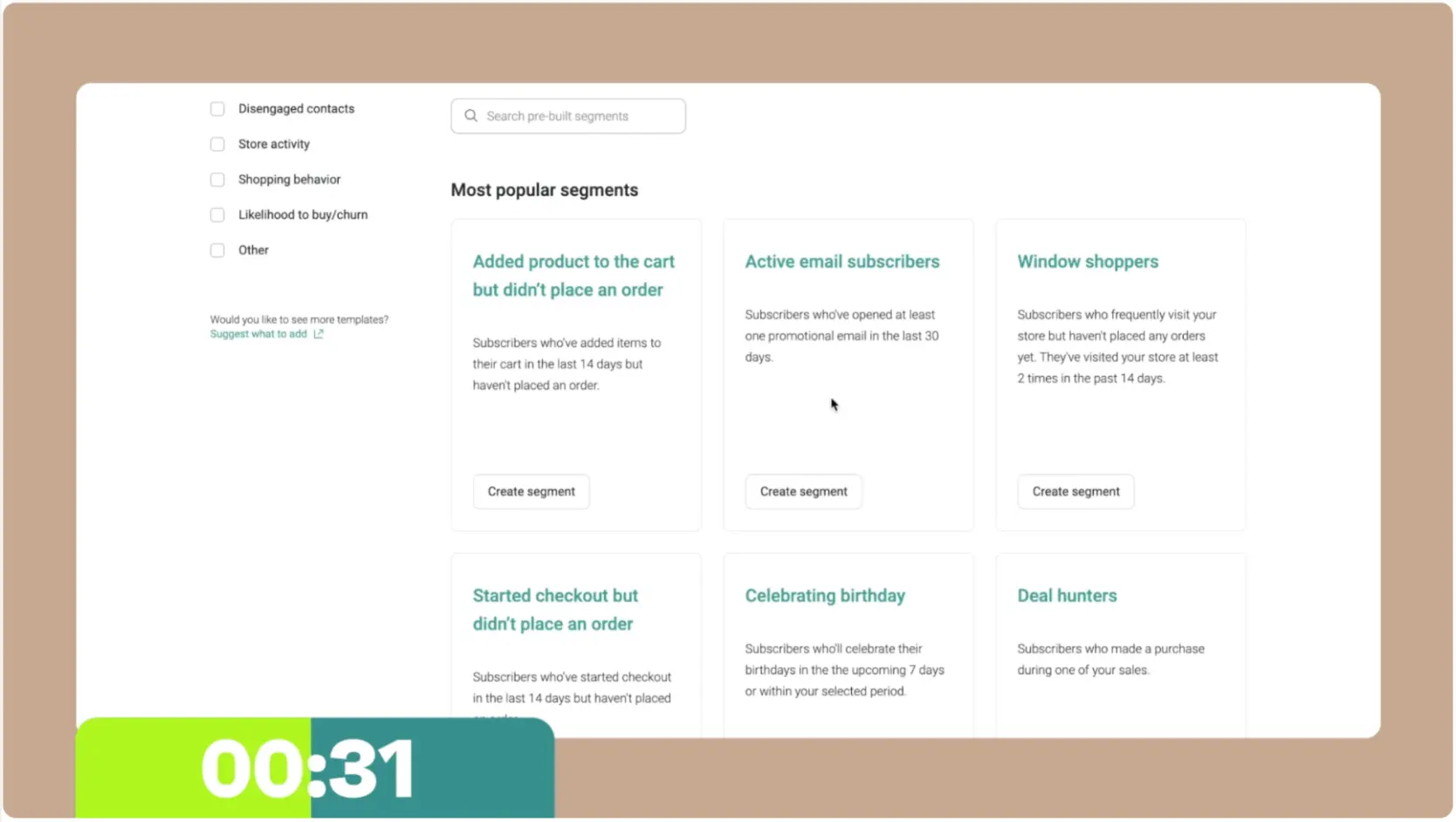
Here’s how Omnisend segmentation works:
- Segments update automatically based on rules, either in real time or at scheduled intervals
- The AI Segment Builder simplifies segment creation based on lifecycle stage in the customer journey
Use Omnisend to build smarter campaigns and automate marketing workflows
Quick sign up | No credit card required
4. Balance value and selling with the 80/20 rule
The 80/20 rule is based on offering recipients as much value as possible by dedicating 80% of email content to useful, helpful information and only 20% to promotions. In other words, the value customers get from the 80% should make the 20% of promotional content convert readers.
Make the value specific and tied to what you know about each subscriber:
- Educational content: Include information on useful how-to guides or masterclasses and give relevant purchase advice that builds on how people can use what they have or how different purchases can add real value
- Personalized product recommendations: Show tailored product recommendations based on what your customers browsed or purchased previously
- Sales on specific product categories: Highlight sales on subscribers’ favorite category rather than a site-wide blast that ignores what they shop for
- Early access to new arrivals/sales: Help people feel valued by providing first access to new products or upcoming sales without training people to wait for a coupon
Remember to plan your actions around subscribers, not your campaigns. New subscribers need significantly more education, while repeat customers need to feel valued for their loyalty. Better yet, use your engagement signals to decide. If you notice your open rate dropping, add value, but if you see increased clicks, upsell.
When subscribers find non-promotional emails valuable, they’re more likely to open and interact with them regularly. This builds sender reputation, helping your emails land in inboxes instead of spam folders.
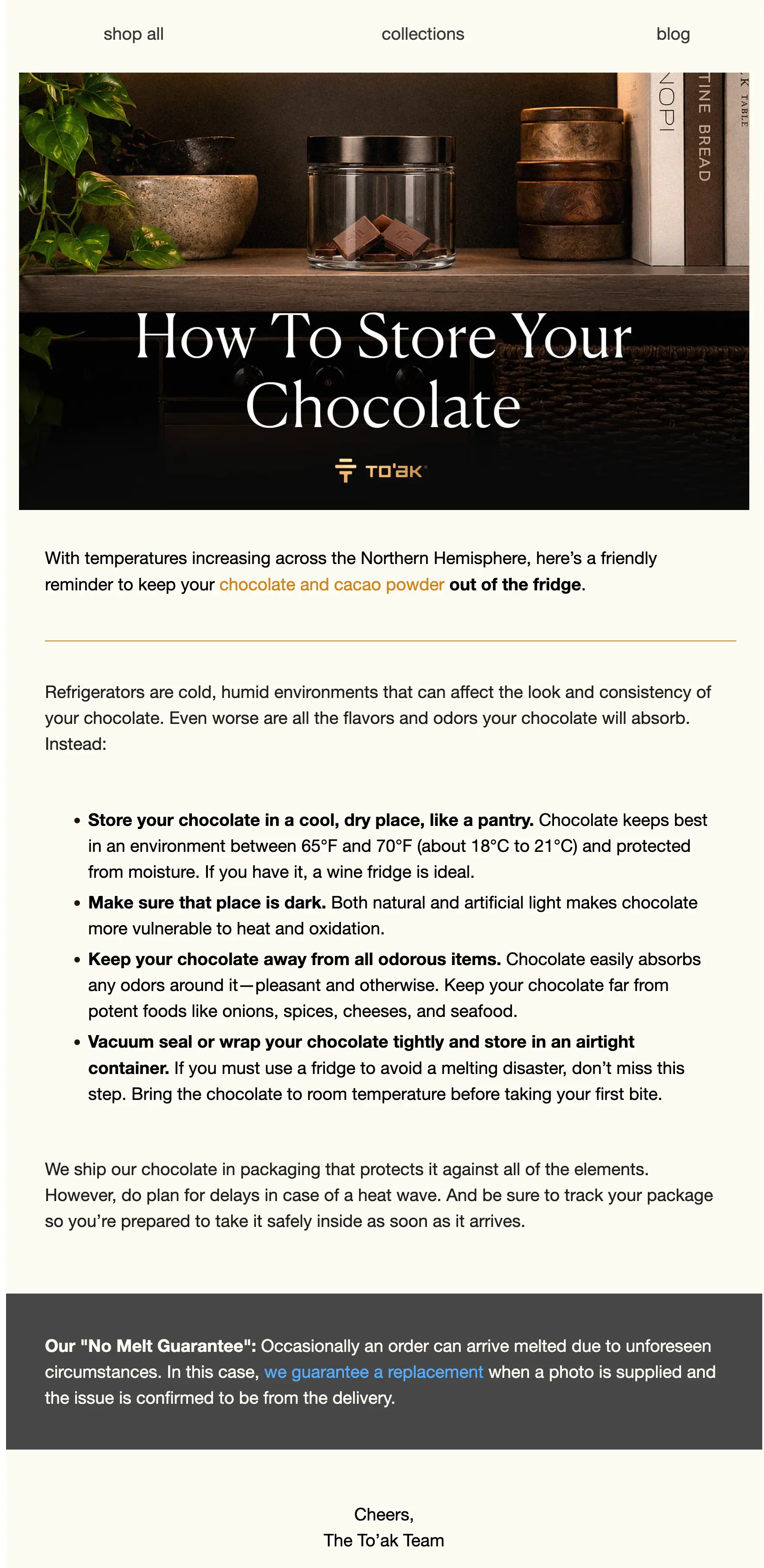
For example, To’ak Chocolate builds its welcome emails around value, like the one below, and reached a 47% open rate and an 18% conversion rate.
5. Automate the customer journey
Our 2026 report found that, in 2025, automated emails accounted for only 2% of all email sends but brought 30% of email marketing revenue. With a proven email marketing automation strategy, you can send messages triggered by customer actions and initiate relationship-building conversations.
Two automations do most of that work: welcome and cart abandonment drive 76% of all automated orders. Across all automations, each automated email earned $2.87 per send against $0.18 for campaigns, a 16-times difference in value per message.
Some of the top automations you can include in your email marketing strategy are:

Island Olive Oil is a good example of a well-executed automation email strategy. Even though automated messages make up 1.22% of its emails, they drive 39% of Island Olive Oil’s email revenue.
Read the full Island Olive Oil success story →
6. Combine automations with campaigns
An email marketing campaign is a one-off or scheduled message, allowing you to engage customers on your terms and create spikes in revenue. In contrast, email automation flows are triggered by behavior.
Here’s a brief side-by-side comparison:
| Automations | Campaigns | |
|---|---|---|
| Trigger | A customer action | You schedule them |
| Timing | In real time | On your calendar |
| Best for | Steady revenue: welcome, cart | Revenue spikes: launches, sales |
| Example | A cart reminder | A Black Friday promo |
Effective campaigns include:
- Newsletter: One useful thing plus one product, like a styling guide that features three items, not a wall of promos
- Product launch: A teaser, then the launch, then a last-chance reminder
- Seasonal promotion: It can be tied to your calendar events, like BFCM early access for VIPs
- Loyalty or VIP: Early access and members-only offers that reward repeat buyers
- Re-engagement for quiet subscribers: A “still interested?” email before you sunset them
As reported in our 2026 report, campaign open rates reached 30.7%, and click-to-conversion rose from 5.9% to 9% in 2025. Try to plan your campaigns and automations a quarter ahead to avoid rushing. You can also refer to our email marketing campaign examples to gather ideas.
7. Write effective subject lines
An email subject line is the first thing subscribers see, so it should be short, clear, and communicate what the email is about in five to seven words maximum. In fact, our data shows that 35% of customers decide to open an email based solely on the subject line.
- Keep your emails short and clear: Our analysis of 10,000+ campaigns found that five to seven words get the highest opens
- Include numbers: Use numerals for numbers under 10, instead of spelling them out, for better visibility
- Use punctuation: Add question marks or exclamation marks to emphasize key messages, but limit punctuation to two or three
- Front-load the point: Position the key message and the offer in the first 40 characters so it survives on mobile
- Personalize where it fits: A name, location, or a product they viewed beats a generic line
- Include a CTA: If your email asks readers to act, make it clear in the subject line
- Use active words: Good examples are buy, get, shop, and save, with a clear reason to open
- Avoid spam words: Skip spammy words like $$$, free, cheap, or “cash bonus” so your email won’t look untrustworthy
Different subject lines work because they tap into different motivations. Here are some common triggers and their corresponding subject line examples:
- Urgency and FOMO: “50% Off Valentine’s Coupon Expires Soon”
- Curiosity: “Three Mother’s Day Gifts She’ll Love”
- Status and exclusivity: “Be Our Valentine (And Get Free Shipping)”
- Utility and clarity: “Welcome! (Important info inside)”
- Benefit: “Your winter base layers, 20% off this week”
- Restock: “Back in stock: the boots you viewed”
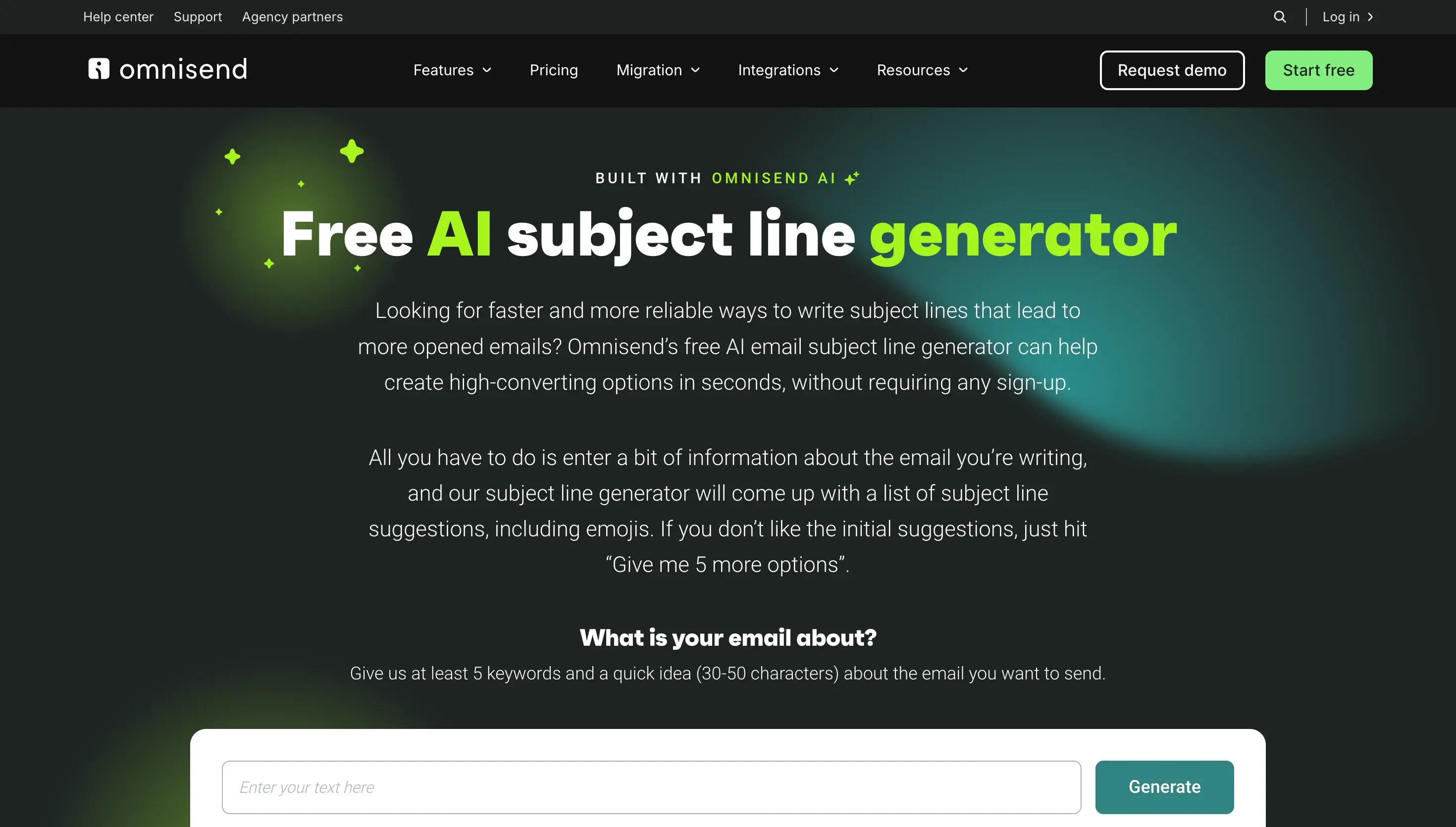
Test various styles to learn what your audience prefers, then match the line to a motivation, with more ideas in our subject line examples. Use Omnisend’s free AI subject line generator to quickly get ideas for your emails and test them by switching to our subject line tester.
8. Send emails at the right time
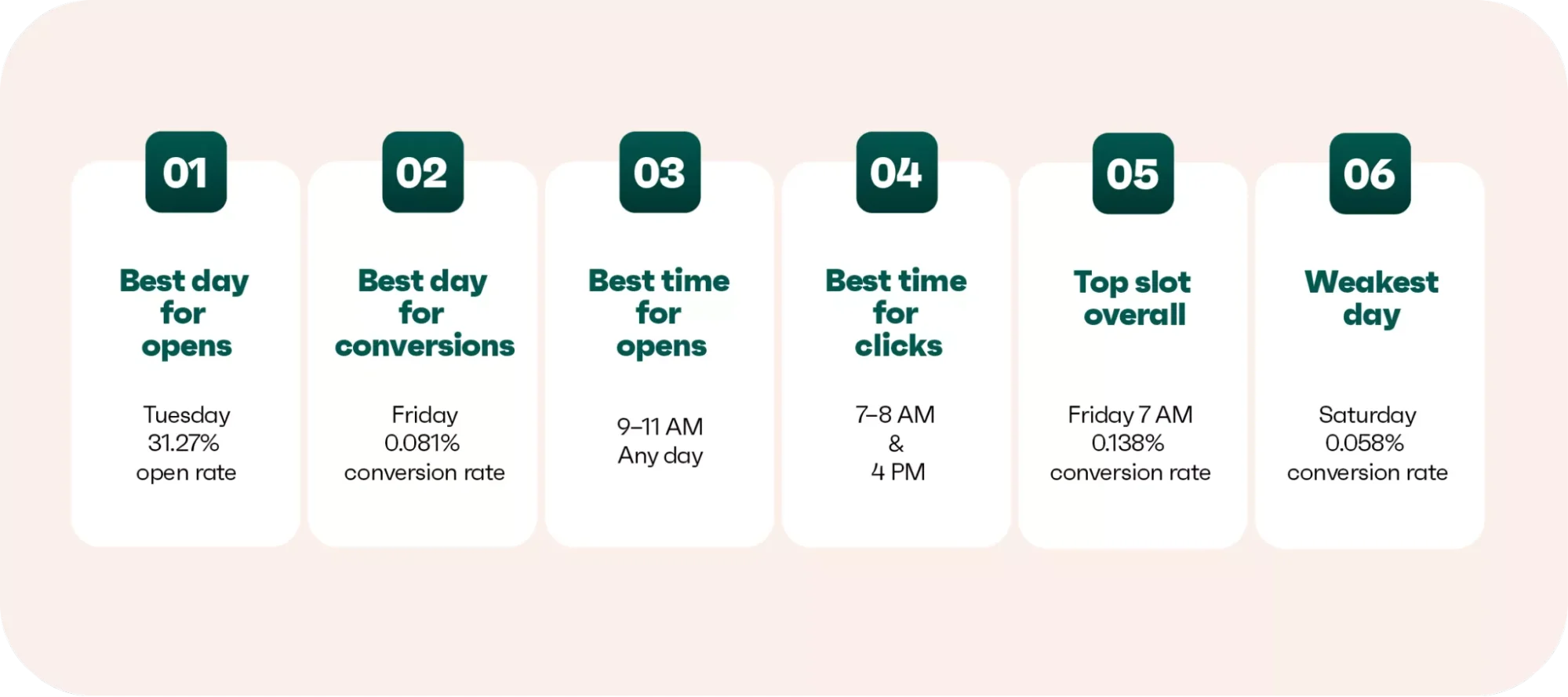
Sending emails to the right audience and at the right time can make all the difference in email deliverability and success. In our 2026 study, we analyzed over 26 billion emails and found that Tuesdays have the highest open rates (31.27%), while Friday wins for sales.
That being said, open data shows that only about one and a half percentage points separate the best day and the worst. So, sometimes it’s more useful to choose the day based on clicks and sales, not opens.
If you have a global audience, segment by time zone or use send-time optimization features to make sure emails arrive at the intended local time for each recipient.
Remember that sending emails too often can overwhelm subscribers. But if you send too few, you can lose engagement. Find a cadence that keeps your audience interested without causing fatigue.
9. Reach subscribers across email, SMS, and push
Email works harder alongside SMS and push: according to our 2026 ecommerce marketing report, automated SMS earned $0.74 per message versus $0.15 for campaigns, while push automation click-to-conversion rate climbed from 13.9% to 22.9%.
Omnichannel marketing can strengthen your campaigns and ensure messages reach customers where and when they’re most likely to engage. It’s best to choose the omnichannel approach and make SMS, email, and push notifications work together:
- If someone opens the email, hold the SMS, but if they go quiet for a day, follow up on the channel they use most
- Save SMS for time-sensitive moments like a cart reminder or flash sales
- Use push to bring back browsers without overloading inboxes: Vagari Bags paired email and SMS and saw 50% email open rates and £121 for every £1 spent on Omnisend
| Protective habits | Common mistakes |
|---|---|
| Pause other messages after engagement | Sending the same message everywhere |
| Reserve SMS for urgent moments | Using SMS for every promotion |
| Match follow-ups to customer behavior | Managing channels in isolation |
| Set cross-channel frequency limits | Messaging customers after conversion |
10. Land in the inbox: Deliverability and compliance
Gmail, Yahoo, and Microsoft now require all bulk senders to authenticate, so you need to set up three records: SPF, DKIM, and DMARC. Sender Policy Framework (SPF) records who can email from your domain, DomainKeys Identified Mail (DKIM) adds a tamper-proof seal to every email, and Domain-based Message Authentication, Reporting, and Conformance (DMARC) decides what to do when email sends fail SPF and DKIM checks.
Once you have the three records, follow these best practices:
- Send promotions from your main domain and transactional emails like order confirmations from a subdomain, so a promo complaint never threatens delivery of customer receipts
- Keep your spam-complaint rate under 0.1% and clean inactive contacts quarterly
- When you switch providers, warm up first by starting with your most engaged contacts and raise volume 25–35% a day over two to four weeks
- Stay compliant with CAN-SPAM, GDPR, and CASL, and AcreValue rebuilt its deliverability by segmenting tightly and moving to a dedicated IP
There are several common mistakes that you should avoid, such as sending to unengaged or outdated lists, leaving authentication incomplete, and letting volume spike near peak seasons like BFCM without planning for it.
11. Design for mobile
Over 64% of recipients check email on phones or tablets, so design emails for mobile use. Failing to do so could exclude a significant portion of your audience you could otherwise engage.
There are a few practical methods you can use to optimize emails for mobile:
- Design for single-column scrolling: Use responsive email designs that stack content vertically to ensure text and images are readable without shrinking on phones
- Size buttons and text for thumbs: Place buttons where thumbs naturally reach and keep font sizes readable without zooming
- Preview on mobile and dark mode before sending: Check how your email looks on small screens and in dark mode to ensure all text, images, and buttons display correctly
- Test emails like a real customer: Send test emails to a small segment or trigger your automation to see how dynamic content appears
Here’s an example from Amundsen Sports (an Omnisend customer):
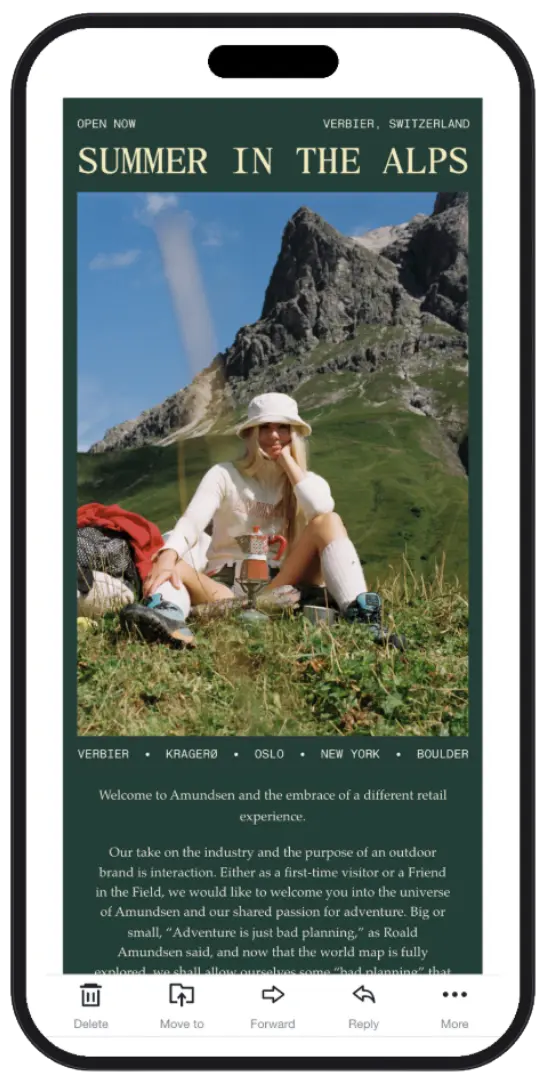
Amundsen keeps its mobile emails clean and single-column, which is one reason its order-confirmation email earns 9.5 times the revenue per email of its promotional sends.
12. Track the metrics that matter
Track a handful of metrics that map to your goal, not everything. Our email marketing metrics guide defines them all. Here are key metrics to monitor and their importance:
- Conversion rate: Conversions divided by delivered emails, the clearest link to revenue. You can also use conversions divided by clicks to tell a weak send from a weak landing page
- Revenue per email: Shows the total revenue divided by emails delivered, so you can compare a small VIP campaign against a full-list one fairly
- Click-through and click-to-open rate: Clicks signal real interest, and click-to-open shows if the email copy and subject line earned clicks after opening
- List-health signals: All unsubscribes, spam complaints, and hard bounces are your early warning that deliverability is dropping
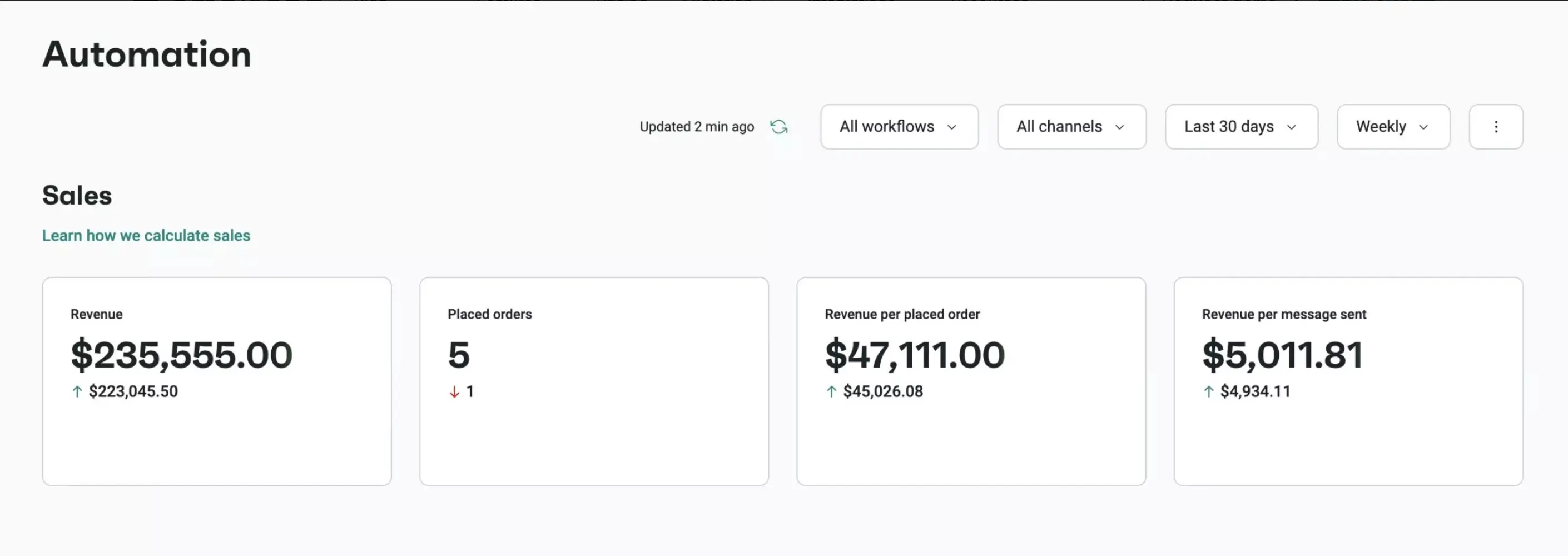
Keeping a close eye on your metrics is a strong start, but you need to compare them against benchmarks to understand what good looks like. For instance, our email marketing benchmarks put the average campaign open rate at 30.22%, and our 2026 report puts the click-to-conversion rate at 9%. Review by segment and by flow, because one weak flow hides inside a healthy average.
13. Test and improve with A/B testing
A/B testing can help you improve your email marketing strategy over time. It involves sending two versions of the same email to small groups, then sending the better version to the rest of your list. You can test subject lines, email copy, CTAs, layouts, offers, or send times to see what performs best. Our A/B testing guide walks through the setup step by step.
For example, this is how Omnisend would run A/B testing:
| What to test | A versus B example |
|---|---|
| Subject line | “New arrivals” vs “New arrivals, 20% off today” |
| Sender name | “Omnisend” vs “Sarah at Omnisend” |
| Preheader | Repeat the subject vs add a benefit |
| CTA copy | “Shop now” vs “Get 20% off” |
| Content or image | Product-only vs a lifestyle shot |
For cleaner, more reliable results, use only one variable and include at least 2,000 recipients per version. This framework is typically enough to reach 95% confidence, and you can test it with an A/B testing calculator.
“It may not make a huge difference when you’re starting out building your list. But once you have hundreds of thousands of customers in your database, even a .2 or .3 percent increase in any of your metrics can drastically have an improvement on your revenue overall. So I do believe A/B testing is very crucial.”
– David Sung, Digital Marketing Director of SM Global Shop
Read the full SM Global Shop success story →
PRO TIP: Use Omnisend’s A/B testing calculator to check the statistical significance of your results to make informed decisions later on
Email marketing strategy template
Strategies differ by business model, but the email marketing strategy template below covers the emails that appear in nearly every ecommerce program. While the channels may be the same, the goals, timing, and content will vary. Use this template to plan your emails and adapt it to your needs:
| Email or automation | Goal | When it goes out | Who it targets | What’s inside | Metric to watch |
|---|---|---|---|---|---|
| Welcome series | Turn a new subscriber into a first order | Right after sign-up | New subscribers | A warm intro and a first-order offer | Welcome revenue, first-order rate |
| Cart abandonment | Recover a started checkout | A few hours after checkout is abandoned | Shoppers who did not buy | The cart, a reminder, and help to finish | Recovered revenue |
| Browse abandonment | Bring a browser back | After a product view with no cart add | Product viewers | The product viewed plus related picks | Click-through, conversions |
| Newsletter | Stay top of mind and add value | Weekly or every two weeks | Engaged subscribers | One useful thing plus one product | Open, click, revenue per recipient |
| Seasonal promotion | Stay top of mind and add value | Around key dates, like BFCM | VIPs first, then everyone | The offer and a clear deadline | Campaign revenue |
| Win-back | Re-engage or sunset quietly | After a set quiet period | Lapsed buyers | A reason to return, then a last try | Win-back rate |
This template can also serve as a checklist, so when you see that there’s a row you can’t fill yet, you’ll know what you need to focus on next.
Final thoughts
Building a strong strategy requires careful planning, consistent execution, continuous performance monitoring, and avoiding common email marketing mistakes. Focus on understanding your audience, setting clear goals, and using automated and personalized messages to drive engagement. To see where and how distinct tactics fit into the entire lifecycle, check out our email marketing funnel guide.