9 Best Practices and Examples [2026 ]
Key takeaways
Fashion email marketing is the use of email to promote clothing and accessories, build customer loyalty, and increase sales.
The best fashion emails use strong visuals, a clear brand style, and a simple message that encourages clicks.
Send a mix of welcome emails, new arrivals, sales, abandoned cart emails, post-purchase emails, and back-in-stock alerts.
Segment your email list by gender, category, or behavior to send more relevant emails.
Make every email relevant by showing customers why it matters and what they should do or buy next.
Fashion is a visual industry that relies on compelling photos and messages to drive sales. For this, brands use fashion email marketing to reach shoppers with new collections and useful updates.
Omnisend’s 2024 ecommerce marketing report found that automated emails made up just 2% of sends but drove about 30% of all email revenue for ecommerce brands — proof that the right message at the right moment pays off. This guide covers what fashion email marketing is, the types worth sending, real fashion email examples, and how to build your first one for fashion ecommerce.
Build your first fashion email in under an hour, with ecommerce-ready templates and blocks
Quick sign up | No credit card required
What is fashion email marketing?
Fashion email marketing is the use of email to help clothing and accessory brands promote products and increase sales. It includes one-time campaigns like new arrivals and seasonal offers, as well as automated emails such as welcome messages, abandoned cart reminders, and post-purchase follow-ups.
In fashion email marketing, strong visuals and a consistent brand style are just as important as the message. A good fashion email keeps shoppers interested before, during, and after they make a purchase. It helps brands stay connected with customers and build long-term loyalty through relevant messages.
The annotated mockup below labels the building blocks of a fashion email:
Core fashion email types
A healthy fashion email marketing strategy uses different email types to reach shoppers at different stages of their journey. Each one has a clear purpose and helps move customers closer to their next purchase:
- Welcome emails: Introduce your brand, share what makes it unique, and encourage new subscribers to make their first purchase
- New arrivals and new collection: Highlight new arrivals or the latest collections to keep customers excited and encourage them to shop what’s new
- Sales and promotions: Share limited-time offers, seasonal discounts, and special events that encourage shoppers to buy before the deal ends
- Abandoned cart: Remind customers about their abandoned shopping cart and make it easy for them to complete their purchase
- Post-purchase: Confirm, reassure, and suggest what pairs well, including product recommendations — see the Shopify and WooCommerce order-confirmation guides
- Back-in-stock: Let shoppers know when a popular item or size is back in stock so they can buy before it sells out
- Best sellers: Feature your most popular products to help shoppers discover items that other customers already love
- Winback: Reconnect with inactive customers through exclusive offers or personalized recommendations that encourage them to return
What works in fashion: Best practices
Successful fashion email marketing campaigns present products in a way that fits the brand and make buying feel simple. Below are best practices and fashion email marketing examples to learn from. These examples span boutique email ideas and big-label tactics alike.
1. Lead with brand identity over discounts
2. Give the product a story that teaches
3. Create urgency and exclusivity for sales
4. Segment so each shopper sees the right edit
5. Let lifestyle photography show fit and texture
6. Bring lapsed demand back with a back-in-stock email
7. Time campaigns to the season
8. Turn customers into your campaign with social proof
9. Recover the abandoned cart
Lead with brand identity over discounts
Effective fashion emails should include brand elements that customers recognize before they read a single word. Colors, photography, typography, and tone should work together so the campaign feels familiar.
Discounts may increase short-term sales, but a consistent brand identity keeps people opening future emails.
Example: Amundsen, Old Salt Slacks
Type of email: Product story campaign
Amundsen builds its email around an outdoor lifestyle instead of a promotion. Large images of life on the water appear alongside detailed product descriptions. Rather than filling the email with offers, the products naturally support the story:
Best practices to consider:
- Keep the same visual style from the hero image to the product grid for good email branding
- Describe products with specific details, such as fabric, fit, or craftsmanship
- Let the imagery create interest before introducing promotional messaging
Fashion email case study: Amundsen
Amundsen Sports generates about 30% of its sales through automations, with order-confirmation emails alone driving roughly 16.7% of yearly Omnisend revenue and automations lifting revenue per email by around 1,010%. Read full success story here.
Give the product a story that teaches
Not every campaign needs a full collection. Many successful fashion email marketing campaigns focus on one product and explain why it deserves attention. When shoppers understand what sets an item apart, they need less convincing to buy.
Example: Asphalte, The Ultimate T-shirt
Type of email: Product launch campaign
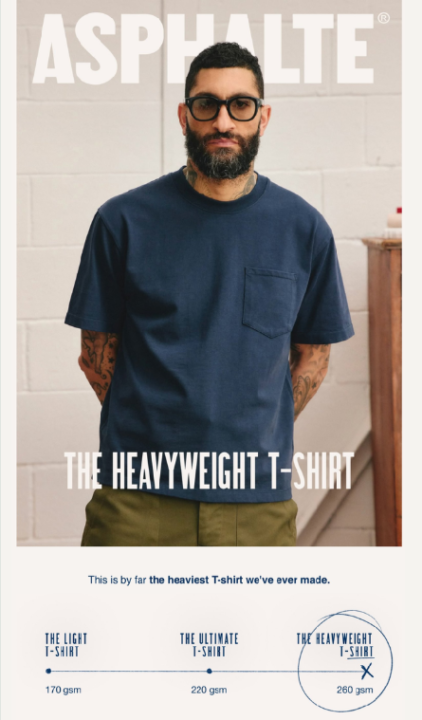
Instead of promoting multiple products, Asphalte dedicates the email to one t-shirt. It includes a simple graphic that compares fabric weights to help readers understand how the shirt differs from lighter alternatives:
Best practices to consider:
- Build the email around one hero product and one key message
- Use simple visuals to explain features or performance
- End with one clear call to action instead of several competing options
Create urgency and exclusivity for sales
Your fashion email marketing offers or promotions should feel limited, personal, or reserved for loyal customers. Offer early access, member-only events, and limited-time offers to create motivation without changing the discount itself.
Example: Rachel Riley, Archive Sale (VIP early access)
Type of email: Sale campaign (VIP early access)
Rachel Riley introduces its archive sale as an exclusive event for VIP subscribers. The email opens with a greeting to VIP. It highlights that the sale ends soon and includes a single code ARCHIVE60 that is easy to remember:
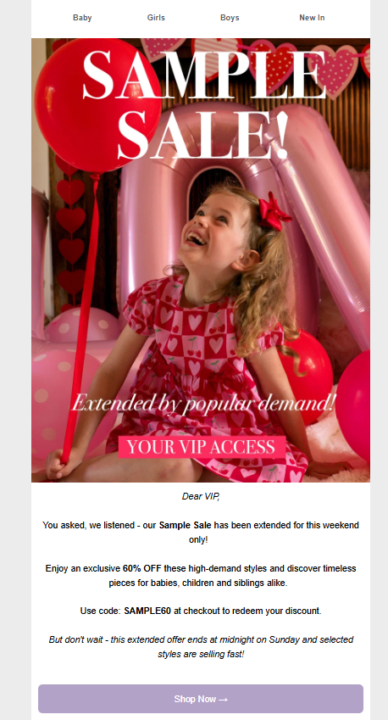
Image via Milled
Best practices to consider:
- Give loyal subscribers early or exclusive access when possible
- Keep deadlines and discount details easy to find
- Maintain your usual branding so the promotion still feels premium
Fashion email case study: Rachel Riley
Rachel Riley grew year-over-year Black Friday/Cyber Monday revenue by 77.33% with Omnisend, with 48.1% of total store revenue during the period coming from Omnisend and 46% of that from automations. Read the case study here.
Segment so each shopper sees the right edit
Not every subscriber shops the same way, so every email shouldn’t look the same. Good fashion email marketing campaigns match products to customer interests, previous purchases, or browsing behavior.
Show shoppers items that fit their preferences to increase the chance of a click.
Example: Ralph Lauren, Summer Sale
Type of email: Seasonal sale campaign
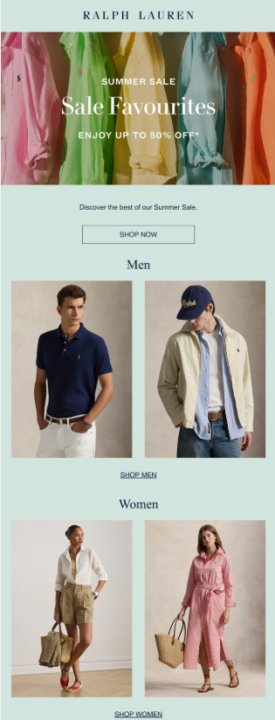
Ralph Lauren organizes one sales email into separate shopping paths for men, women, children, and home products. Instead of asking subscribers to browse a large catalog, the email helps them reach the most relevant section in one click:
Best practices to consider:
- Group products by audience, category, or shopping behavior
- Highlight the items each customer is most likely to want
- Keep the email layout consistent while changing the product selection
Let lifestyle photography show fit and texture
Fashion is visual, so email images often carry more weight than long product descriptions. Great fashion email marketing shows customers how clothes look and fit. A mix of lifestyle photos and close-up product shots answers questions before shoppers ask them.
Example: Taylor Stitch, The Brody Sweater Tee
Type of email: Product feature campaign
Taylor Stitch combines outdoor lifestyle photography with detailed close-up images of the fabric. One image shows the complete outfit, while another shows how it fits when worn. The email gives shoppers a better sense of quality without relying on lengthy copy:
Image via Milled
Best practices to consider:
- Show the product worn in a real setting from more than one angle
- Include close-up images that highlight fabric and construction
- Keep image captions short and focused on useful details
Bring lapsed demand back with a back-in-stock email
Back-in-stock emails reach shoppers who already showed buying intent. Instead of introducing a new product, they remind customers that a product they wanted is back in stock. That makes this one of the highest-converting types of fashion email marketing campaigns.
Example: Bonobos, Return of the Sweater Tee
Type of email: Back-in-stock automation
Bonobos opens the email with a “Back in stock” headline featuring the returning Sweater Pocket Tee. Simple product details follow this. The email then introduces a “Finish the rest of the look” section, which suggests complementary items to encourage additional purchases:
Image via Milled
Best practices to consider:
- Lead with the exact product that has returned
- Include a few useful product details to refresh shoppers’ memory
- Recommend complementary products after the main call to action
Time campaigns to the season
Fashion buying behavior often follows the calendar. People shop for holidays, weather shifts, and cultural moments. Strong fashion email marketing aligns campaigns with those moments instead of sending generic promotions.
Example: Net-a-Porter, Vacation Mode
Type of email: Seasonal/new-in campaign
Net-a-Porter frames its summer collection around travel. The email opens with a single lifestyle image and builds around a curated selection of resort-ready pieces:
Best practices to consider:
- Plan campaigns around seasons, holidays, and occasions
- Lead with a seasonal theme and let the products follow it
- Keep product edits tight and relevant to the moment
Turn customers into your campaign with social proof
People tend to trust other customers more than brand messaging. That’s why user-generated content plays a strong role in fashion email marketing. Real customers wearing products help new shoppers imagine fit and style.
Example: Rouje, #LaVieEnRouje
Type of email: User-generated content campaign
Rouje shows customer photos shared under its branded hashtag. The email starts with a featured image, then shows a grid of real customer looks, each with an Instagram handle. It also invites subscribers to tag @rouje with #lavieenrouje for a chance at a €200 gift card:
Best practices to consider:
- Feature real customer photos instead of only studio images
- Give people a clear reason to share their own content, such as a hashtag, a prize, or a feature
- Link every image back to a shoppable product.
Recover the abandoned cart
Cart abandonment emails target shoppers who already showed clear intent to buy. The goal is not to convince them again, but to remove hesitation. In fashion email marketing, this often means showing the exact product left behind and making the return path simple.
Example: Gymshark, Hey, you left something behind
Type of email: Abandoned cart automation
Gymshark’s email shows the exact item from the cart, including name, color, and price. It also includes a single clear button that returns to checkout. Additional reassurance, such as returns and support information, is placed below the main action:
Best practices to consider:
- Show the particular items left in the cart with clear visuals
- Use one primary call to action back to checkout
- Reduce hesitation with simple reassurance like returns or support
How to build a fashion email with Omnisend
Getting started with fashion email marketing isn’t complicated. Omnisend includes the tools you need to create professional campaigns and personalize your messages. Follow these steps to build your clothing brand emails from start to finish.
1. Pick a fashion template
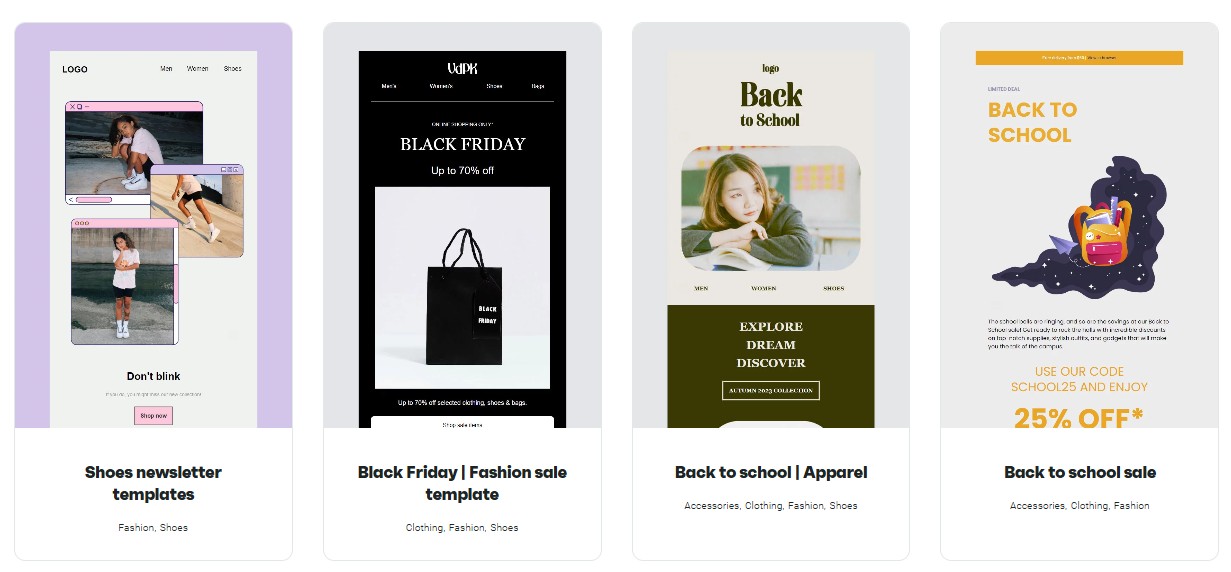
Start with a fashion email template that matches your campaign. It can be used to announce a new collection, promote a sale, or share style inspiration; choose a ready-made layout to save time.
2. Set your brand kit
Upload your logo, set your brand colors, choose your fonts, and update your button styles. Save these settings so all your campaigns look consistent. This way, customers recognize your brand each time they open your emails.
3. Build the email
Add a hero image, a short headline, and product blocks that pull product names, prices, images, and links from your store. Keep your layout simple and include one clear call to action.
If you need help writing subject lines or email copy, Omnisend’s AI features can generate a starting draft that you can edit to match your brand voice:
4. Turn on the core automations
Once your campaign is ready, set up the email automations that keep your store connected with customers. Workflows for welcome emails, abandoned cart reminders, back-in-stock notifications, and post-purchase emails continue your fashion email marketing even when you’re not actively creating campaigns.
5. Segment the send
Create segments by gender, category, or purchase history. Then send each group content that matches what they are most likely to buy.
6. Preview, test, and schedule
Before sending, preview your email on desktop and mobile, check every link, and run an A/B test for your subject line or call to action. Schedule the campaign, and watch open rate, click rate, and revenue per email.
Summary
Fashion email marketing brings together clear product focus, strong visuals, and timing that matches how people shop. The best campaigns stay simple, show products in context, and make it easy for customers to take action.
It doesn’t matter whether you’re running seasonal drops or everyday updates; the same ideas apply across different campaign styles. It works across both small boutiques and large retail brands without needing complex setups.
If you want to put these ideas into practice, start with Omnisend’s fashion templates. Pick two practices from this guide, ship them this season, and measure email marketing metrics as you go.
Launch your fashion email in Omnisend and track performance from send to sale in one place
Quick sign up | No credit card required