BrightLocal is one of those tools that can do a little bit of everything. You can track local rankings, manage citations, monitor reviews, run audits, and pull reports for clients; all from one platform.
That sounds great until you realize you’re not actually using half of it. Maybe you mainly need review management. Maybe you need better directory coverage as you add more locations.
Or maybe BrightLocal works well enough, but the pricing, performance, workflow, or feature set no longer makes sense for the way your team operates.
For some teams, it’s the small limitations that become harder to overlook as their needs grow. And that’s usually when the search for alternatives begins.
The good news is that you have plenty of options. The less obvious part is figuring out which ones are actually worth considering.
Some are close to BrightLocal in what they offer, while others take a more focused approach to reviews, listings, customer messaging, or local search visibility.
We tested eight of the most relevant BrightLocal alternatives to see how they stack up on features, pricing, review platform support, directory reach, and overall fit. This guide walks you through each alternative and how it stands against Brightlocal.
Why Look Beyond BrightLocal
BrightLocal is a solid local SEO platform, and there’s plenty to like about it. Its G2 profile carries a 4.6/5 rating from 230 reviews, and BrightLocal Academy offers genuinely useful local marketing training for free.
But a strong product can still have limitations that matter to certain users. As you look more closely at BrightLocal, a few recurring concerns start to emerge, particularly for teams with specific workflows, growing requirements, or different expectations from their software.
Here’s where those limitations become worth considering before you make a decision.
Pricing Concerns
BrightLocal‘s pricing is based on the location count across three plans, and the number climbs faster than most people budget for.
Track starts at $41 a month for a single location. Grow, the only plan that includes review monitoring and review responses, starts at $65 a month for one location and reaches $494 a month at 50 locations, or $989 a month at 100.
Citation building is not included in any of those plans. It is pay-as-you-go at $3.20 per site, dropping to $2 with bulk credits, and the five data aggregator submissions cost $30 each or $120 a year for all five. The Local Search Audit that agencies use for prospecting is credit-gated on re-runs.
Reviewers have been blunt about the billing:
They force you into annual billing and then hide behind a clause that lets them keep every penny once you cancel, even if you’ve barely used the thing…
The credit model draws its own complaints, including from users who otherwise like the product. In a Reddit thread comparing BrightLocal against SEMrush, users share their dissatisfaction with the credit-based model:
“The ‘Local SEO Report’ that runs when a client is first added doesn’t run again unless you use a credit, and there are different citations listed there than in the citation tracker.”
Performance and Reliability Issues
Speed and data accuracy come up repeatedly, and the most recent complaints are the sharpest.
Geografixx – Your Local Business
Reports that previously took approximately five minutes to complete are now taking more than 12 hours with constant failures wasting my entire day…
Citation accuracy is the other recurring theme, which matters given that citations are the product’s heritage.
Not all of the directory listings go live, with new listings sometimes created on directories that cannot subsequently be edited, working against the goal of one listing with the same NAP data.
User Experience Challenges
The dashboard is dense, and the parts of it built for reputation management feel like the newest and least finished.
A Reddit user, while sharing their experience with BrightLocal on r/localseo mentioned “The review request feature is ugly and outdated.”
That quote comes from someone broadly positive about the platform, which is what makes it useful. The people who like BrightLocal still do not like its review tooling.
Scaling has hard edges too. Account-level ceilings force multi-location operators into workarounds:
If you have several locations as I do (77 at this time) we do have to have 2 separate accounts since each account can technically hold 100 locations, but reporting can only manage 50 per account.
This one is not a matter of opinion, and it is the clearest reason people end up running two subscriptions.
BrightLocal does not publish to social media. The only publishing feature anywhere in the platform is the Google Business Profile Post Scheduler, and the Manage plan describes it exactly that way: “schedule posts on Google Business Profile.” No Facebook, Instagram, LinkedIn, X, TikTok, Pinterest or YouTube publishing exists at any tier.
These limitations don’t make BrightLocal a poor platform, but they can make other tools a better fit for certain teams.
So, how did we evaluate those alternatives? Let’s look at our testing and fact-checking process.
How We Tested These BrightLocal Alternatives
A list of alternatives is only useful if you can trust the comparisons behind it. We looked beyond feature lists and marketing pages to understand what each platform actually offers, what it costs, and where its capabilities differ from BrightLocal.
We tested the products where possible, checked published documentation and pricing, and cross-checked claims against independent sources.
When a detail couldn’t be verified, we’ve said so rather than filling the gap with assumptions. Here’s how we approached the testing and fact-checking for each alternative.
Our Testing Protocol
We ran each platform against our own test locations rather than live client profiles.
- Connected the same Google Business Profile and Facebook Page where supported.
- Measured reply times using the same batch of unanswered test reviews.
- Generated AI replies to the same 2-star review and assessed tone and specificity.
- Ran email or SMS review request campaigns and checked the messages recipients received.
- Ran listings scans and recorded the publishers each platform actually reported.
- Ran rank reports or geo-grid scans and compared results with BrightLocal using the same location and keywords.
How We Fact-Checked Every Comparison
- Re-verified pricing against each vendor’s live rate card in September 2026.
- Recorded when vendors no longer publish pricing instead of using outdated figures.
- Confirmed ratings and review counts directly on G2 and Capterra.
- Standardized billing units, distinguishing monthly, annual, per-location, and other pricing models.
- Checked corporate ownership, including recent changes in ownership.
What We Didn’t Test, and Why
- Enterprise tiers requiring contracts, custom onboarding, or SSO provisioning. Vendor-stated claims are identified as such.
- Long-term support responsiveness, which requires a longer testing period to assess fairly.
- Chatmeter and Uberall at full platform depth, as both are quote-only and have location minimums that prevented a standard evaluation.
- Local Dominator’s Enterprise tier, although we evaluated the platform’s available entry-level offering.
With the methodology covered, the table below gives you a quick head-to-head comparison of all eight BrightLocal alternatives before we take a closer look at each one.
BrightLocal Alternatives at a Glance
Not every BrightLocal alternative is built for the same job. Some come close to its broader local SEO toolkit, while others take a more focused approach to reviews, listings, messaging, or local search visibility. Here’s how the top alternatives compare head to head.
The table gives you the quick comparison, but the best BrightLocal alternative depends on what you actually need from the platform.
Some are built for broader local SEO, while others focus on reviews, listings, messaging, or local search visibility.
Next, we’ll look at each alternative in more detail to see where it stands out, where it falls short, and who it’s best suited for.
The 8 Best BrightLocal Alternatives, Reviewed in Depth
We’ve reviewed each alternative across its core features, review platform support, pricing, strengths, limitations, and ideal use cases. Where a product takes a different approach to local SEO or reputation management, we’ve called that out too.
Let’s start with SocialPilot Reviews, our own online review and listing management platform, and then move through the other alternatives.
Free Starter plan, then $25.50 per month billed annually, or $30 when billed monthly
Rating
4.5 on G2
Apps
Android, iOS and Web, with review management inside the main SocialPilot app rather than a separate one.
Review Platforms Supported
Google Business Profile, Facebook, Yelp, Tripadvisor, Trustpilot, Foursquare, Zillow, YellowPages and Influenster, plus a custom link for anything else.
SocialPilot Reviews sits at the reputation end of this category rather than the local SEO end. Review monitoring, AI replies, campaigns, feedback forms, QR codes and widgets are available on every plan, including the free Starter tier.
On BrightLocal, review monitoring and responses require the Grow plan, which starts at $65 a month for one location and rises with every location you add. SocialPilot Reviews offers the same features for $30/month, billed monthly.
Key Features
- Review monitoring across nine platforms in one feed, pulling up to 1,000 past reviews when you connect a new platform
- AI-generated replies in 40-plus languages, with tone adjustment, reply templates carrying custom fields, and AI Auto-Reply rules that trigger on star rating
- Review request campaigns by email, SMS through Twilio, and WhatsApp through Meta Business, with multi-step workflows and duplicate request prevention
- Feedback forms with 20-plus question types and conditional logic, plus dynamic QR codes whose redirect target you can change without reprinting anything
- Six review widget types for your site, including a floating slide-in and an average rating badge, with a feedback page that routes low ratings to a private form
- Team and client management with role-based access, and client management controls granular enough to hand a client their own limited view
- Listings publishing and auto-sync to Google Business Profile and Facebook Pages, with listing health monitoring per location
Pricing, Tier by Tier
Pricing scales by location rather than by feature tier, so a small agency is not paying for capability it will not use.
| Tier | Monthly | Annual | What You Get |
| Starter | Free | Free | 1 brand, 1 location, 100 email credits a month |
| Pro | $30/mo | $25.50/mo | Unlimited brands, 3 locations then $10 per location, 5,000 email credits |
| Enterprise | Custom | Custom | White label, custom locations and credits |
See SocialPilot Reviews’ pricing plans for the current breakdown. Extra email credits are $10 per 1,000, and auto-fill tops you up automatically when the balance hits 100.
Direct Reply, and Where It Actually Posts
This is the limit to know before you migrate anything. Replies publish directly to Google and Facebook only, and every other source is draft and paste, so the AI writes the response and a human still opens the platform to post it. If Tripadvisor drives your hospitality clients, price in that step.
Listings Reach, the Gap You Have to Price In
Listings publishing covers Google Business Profile and Facebook Pages. Not Apple Maps, not Bing, not the directory networks Yext and Chatmeter reach, so if citation distribution is why you bought BrightLocal, this is not a swap.
Who Should Actually Use This
The stronger fit is an agency or multi-location brand at 10 to 60 locations, where response time and predictable per-location cost are the pressure points. The weaker fit is a local SEO shop whose retainer is built on audits and rank reports, because that half of BrightLocal’s job is not here.
A Realistic Scenario
A three-person agency carries 12 client locations. On Pro billed annually that is $25.50 for the first three plus nine at $10 each, so $115.50 a month, or $1,386 a year, with no seat charge for the third person. The same 12 on Yext’s Emerging package run $2,388.
Pros
- Published pricing, and the lowest per-location math here at agency scale
- Direct reply publishing on Google and Facebook, with approval-gated automation
- A free tier that is genuinely usable rather than decorative
Katie F.
I like consolidating our social and reviews down to one platform. Their support team was incredible about onboarding and accommodating specific feature requests – super quick to respond, pleasant and flexible. It’s also priced super fairly.
Cons
- Replies post directly on Google and Facebook only, everything else is draft and paste
- Listings publishes to Google Business Profile and Facebook Pages only, not the 200+ publisher network Yext reaches or the 140+ directories Chatmeter claims
- No local rank tracking or citation auditing, so SEO reporting needs a second tool
Company Snapshot: SOC 2 Type 2 certified following an 11-month audit period by an independent licensed auditor.
What Sets It Apart: The only tool here pairing a free single-location tier with a flat $10 per additional location, instead of multiplying a rate from location one.
$49 a month for a single location when billed monthly, all features included
Rating
4.5 on G2 and 4.1 on Capterra across 17 reviews
Apps
Web, with public APIs and a native MCP server for connecting AI assistants
Review Platforms Supported
30-plus review sites including Google, Facebook, Apple and Tripadvisor, plus custom sources
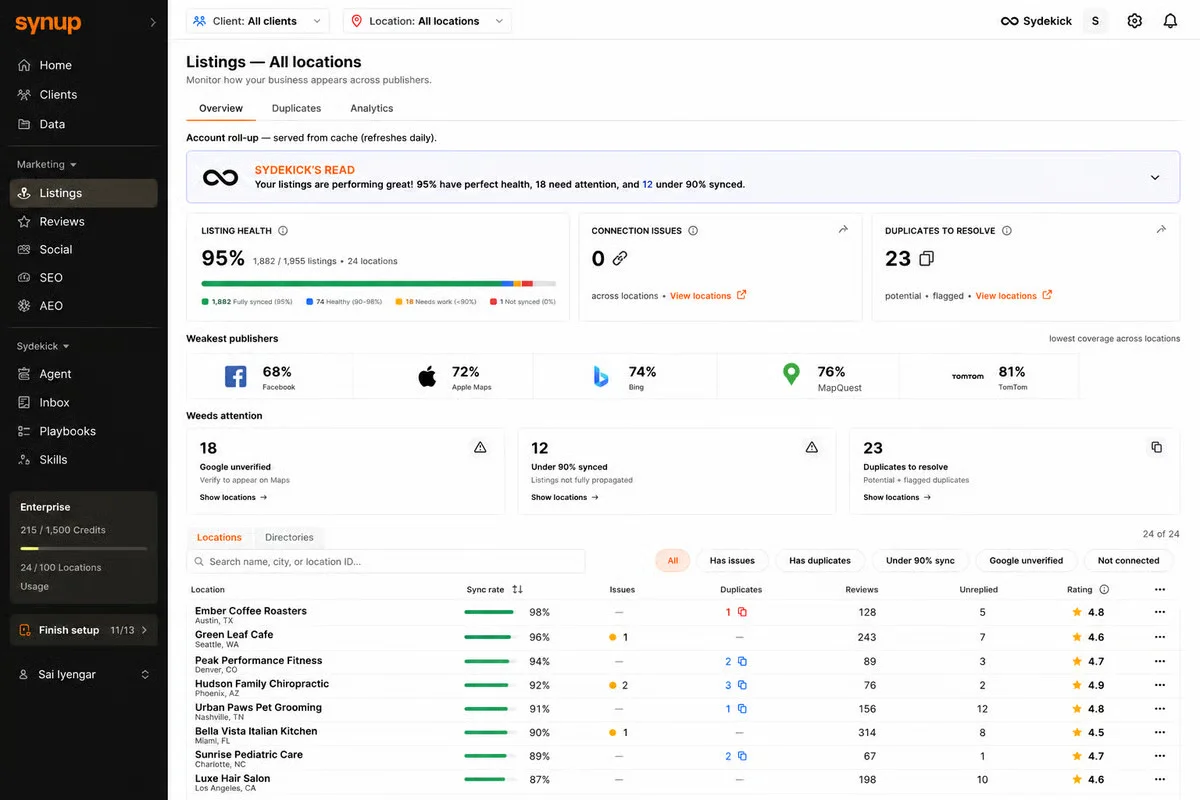
Where BrightLocal shows you that your rating moved, Synup tells you which topic moved it. Its reputation analytics are built around topic tagging and month-over-month sentiment tracking, and it is the only tool here publishing a competitor sentiment benchmark alongside your own numbers.
Key Features
- Sentiment Analysis: Track review themes and sentiment trends over time.
- Competitor Benchmarking: Compare ratings, review volume, sentiment, and star distribution.
- Listings Management: Sync business data across 100+ publishers, including Google, Apple, Bing, and Facebook.
- AI Review Responses: Generate on-brand replies with templates, bulk actions, and approval workflows.
- Multi-Location Management: Rank locations by reputation with leaderboards and manage them from a centralized dashboard.
Pricing, Tier by Tier
Every tier includes every feature. What changes is capacity, which is an unusually honest pricing model and worth noting.
| Tier | Monthly | Locations | What You Get |
| Solo | $49/mo | 1 | 20,000 monthly credits, 1 parallel agent task |
| Premium | $299/mo | up to 10 | 200,000 credits, 3 parallel tasks, white labeling |
| Pro | $499/mo | up to 25 | 600,000 credits, 5 tasks, dedicated environment |
| Scale | $899/mo | up to 50 | 1,200,000 credits, 10 parallel tasks |
| Enterprise | Contract | 50+ | Custom credits, bring your own key or model |
Sentiment Analysis, and Why It Beats a Star Average
A star average tells you something is wrong roughly a month after it started going wrong. Theme-level tracking tells you that “wait time” mentions tripled in three weeks while your rating held steady at 4.4.
That is the difference between a reporting tool and a diagnostic one, and it is the specific reason to pick Synup over BrightLocal’s Reputation Manager.
BrightLocal monitors 80-plus review sites and alerts you on negative reviews. It does not tell you which recurring theme is generating them.
Cost Compared With BrightLocal, at Scale
At one location Synup is $49 against BrightLocal Grow’s $65, so slightly cheaper. At 10 locations Synup Premium is $299 against BrightLocal Grow’s $131, so more than double.
Synup is buying you sentiment analytics, a 100-plus publisher network and white labeling at that price, and whether that is worth $168 a month depends entirely on whether you will use the analytics.
Who Should Actually Use This
The stronger fit is an agency or multi-location marketer who has to explain reputation performance to someone else, and who needs the explanation to be causal rather than descriptive.
The white-label client portal from Premium up makes it a genuine BrightLocal replacement for agency reporting.
The weaker fit is a single-location business. At $49 a month for one location, you are paying analytics prices for a review volume that will not generate meaningful themes.
A Realistic Scenario
An agency manages reputation for eight restaurant locations under one brand. On BrightLocal Grow, 6 to 10 locations costs $131 a month.
On Synup Premium, up to 10 locations costs $299 a month, and includes white labeling that BrightLocal also provides at no extra cost.
The honest read: you are paying $168 more per month for topic-level sentiment analysis and a wider publisher network. If the client’s question every month is “why did our rating drop,” that is worth it. If the question is “what is our rating,” it is not.
Pros
- Feature parity across every tier, so a small account is not artificially crippled
- Competitor sentiment benchmarking is genuinely uncommon at this price
- Sub-five-minute review sync means alerts arrive while the situation is still fixable
Noah R.
Synup has made it super easy to set up our online presence before our pool store even opens. It’s helped us get our listings organized, boost our visibility, and make sure everything’s consistent across Google, maps, and other directories.
Cons
- Only 17 Capterra reviews, with a polarized distribution that suggests inconsistent experiences
- Support responsiveness is a recurring theme in negative reviews
- The step from Solo to Premium is $250 a month with nothing in between
Daniel B.
Confusing UI – very difficult to navigate Majority of websites they check have lower traffic or DA making it almost a waste of time to update
Company Snapshot: Synup publishes developer documentation and a listing management API, and supports MCP for connecting AI assistants directly to reputation data, which is ahead of most of this category.
What Sets It Apart: Theme-level sentiment tracking with competitor benchmarking, on a pricing model where the entry tier has the same features as the enterprise one.
Quote only, no public pricing
Rating
4.7 rating on G2 across 96 reviews and 4.9 on Capterra across 21 reviews
Apps
Web platform with six modules: Listings, Reputation, Social, Ads, Bookings and an AI Insights Hub
Review Platforms Supported
Google, Facebook, Instagram, Tripadvisor, Trustpilot and HelloPeter, among others
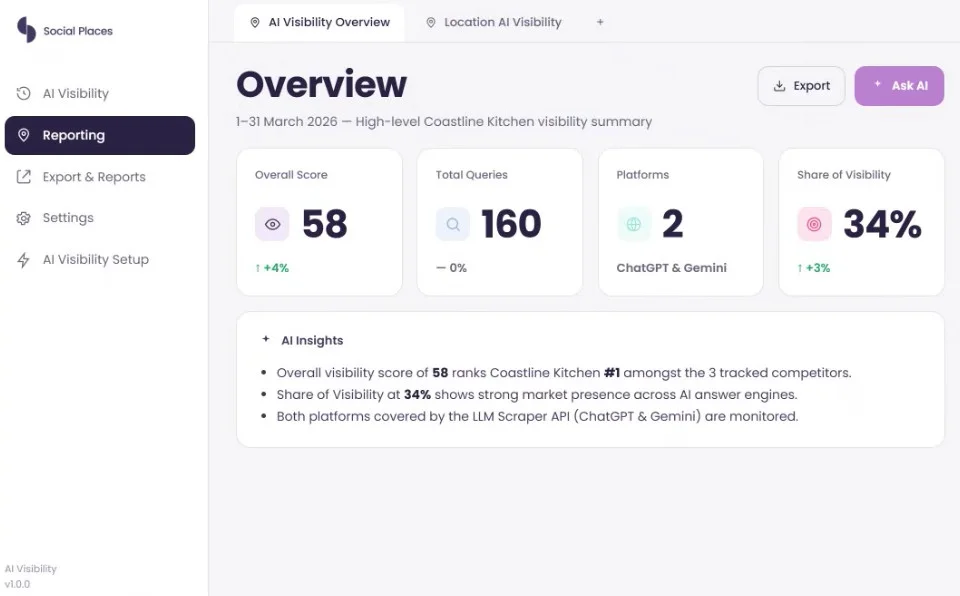
If your problem is not reporting but governance, this is the one to look at. Social Places is built around the franchise question BrightLocal never tries to answer: how do you let 200 local managers post and reply without letting them go off-brand?
Key Features
- Multi-Level Approvals: Route content from local teams to head office for approval.
- Listings Management: Sync listings across 50+ platforms with pin-placement verification.
- Duplicate & Rogue Listing Protection: Detect duplicates and automatically revert unauthorized edits.
- Unified Reviews & Messaging: Manage reviews and direct messages in one inbox with AI replies and alerts.
- Social Media Publishing: Publish across Facebook, Instagram, Google Business Profile, X, LinkedIn, and TikTok with location-specific content.
Pricing, and the Absence of It
Social Places has no public pricing page. Capterra lists it as “contact vendor,” and GetApp shows no pricing information at all. Every evaluation starts with a demo booking.
Figures circulating on third-party comparison sites range from $17 a month to $1,800 a month and contradict each other. We could not confirm any of them on a Social Places property, so we are not publishing a number.
The Franchise Machinery Is the Product
The approval chain is the thing worth paying for. A brand with 600 sites can set guardrails centrally, let each location add genuine neighborhood content, and never publish something legal has not seen.
Social Places cites a 600-site rollout reaching consistency within weeks, and 96% listing verification across 1,842 managed locations.
BrightLocal has no equivalent. It reports on locations; it does not orchestrate the people running them.
A Geography Worth Knowing About
Social Places is South Africa-rooted, and HelloPeter, a major South African review platform, is a first-class integration no US-centric competitor here carries. If you operate in that market, this is the only tool on the list that treats it as a primary rather than an afterthought.
Who Should Actually Use This
The stronger fit is a franchise or multi-location brand above roughly 50 sites where the bottleneck is coordination rather than data. Restaurant groups in particular, given the menu management and bookings modules.
The weaker fit is anyone below about ten locations, an agency wanting to start today without a sales call, or a team whose core need is local rank tracking. Social Places does not advertise rank tracking anywhere, which is a direct gap against BrightLocal.
A Realistic Scenario
A 120-site quick-service restaurant franchise has head office fielding complaints about locations posting off-brand promotions and replying badly to reviews. On BrightLocal, 100-plus locations is quote-only, and even then you get reporting rather than workflow control, plus the account ceiling that forces multi-location operators into a second account.
Social Places gives head office the approval chain, the asset library and the per-region ad wallets in one place. You will not know what it costs until you book the demo, which is the real trade-off.
Pros
- Franchisee-to-head-office approval workflow is the deepest on this list
- Auto-revert protection against unauthorized listing edits is rare outside enterprise tools
- Genuinely strong Capterra sentiment, with no review below four stars
Cons
- No published pricing anywhere, so budgeting requires a sales conversation
- Only 21 Capterra reviews, which is thin third-party validation for a platform this size
- No local rank tracking advertised on any product page
Company Snapshot: Social Places states it manages over 30,000 locations. Note that its Capterra listing still sits under a legacy product ID, “Go-Review,” which is the correct page despite the name.
What Sets It Apart: Approval chains built for the franchisee-to-corporate relationship, which no other tool here models properly.
$199 per location per year on the entry tier, billed annually
Rating
4.4 on G2 based on 1,124 reviews and 4.2 on Capterra across 114 reviews
Apps
Web platform spanning Listings, Reviews, Pages, Content and Search
Review Platforms Supported
Google, Facebook, Yelp and 80-plus industry-specific sites
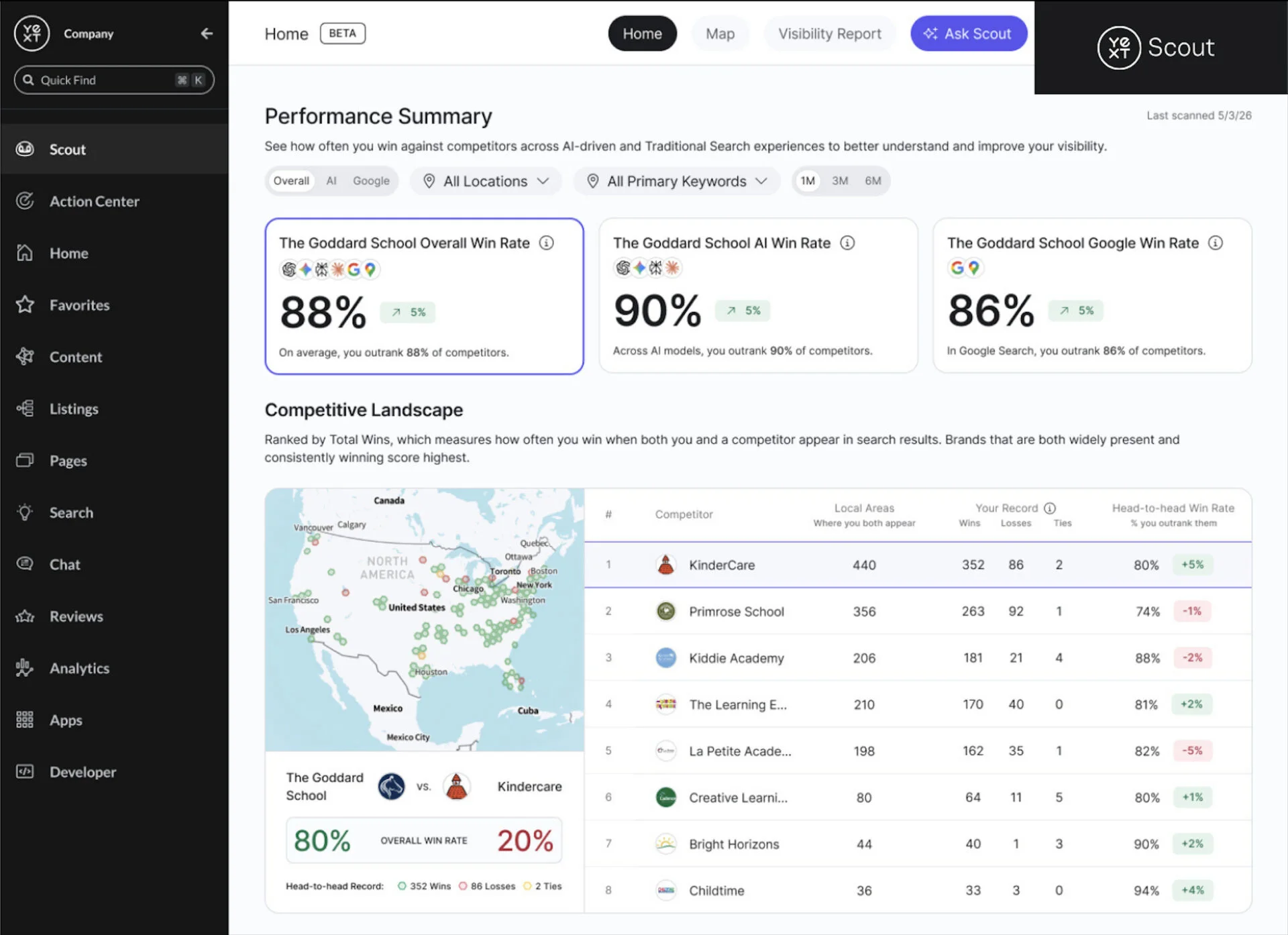
Yext is what BrightLocal’s citation network looks like with an enterprise budget behind it. Its 200-plus publisher connections are direct integrations rather than aggregator relationships, which means an address correction propagates in seconds instead of waiting on a data feed.
Key Features
- Listings Management: Connect to 200+ direct publishers without an aggregator middleman.
- NAP Management: Keep business information consistent and push listing updates across the network.
- Review Generation: Route review requests to relevant platforms via email, SMS, or QR code.
- AI Review Responses: Create responses using AI-powered templates, rules, and optional automation.
- Knowledge Graph: Manage structured business content across listings, landing pages, site search, and answer engines.
Pricing, Tier by Tier
Self-serve pricing is per location and billed annually only. There is no monthly option.
| Tier | Annual per location | What You Get |
| Emerging | $199 | Listings on 40-plus sites |
| Essential | $449 | Google, Yahoo, Facebook, Bing, Apple, Yelp, MapQuest, Citysearch, Local.com, Foursquare |
| Complete | $499 | Full Essential and Emerging networks, PowerListings+ and analytics |
| Premium | $999 | Everything above, plus review monitoring and website widgets |
Enterprise contracts beyond this ladder are quoted individually. We found third-party estimates of typical enterprise spend and could not verify any of them, so they are not repeated here.
Review Management Costs $999 Per Location, Per Year
This is the number that matters for anyone shopping competitors to BrightLocal on reputation grounds. Review monitoring does not appear until Premium, the top self-serve tier, at $999 per location annually.
Ten locations on Premium is $9,990 a year. The same ten locations on BrightLocal Grow is $1,572 a year billed monthly. Yext is buying you a directory network five times larger and sub-second propagation, and if reviews are your actual problem, you are paying an enormous premium for listings infrastructure you did not come for.
Support Is the Consistent Complaint
Across Capterra, support quality is the theme that recurs most, and it recurs in five-star reviews as well as one-star ones. That is worth weighting properly. People who like Yext still flag it.
Who Should Actually Use This
The stronger fit is an enterprise with hundreds or thousands of locations where listing accuracy across a wide directory network is a revenue issue, and where a solutions engineer and a signed contract are normal procurement.
The weaker fit is almost everyone else. For a single-location business or a small agency, per-location annual billing and the $999 review tier make this the most expensive way to solve a reputation problem on this list.
A Realistic Scenario
A 400-branch retail bank needs hours, addresses and attributes correct everywhere a customer might look, including Apple Maps, Bing and dozens of vertical directories, and needs corrections live the same day.
That is exactly Yext’s job, and nothing else here does it as thoroughly. The knowledge graph feeding location pages and site search from the same data is a genuine architectural advantage at that scale.
Pros
- The widest verified publisher network on this list, at 200-plus direct connections
- Updates propagate in seconds rather than through aggregator batch cycles
- Manages over 12 million locations, which is operational proof at a scale nothing else here matches
Liz J.
The Yext platform is transparent about what’s it’s doing for every user. I can see what platforms my data is reaching and where the gaps are that i need to fix.
Cons
- Review management requires the $999-per-location Premium tier
- Annual billing only, with no monthly option on any self-serve tier
- Support quality is criticized consistently, including by satisfied customers
Jarret V.
Poor support, refusal to end contracts, billing my credit card after contracts have ended
Company Snapshot: Yext integrates with Salesforce, Adobe Experience Cloud, HubSpot, Zendesk, Domo and Smartling through its app directory, which is the integration depth enterprise procurement usually requires.
What Sets It Apart: Direct publisher connections instead of aggregators, and a knowledge graph that makes listings, pages and search consistent by construction rather than by syncing. If you want a narrower comparison, our Yext alternatives breakdown and Yext pricing analysis are worth reading.
Quote only, priced by industry
Rating
4.8 on G2 based on 58 reviews and 4.9 on Capterra across 8 reviews
Apps
Web platform plus a unified messaging inbox spanning SMS, web chat, email and social channels
Review Platforms Supported
Google, Yelp and Facebook, plus healthcare-specific review sites. No published count.
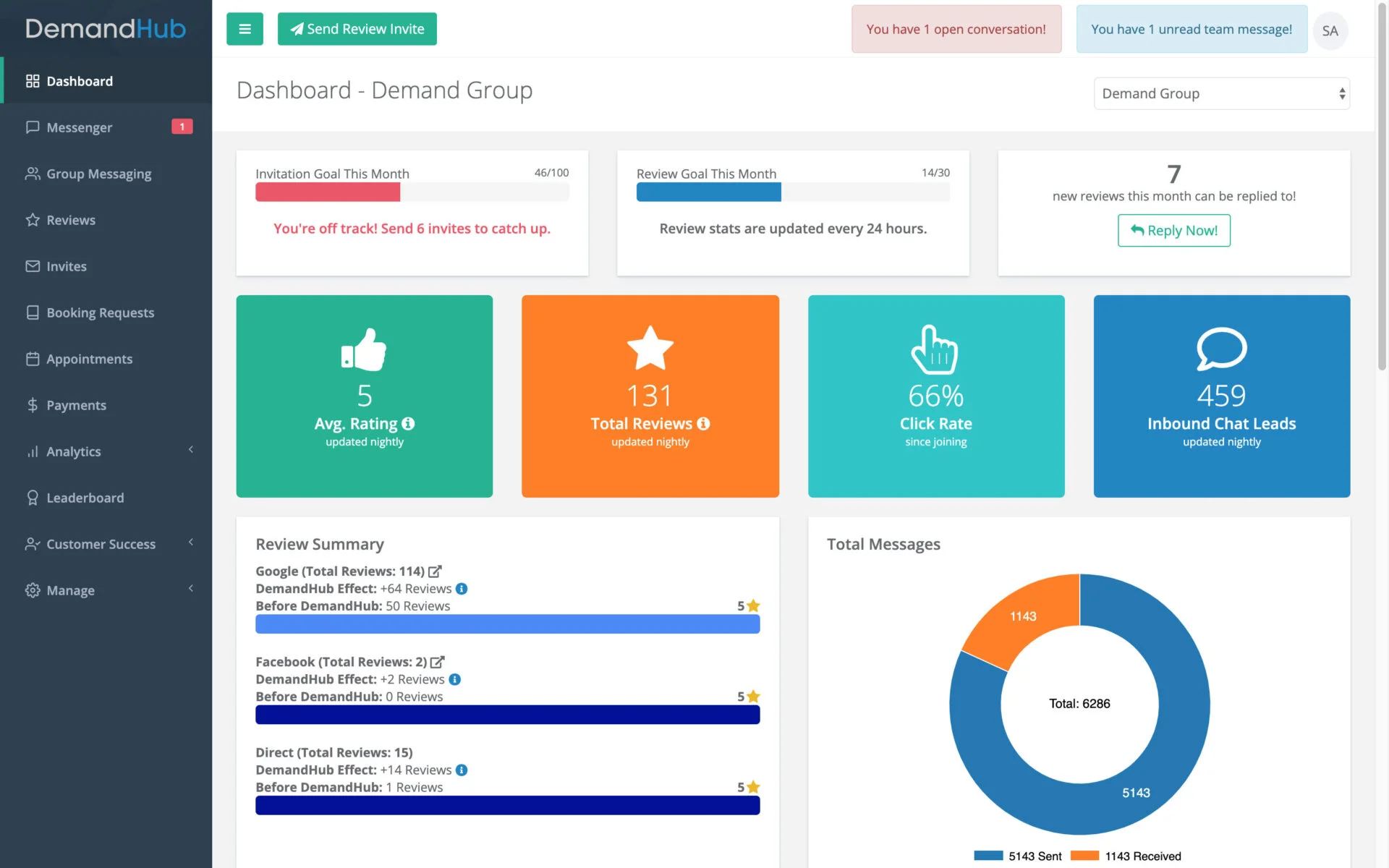
If you run a medical, dental or therapy practice, the compliance question comes before the feature question. DemandHub answers it directly on its own FAQ: it is HIPAA-compliant, with end-to-end encryption, and it backs that with a formal Business Associate Agreement.
Key Features
- Secure Messaging: HIPAA-compliant messaging with end-to-end encryption and a published BAA.
- Automated Review Requests: Trigger SMS review requests from practice management systems after appointments.
- AI Review Coordinator: Automate review collection and responses.
- Unified Messaging Inbox: Manage Google, Facebook, Instagram, web chat, email, and SMS in one place.
- AI Missed Call Handler: Automatically text back missed callers to keep leads engaged.
Pricing, and Why There Is No Table
DemandHub’s pricing page exists but shows no plan names and no figures. It asks you to select your industry, from chiropractic, physiotherapy, dental, optometry, automotive or other, and routes you to a demo.
Pricing by vertical rather than by seat or location is genuinely unusual in this category, and it means a dental quote and an automotive quote are different products, not different discounts on the same one.
It Does Not Do Listings At All
State this plainly before anyone switches: DemandHub has no listings sync, no citation distribution, no NAP management and no local rank tracking. There is no listings product on its site.
It is a customer communication and review platform, not a local SEO platform, which makes it a poor one-to-one BrightLocal swap and an excellent complement to one. If you are leaving BrightLocal because citations do not matter to your practice and reviews do, that distinction is the whole point.
The Integrations Are the Real Moat
The compliance badge gets attention, but 29 named integrations into practice management and EHR systems are what actually make it stick. Dentrix, Open Dental, eClinicalWorks, WebPT, Practice Fusion, Cliniko, Simple Practice and Therapy Notes are all supported natively, alongside automotive dealer systems including CDK, Reynolds and Reynolds, and Vin Solutions.
A review request that fires automatically from the appointment record is a different workflow from one you remember to send.
Who Should Actually Use This
The stronger fit is a healthcare practice, therapy clinic or dental group where patient data touches the review workflow and a BAA is a procurement requirement. Automotive dealerships are the clear secondary market.
The weaker fit is retail, hospitality, restaurants or any general multi-location brand. The integration list barely serves you, and there are no enterprise multi-location rollups, no location hierarchies and no white label.
A Realistic Scenario
A four-location physiotherapy group wants review requests going out by text after each appointment, pulled straight from WebPT, without PHI ever leaving a compliant channel.
BrightLocal can send review requests by SMS on the Grow plan, but it has no PMS integration and makes no HIPAA compliance claim. DemandHub does both. That is a narrow advantage, and for this buyer it is the only one that matters.
Pros
- An explicit HIPAA compliance claim backed by a published Business Associate Agreement
- 29 native practice management and EHR integrations, so requests fire from the appointment record
- The missed-call auto-text recovers leads most review tools never see
Wendy Y
We love that the chatbot converts to text message so our clients do not need to stay on our website in order to chat or book an appointment with us.
Cons
- No listings, citations, NAP sync or rank tracking whatsoever
- Only 8 Capterra reviews, so a 4.9 rating carries limited weight
- No white label and no multi-location rollup reporting
Jesse R.
Really the only thing I notice about DemandHub compared to the other products is the aesthetic which I’m not really all that concerned about when picking a product. The goal is get reviews and it works really well for that.
Company Snapshot: DemandHub publishes its BAA as a legal document forming part of its terms of use for covered entities, rather than as a marketing compliance page, which is the version a compliance officer will actually accept.
What Sets It Apart: HIPAA compliance and deep EHR integration in one product, aimed at a buyer the rest of this list treats as a generic small business.
$75 a month on the Reviews plan
Rating
4.8 on G2 across 419 reviews and 4.9 on Capterra across 203 reviews
Apps
Web platform with roughly 25 direct integrations and over 1,000 more through Zapier
Review Platforms Supported
Multi-platform monitoring, with Google as the primary target for review generation
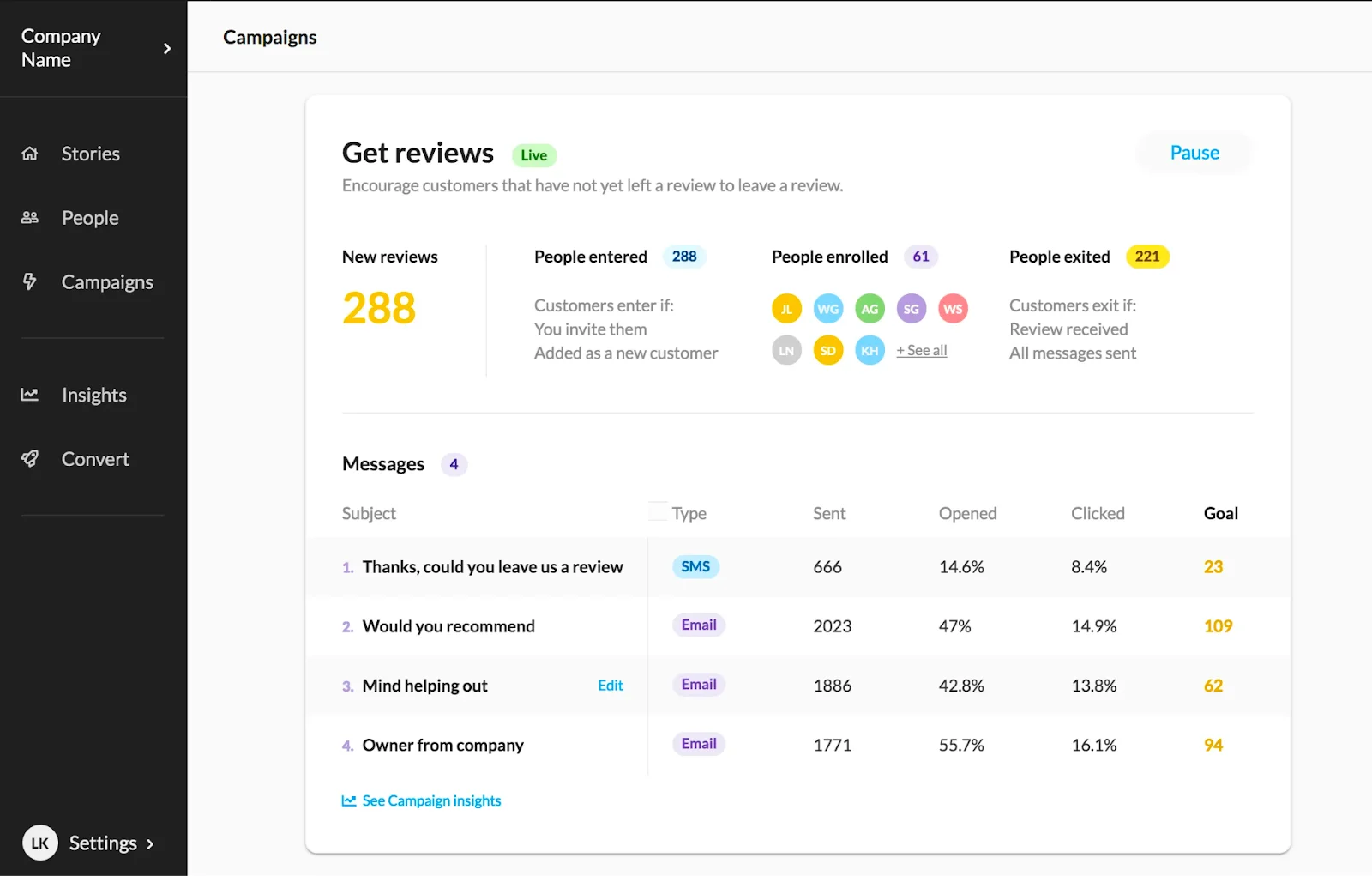
BrightLocal’s review request feature is the part its own users call outdated. NiceJob is a company built entirely around that one feature, and the difference shows in the results customers report.
Key Features
- Automated Review Requests: Send email and SMS requests triggered by job completion.
- Review Monitoring: Monitor reviews across multiple platforms with AI-generated response drafts.
- Social Proof Widgets: Automatically display new reviews on your website.
- Staff Leaderboards: Track which team members generate the most reviews.
- Referral & NPS Campaigns: Automate referrals, customer gifting, NPS surveys, and booking reminders.
Pricing, Tier by Tier
| Tier | Monthly | What You Get |
| Reviews | $75/mo | Automated review requests, monitoring, AI replies, social proof widgets, staff leaderboards, microsite |
| Pro | $125/mo | Everything above, plus booking reminders, referral automation, customer gifting, NPS surveys, competitor SEO insights |
| Sites add-on | $99/mo plus $199 setup | Custom website design, content writing, SEO, call tracking |
It Does Not Gate Reviews, and That Matters
Review gating means filtering unhappy customers out of the request flow before they can post publicly. It also breaches Google’s user-generated content policy, and plenty of tools do it quietly anyway.
NiceJob does not. The campaign goes to whoever the trigger enrolls, and your only lever is excluding someone beforehand. That is a compliance advantage as much as an ethical one, and it is worth asking any vendor on this list the same question directly.
The Multi-Location Math Works Against You
NiceJob requires a separate license per Google Business Profile. Three locations means three licenses, so $75 a month becomes $225.
Against BrightLocal Grow at $87 a month for 2 to 5 locations, NiceJob is roughly two and a half times the price at three locations, and the gap widens with every site you add. This is a single-location and small-operator tool, and its pricing says so even when its marketing does not.
Who Should Actually Use This
The stronger fit is a home services business, contractor or single-location operator whose review count is the entire problem and whose field service software can fire the trigger. Jobber, Housecall Pro, FieldPulse, Workiz and CompanyCam all integrate natively.
The weaker fit is any multi-location brand or agency, given per-profile licensing, and anyone needing listings or citations, which NiceJob does not offer at all.
A Realistic Scenario
A single-location HVAC company has 40 Google reviews and a competitor down the road with 300. Every completed job in Housecall Pro should trigger a review request without anyone remembering to send it.
That is precisely what NiceJob is for, and customers report the results plainly. On BrightLocal, review requests exist on the Grow plan but there is no native Housecall Pro trigger, so someone has to run the campaign manually.
Pros
- The strongest documented results for review generation of any tool on this list
- Native integrations with the field service software home services businesses already run
- No review gating, which keeps you inside Google’s policy
Angela N.
By integrating NiceJob with my customer software we’re now able to eliminate manually asking customers for reviews, and can easily get 5-10 new positive reviews per week – with our eyes closed.
Cons
- Separate license per Google Business Profile makes multi-location cost multiply
- No listings management, citation distribution or NAP sync
- Campaign scheduling is rigid, with fixed intervals you cannot edit
Radha S.
Reporting and analytics are also fairly basic, which may not be ideal for businesses looking for deeper insights into review performance or customer behavior.
Company Snapshot: 203 Capterra reviews at 4.9 is the deepest positive review base on this list, which for a category where thin samples are common is worth weighting heavily.
What Sets It Apart: One job, done better than anyone else here does it, with the integration triggers to make it genuinely automatic.
Quote only, priced per location with unlimited users
Rating
4.5 on G2 across 120 reviews and 4.5 on Capterra across 74 reviews
Apps
Web platform, plus ChatExec, a managed review response service
Review Platforms Supported
Google, Apple Maps, Bing and Yelp through direct API partnerships
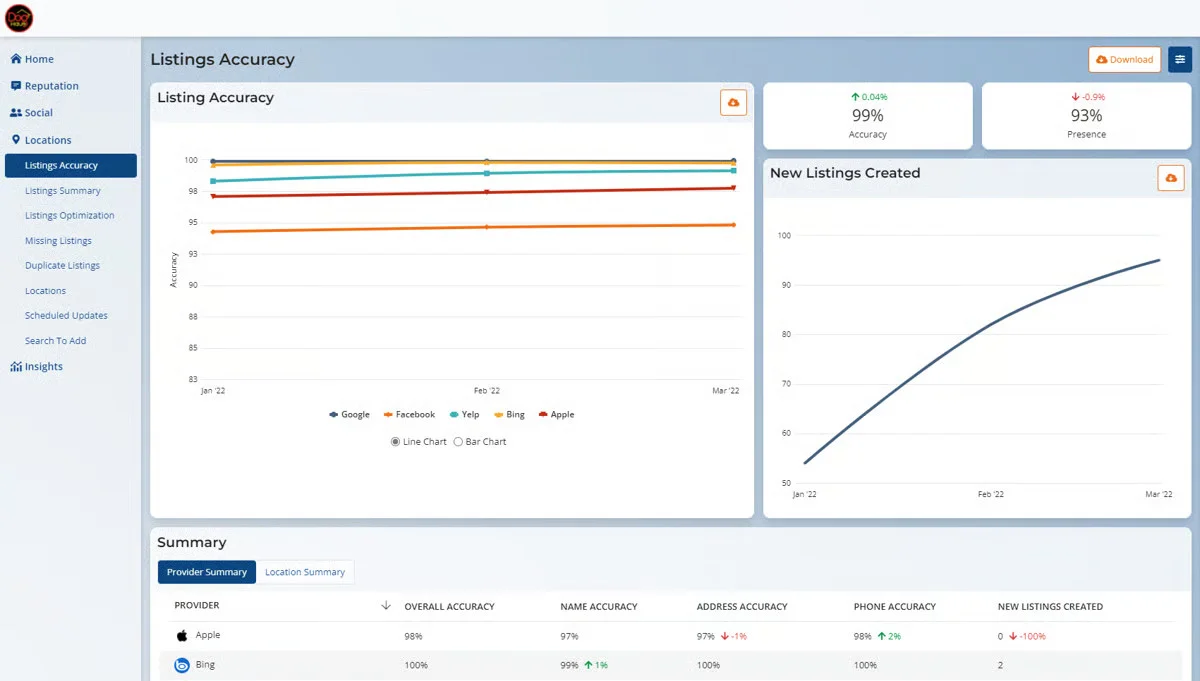
First, the thing you need to know before evaluating it: Alchemer acquired Chatmeter in September 2025. The brand still operates and existing accounts still run on chatmeter.com, but G2 has already renamed the product listing to Alchemer Reputation Management, and its Capterra page has moved. Factor that transition into any multi-year contract conversation.
Key Features
- Pulse AI: Analyze review sentiment and topics with NLP-powered insights.
- Pulse AI Signals: Query reviews, social posts, and survey data using natural-language questions.
- Local Brand Visibility Score: Compare location-level visibility using a single proprietary score.
- Listings Management: Distribute and update listings across 140+ directories.
- Bulk Listing Management: Edit hundreds or thousands of listings in a single operation.
Pricing, Tier by Tier
Chatmeter publishes no pricing. Its pricing page states the model directly: “We price by location, with unlimited users,” and “we don’t use one-size-fits-all pricing.” Features are modular, so a quote depends on which you select.
Unlimited users on a per-location price is genuinely useful for a large brand where dozens of local managers need access. It is also the reason there is no self-serve entry point.
Signals Is the Feature Worth the Sales Call
Most reputation dashboards answer questions you already knew to ask. Signals lets you type a question you did not have a report for, and analyzes reviews, social posts and surveys to answer it.
At 400 locations, that is the difference between a monthly report cycle and asking “which regions are complaining about staffing this week” and getting an answer before the meeting. BrightLocal has nothing comparable, and neither does anything else on this list.
What We Could Not Verify
Chatmeter publishes no count of supported languages anywhere, and its own reputation page does not mention multi-language capability at all, so we are not positioning it as a multi-language tool despite the translation feature.
Who Should Actually Use This
The stronger fit is a brand above roughly 100 locations that needs reputation intelligence rather than reputation reporting, and that has the procurement patience for a modular enterprise quote.
The weaker fit is single-location businesses, SMBs, and anyone who needs social media management as a primary function. That last one is a documented weak spot, with reviewers reporting the social suite underdelivering across multiple quarters.
A Realistic Scenario
A 250-location retail chain wants to know whether a new checkout process is generating complaints, and wants the answer this week rather than in next month’s report.
Pulse AI tags the theme as it emerges and Signals answers the question directly. On BrightLocal, you would be reading through review exports and building the analysis yourself, which is the labor Chatmeter is selling you out of.
Pros
- Natural-language querying across reviews, social and survey data in one engine
- Unlimited users on per-location pricing suits brands with many local managers
- 140-plus directory distribution, second only to Yext on this list
Verified User in Investment Management
Chatmeter has been a game-changer for us. The platform makes it easy to monitor reviews, track customer sentiment, and improve local SEO—all from one dashboard.
Cons
- No public pricing and no self-serve path
- Product identity is mid-migration following the Alchemer acquisition
- Bulk location verification is a documented gap, with reviewers verifying locations one at a time
Rachel M.
I find there are to be too many options regarding how to analyze the data. I would find it helpful to have more prebuilt reports that we could then tailor to the stats that we are looking for.
Company Snapshot: Alchemer acquired Chatmeter in September 2025, with the stated intent of unifying survey and review feedback into one intelligence layer. That direction is promising and the integration is still in progress.
What Sets It Apart: Signals, which turns a reputation database into something you can interrogate in plain language rather than query through a report builder.
$39 a month on the Lite plan
Rating
Local Dominator has too few reviews find meaningful insights. It’s G2 profile has zero reviews and Capterra has one. The platform is rated 3.8 on Trustpilot across 10 reviews, which is the most representative figure available.
Apps
Web platform, with integrations into Google Data Studio, HighLevel and Make
Review Platforms Supported
Local pack and organic rankings, plus share of voice inside ChatGPT, Gemini and Google AI Overviews
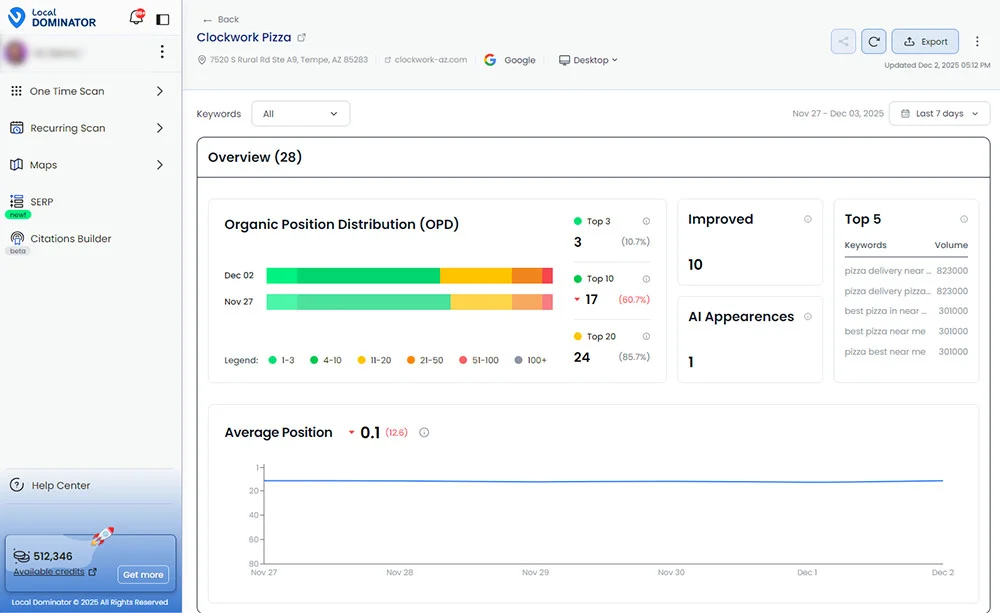
Here is the shift this tool is built for. BrightLocal’s 2026 Local Consumer Review Survey found that use of ChatGPT and similar tools for local recommendations jumped to 45%, up from 6% the year before. Almost nothing in this category tracks whether you appear in those answers. Local Dominator does.
Key Features
- AI Tracker monitoring share of voice inside AI models including ChatGPT, Gemini and Google AI Overviews
- AI hallucination detection, flagging where an AI model states incorrect hours or services for your business
- High-fidelity geo-grid rank tracking showing ranking decay block by block
- Local SERP Tracker combining organic and map pack positions in one view
- Citations Builder for NAP sync and citation auditing, which the vendor states covers over 70 platforms
- Google Business Profile management and audits
- White-label client reporting on every tier, which is unusual at this price
Pricing, Tier by Tier
Credit-based, with unused credits rolling over from Pro upward.
| Tier | Monthly | Credits | GBP connections | SERP campaigns |
| Lite | $39 | 5,000 | 1 | 1 |
| Advanced | $59 | 15,000 | 15 | 3 |
| Pro | $97 | 36,000 | 25 | 7 |
| Powerhouse | $197 | 81,000 | 80 | 18 |
| Enterprise | $399 | 178,000 | 200 | 40 |
It Does Not Manage Reviews
The most important sentence in this entry. Local Dominator has no review generation, no review request automation and no review response workflow. It measures visibility; it does not manage reputation.
That makes it a partial BrightLocal replacement at best. If you are leaving BrightLocal because its rank tracking costs too much, this covers that job at $39. If you are leaving because its review tooling is weak, this does not help you at all.
The Review Base Is Almost Nonexistent
G2 lists zero reviews and says there are not enough to provide buying insight. Capterra has one. Software Advice has one. Trustpilot has ten, averaging 3.8.
A 5.0 from a single reviewer is not a rating, it is an anecdote. Treat this as an early-stage product, trial it properly, and do not sign anything long-term on the strength of its scores.
Who Should Actually Use This
The stronger fit is a local SEO agency that wants AI visibility tracking and geo-grids at a price that works per client, and that already has review management handled elsewhere. White-label reporting on every tier and the HighLevel and Make integrations make it genuinely agency-shaped.
The weaker fit is anyone whose primary need is reviews, any single-location business, and any risk-averse buyer who needs peer validation before purchasing.
A Realistic Scenario
An agency managing local SEO for 20 clients wants to show each one where they rank block by block, and whether ChatGPT recommends them when someone asks for a plumber in their city.
On BrightLocal, the geo-grid is capped at five keywords on the Track plan and there is no AI visibility tracking at all. Local Dominator’s Pro plan at $97 covers 25 GBP connections with white-label reports included. The catch is that you are trusting a product with effectively no public review history.
Pros
- AI search visibility tracking that almost nothing else in this category offers
- Hallucination detection catches AI models stating wrong hours before customers act on them
- White-label reporting on every tier, including the $39 entry plan
Brian Higgins.
The insights from LD grid scans have directly helped me generate sales, improve strategy, and better communicate visibility gaps to clients.
Cons
- No review generation, response or management workflow of any kind
- Effectively no public review base to sanity-check the product against
- Credit consumption is unpredictable, which makes budgeting harder than a flat rate
Benjamin Singer
Trial lacks basic usability. The settings button didn’t work, the map grid is impossible to configure on mobile, and you burn through credits before you can even run a meaningful scan.
Company Snapshot: Verify you are looking at localdominator.co. Several similarly named affiliate and satellite sites appear in search results, and “Local Dominator” is also a generic phrase used by unrelated marketing courses.
What Sets It Apart: It answers a question the rest of this category has not caught up with yet, which is whether AI assistants recommend you and whether they describe you accurately.
The eight platforms above cover the strongest alternatives for the use cases we evaluated. But they aren’t the only options worth considering. A few other tools solve a narrower slice of the problem, and are the right answer for a specific buyer.
More BrightLocal Alternatives Worth a Look
Whitespark, Uberall, and Semrush Local each bring something different to the table and may be a better fit depending on your local SEO needs. Here’s what each of these platforms offers:
Whitespark
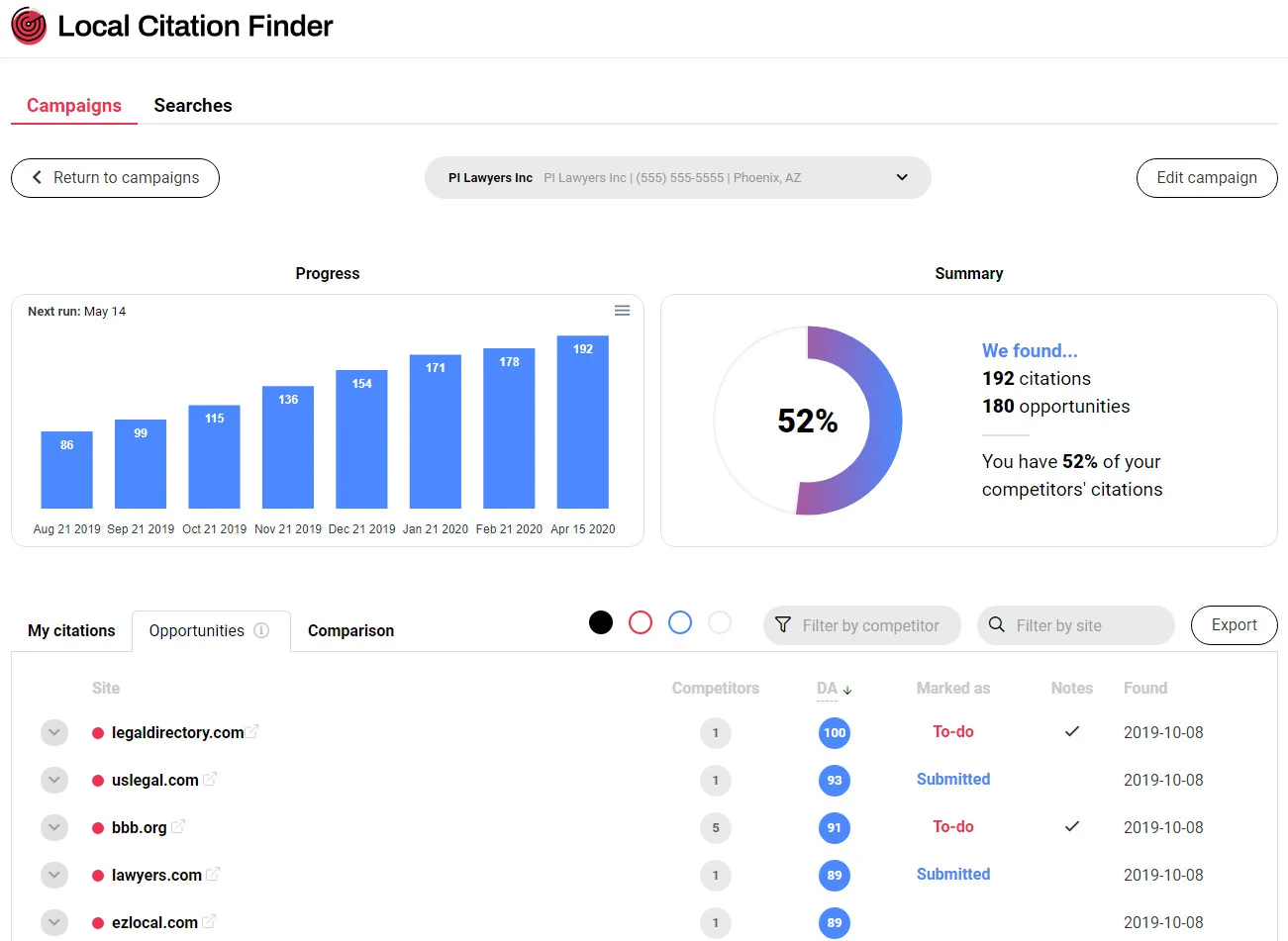
Whitespark takes a specialist, à-la-carte approach to local SEO rather than selling everything as one platform. Its product lineup covers citation research, rank tracking, ranking grids, Google Business Profile management, and review management.
Key pricing:
- Local Citation Finder: From $33/month
- Local Rank Tracker: From $14/month
- Local Ranking Grids: From $10/month
- Local Platform: $1/location/month
- Reputation Builder: $79/location/month
Whitespark also takes a different approach to citation building. Its done-for-you citation service uses manual submissions and costs $20 to $999 as a one-time fee. It also offers a Yext Replacement Service at $399 per location.
One limitation is that Whitespark’s products do not sit within a unified dashboard. Its public review footprint is also small, with no Capterra listing and three Trustpilot reviews.
Worth considering if you: want specialized local SEO tools, particularly for citation building, rank tracking, and ranking grids.
Uberall
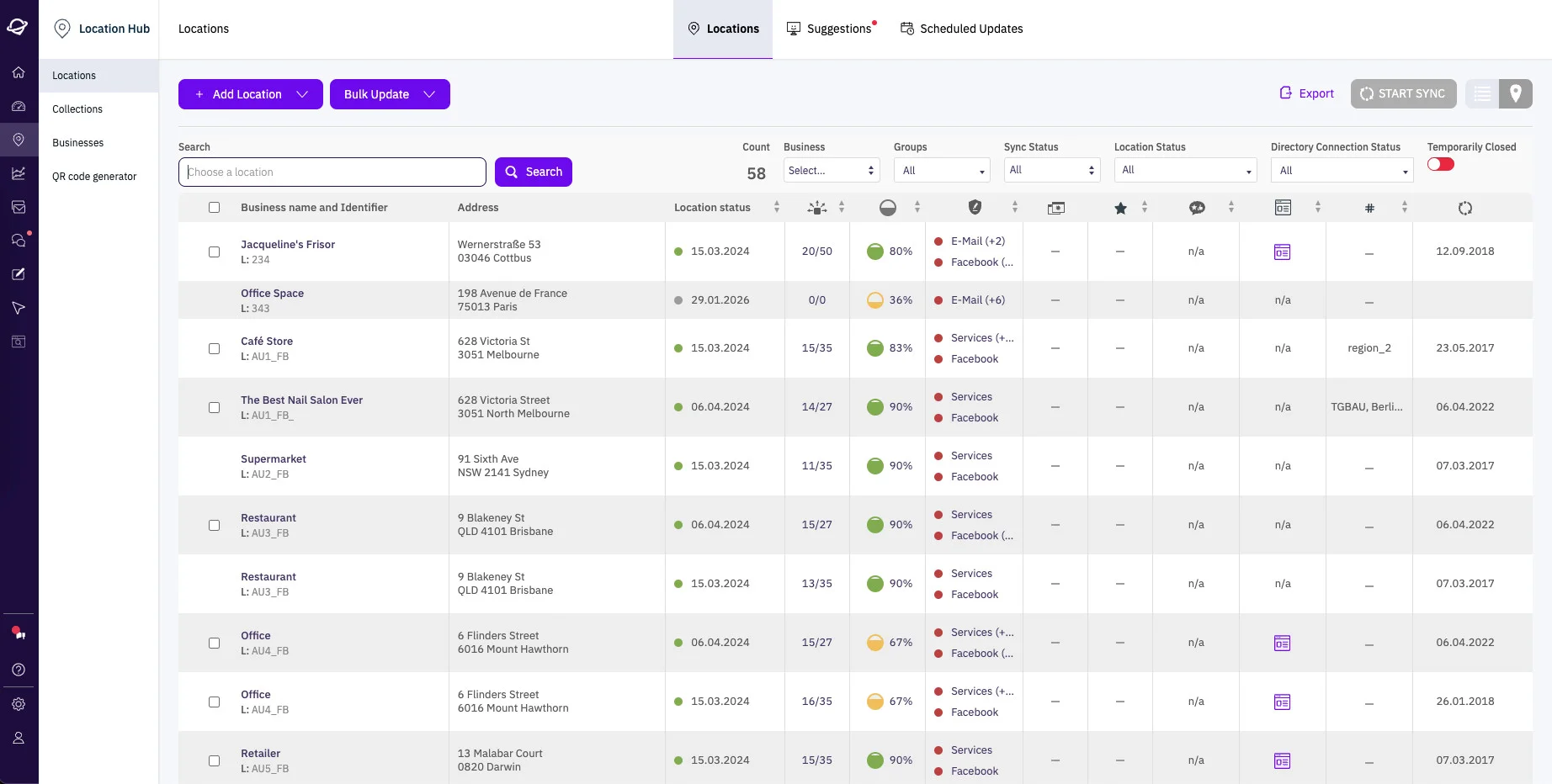
Uberall is designed for brands with a European or global footprint. Headquartered in Berlin and operating across 24 countries, it distributes listings to more than 150 directories globally and counts brands such as KFC, Burger King, Adidas, and Shell among its customers.
Its standout capabilities include:
- Profile Protection: Protects listings from unauthorized third-party edits
- Duplicate suppression: Helps manage duplicate listings
- Real-time NAP synchronization: Keeps business information consistent across listings
- Global directory distribution: Supports listings across more than 150 directories
There are two important considerations. Uberall does not publish pricing for its Show Up, Stand Out, and Connect packages; all three are quote-based. Review management also starts with the Stand Out package, while deeper review functionality is available as an add-on.
Worth considering if you: manage a brand with a European or global footprint and need broad listings distribution and protection.
Semrush Local
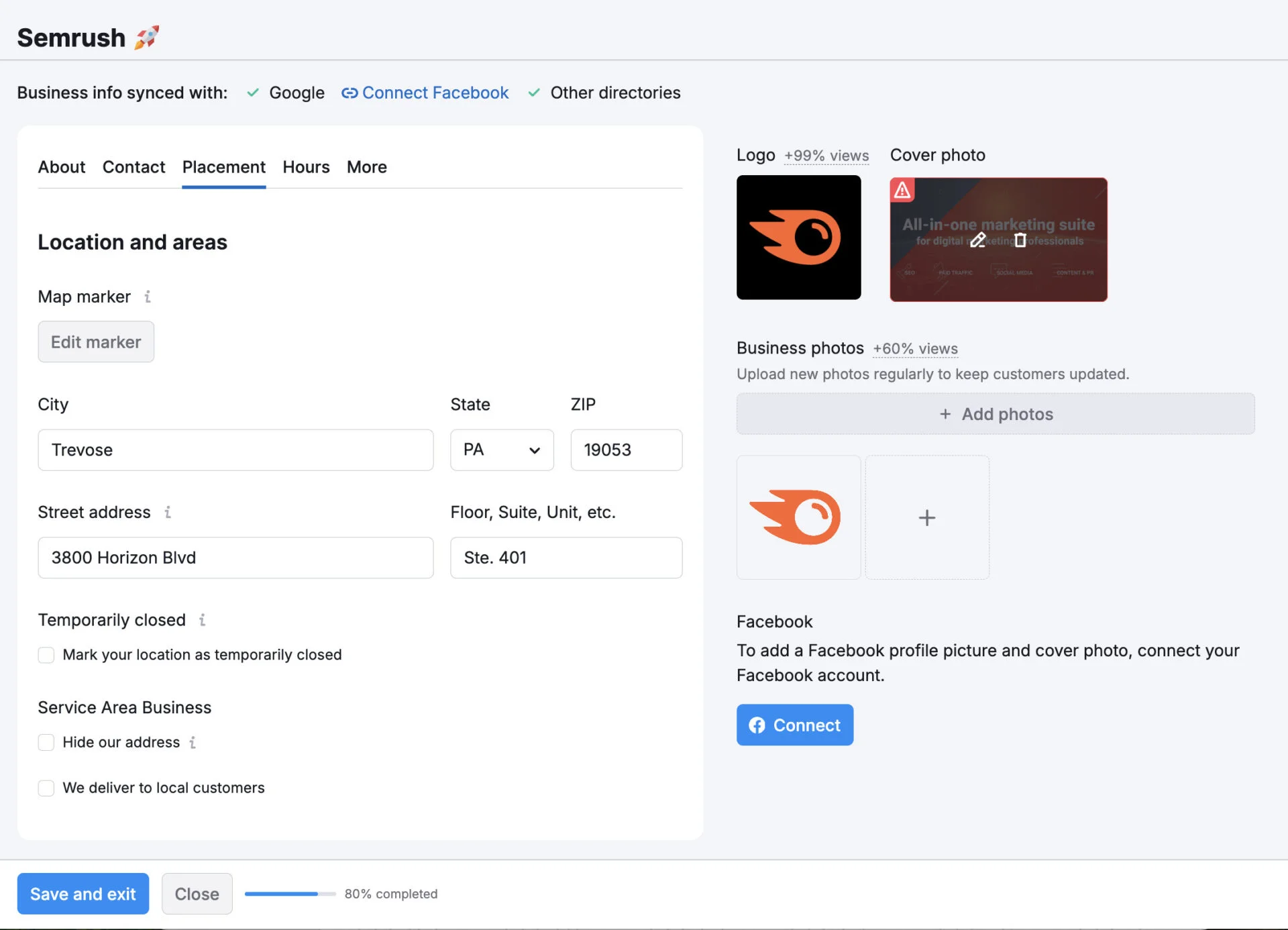
Semrush Local can be purchased independently, so a Semrush subscription is not required. It uses a per-location pricing model:
- Local Base: $30/location/month
- Local Pro: $60/location/month
- 20+ locations: Custom pricing
Listing management, centralized review monitoring, negative review alerts, and review generation campaigns are included in Local Pro. Its listing distribution runs through the Yext Knowledge Network, reaching more than 70 directories in the U.S. and more than 40 elsewhere.
Semrush Local makes the most sense for teams already using Semrush and looking to manage local data alongside tools such as Position Tracking and Site Audit.
Worth considering if you: already use Semrush and want local SEO data in the same workspace as your other Semrush tools.
These platforms expand the shortlist, but more options don’t necessarily make the decision easier.
The right choice comes down to what you need most from a BrightLocal alternative and which trade-offs you’re willing to make. So, which platform is the best fit for you? Let’s break it down by use case.
Which BrightLocal Alternative Should You Choose?
There’s no single BrightLocal alternative that works best for everyone.
The right choice depends on what you need the platform to do, how many locations or clients you manage, and which features matter most to your team.
If you’re primarily focused on reviews, listings, local SEO, or customer engagement, different platforms will make more sense. Here’s how to narrow down the options and choose the one that fits your needs best.
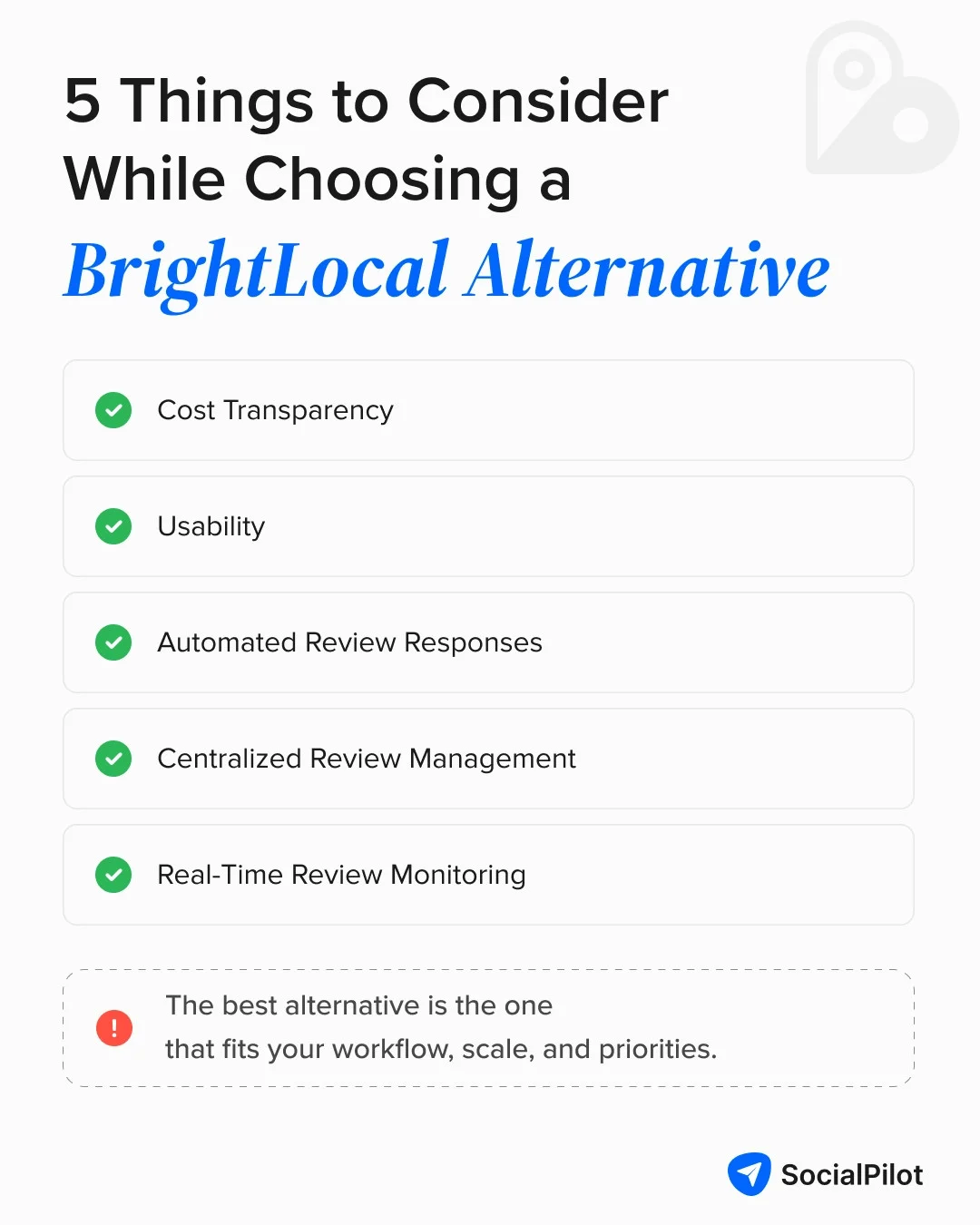
Cost Transparency
If predictable costs matter, start with the pricing model, not just the starting price. SocialPilot Reviews, Local Dominator, Synup, NiceJob, and Semrush Local publish pricing, while Social Places, DemandHub, Chatmeter, and Uberall require a sales conversation.
Also check how pricing scales: per location, per profile, or credits can make a big difference as you grow.
Usability
If your team values a simpler day-to-day workflow, usability should carry more weight than feature count.
NiceJob and Social Places both score 4.9/5 for ease of use on Capterra, while BrightLocal has received criticism for a dense interface and dated review-request tooling.
Be careful reading enterprise tools on this axis. Yext and Chatmeter are feature-dense by design and expect onboarding, so a lower ease-of-use score reflects scope rather than sloppiness.
Automated Review Responses
If you want to automate responses without losing control, look at the level of automation each platform offers. SocialPilot Reviews, for example, lets you trigger responses by star rating and choose between immediate, delayed, or approval-based publishing.
Chatmeter takes a different approach with its done-for-you ChatExec service.
Centralized Review Management
If you manage multiple locations, make sure the platform can centralize reviews without creating more work for your team.
SocialPilot Reviews and Synup are better suited to smaller multi-location operations, while Chatmeter and Social Places offer stronger coordination features for larger networks.
Real-Time Review Monitoring
If responding quickly is a priority, look beyond the number of review sites a platform monitors.
Synup states a sync delay of under five minutes, while BrightLocal, Chatmeter, and Yext also offer review alerts. So, compare not just coverage, but how quickly the right person is notified.
Making the Switch from BrightLocal
BrightLocal remains a strong option if you need a broad local SEO toolkit, particularly for rank tracking, citation management, and reporting. But it isn’t the right fit for every business or agency.
The better choice depends on what you need most. Some platforms are better suited to local SEO and rank tracking, while others focus more on listings, reviews, customer engagement, or multi-location management. Pricing, scalability, and ease of use also become important as your requirements grow.
The goal isn’t to find the platform with the most features. It’s to find the one that fits your workflow, priorities, and budget without adding unnecessary complexity.
For teams primarily focused on reviews and listings, SocialPilot Reviews is one alternative worth considering. In SocialPilot Reviews’ pricing tiers, the Pro plan starts at $30/month, giving teams a straightforward starting point if they don’t need the broader local SEO toolkit that BrightLocal provides.
For everyone else, the comparisons shared in this blog can help narrow down the platforms that best match your needs. Then you can take a closer look and trials for each product before making the final switch.
Frequently Asked Questions
What is BrightLocal used for?
BrightLocal is a local SEO platform built around three jobs: tracking local search visibility through rank tracking and geo-grid reports, managing listings and citation accuracy, and monitoring reviews. Agencies use it most heavily for white-label client reporting and citation audits across multiple local clients.
What is BrightLocal Academy?
BrightLocal Academy is BrightLocal’s free local SEO training platform. Every course is free, certifications are included, and courses are grouped into beginner, advanced, agency and multi-location tracks. It is one of the strongest free education resources in local SEO, and you do not need a paid BrightLocal plan to use it.
What are the drawbacks of BrightLocal?
Cost scales steeply by location, review management requires the top Grow plan, and citation building is billed separately at $3.20 per site. Users also report slow dashboards, inconsistent citation data, and a dated review request interface. It offers no social media publishing beyond Google Business Profile posts.
Why are review management tools important?
Review management tools help businesses monitor reviews, respond promptly, and generate more customer feedback from one place. They reduce the manual work involved in checking multiple platforms and make it easier to maintain a consistent review response process, especially across multiple locations.
Are BrightLocal alternatives suitable for small businesses?
Several are built for exactly that. The free Starter plan on SocialPilot Reviews covers one location, NiceJob starts at $75 a month for a single site, and Local Dominator starts at $39. Enterprise tools like Yext, Chatmeter and Uberall are priced and built for hundreds of locations and will cost far more than a small business needs to spend.
What brands are similar to BrightLocal?
Semrush Local and Whitespark are close alternatives for local SEO, citation management, and rank tracking. Yext and Uberall focus more on enterprise listings, while Synup and Chatmeter offer strong reputation analytics. For review management, SocialPilot Reviews, NiceJob, and DemandHub take a more specialized approach.
About the Author
