The best Klaviyo alternatives for ecommerce are Omnisend for the best overall value, Drip for direct-to-consumer (DTC) value retention, Mailchimp for small businesses, Brevo for best-in-one suite, and ActiveCampaign for deep automation.
Five more round out the list for niche use cases: MailerLite, Campaign Monitor, HubSpot, Privy, and GetResponse.
This guide covers all 10, spanning their use cases, features, pricing, and pros and cons. Plus, a decision tree to help you choose the right one for your needs.
Best Klaviyo alternatives and a decision tree
Here’s how Klaviyo’s top alternatives compare based on business needs, free plan availability, starting price, and migration difficulty:
| Tool | Best for | Free plan? | Starting price | Migration difficulty |
|---|---|---|---|---|
| Klaviyo | Data-rich ecommerce stores with complex customer journeys | Yes | $20/month (500 contacts) | N/A |
| Omnisend | Multichannel ecommerce brands of all sizes looking for enterprise features without the learning curve | Yes | $16/month (500 contacts) | Very low (1/5) |
| Drip | Subscription businesses that want simpler visual workflows | No | $39/month (2,500 contacts) | Moderate (3/5) |
| Mailchimp | Small businesses and stores with basic customer journeys | Yes | $13/month (500 contacts) | Low (2/5) |
| Brevo | Budget-conscious marketers who prefer send-based pricing over contact-based | Yes | $9/month (500 contacts) | Low (2/5) |
| ActiveCampaign | Deep ecommerce automation with advanced CRM functionality | No | $19/month (1,000 contacts) | Low (2/5) |
| MailerLite | Beginners, creators, and micro-brands needing large send limits | Yes | $12/month (500 contacts) | Moderate (3/5) |
| Campaign Monitor | On-brand campaigns and basic automations, with strong agency and team features | No | $13/month (500 contacts) | Moderate (3/5) |
| HubSpot | Businesses already in the HubSpot sales and marketing ecosystem | Yes | $20/month per seat (1,000 contacts) | Moderate to high (4/5) |
| Privy | Small Shopify stores focused on lead capture and list-building | No | $30/month (1,500 contacts) | Moderate (3/5) |
| GetResponse | Webinars, lead nurturing, and content monetization | Yes (limited) | $19/month (1,000 contacts) | Low (2/5) |
Unsure about which Klaviyo alternative fits your store? Use the decision tree below to narrow down your best match in under 60 seconds:
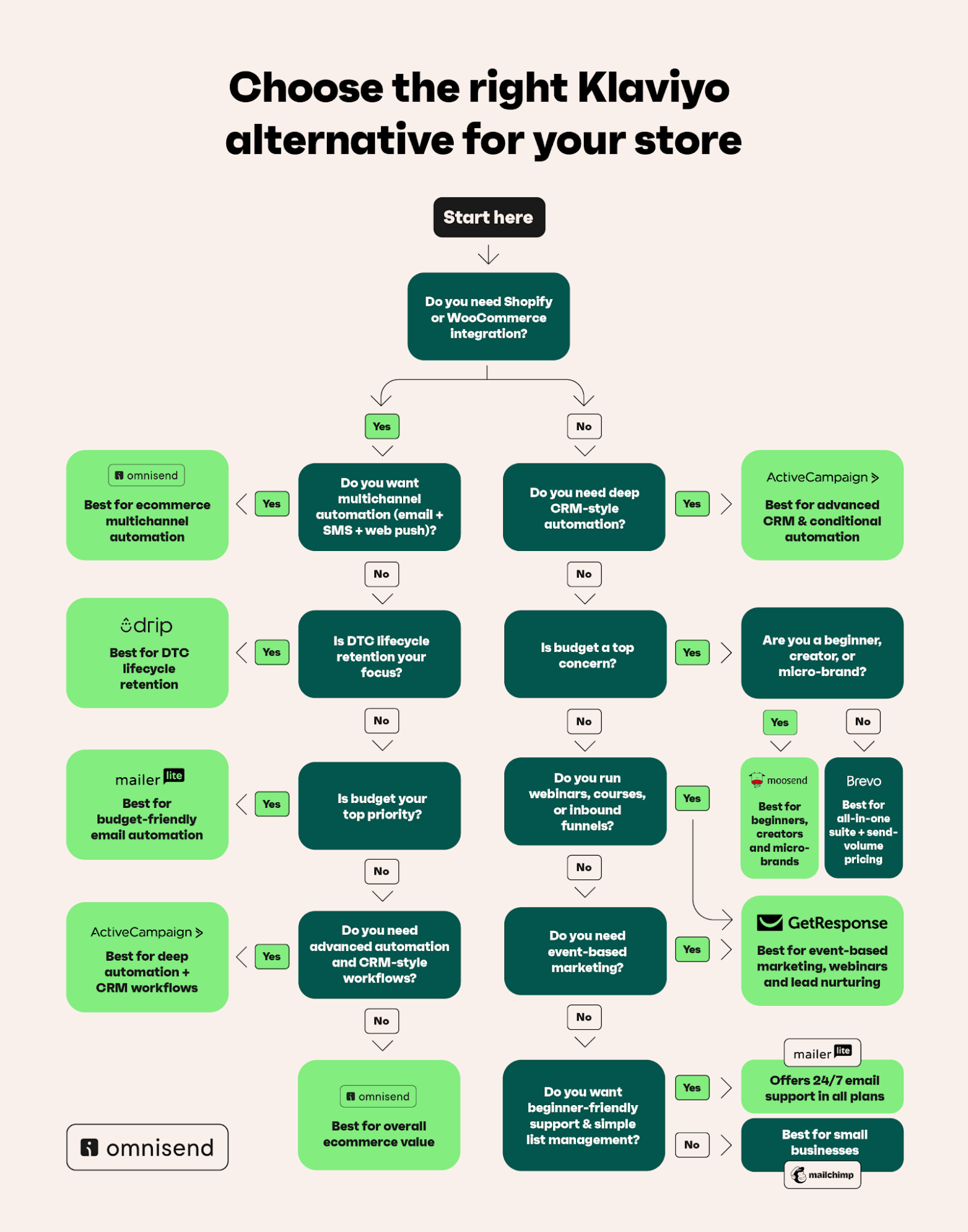
You’ll find a detailed analysis for all these Klaviyo alternatives below.
Omnisend offers a free plan with access to all core email marketing features, no credit card required
Quick sign up | No credit card required
Top 10 Klaviyo alternatives reviewed
We conducted hands-on platform testing of 10 Klaviyo alternatives. The result is a thorough analysis of their pricing, ecommerce features, automations, support quality, ease of use, and the use cases where they make most sense.
These jump links will take you to any tools that interest you. Otherwise, you can continue down our article to discover them all:
1. Omnisend
G2 rating: 4.6/5 (based on 1,230+ reviews) as of July 2026
Omnisend is a top Klaviyo alternative for ecommerce brands that want advanced retention marketing without any setup burden or pricing pressure.
It’s suited to all stores switching from Klaviyo (or comparing tools before they commit), offering email, SMS, and web push notifications for multichannel marketing.
Best for: Stores focused on email marketing ROI, especially those on Shopify, WooCommerce, and BigCommerce thanks to its native sync. Customers achieved a 79:1 ROI across all channels in 2025.
Omnisend’s key features
- Automation workflows: Pre-built and custom multichannel automations for email, SMS, and web push notifications. Covers welcome messages, cart abandonment, browse abandonment, post-purchase follow-ups, and more.
- Content creation and personalization: Universal layouts and dynamic content blocks speed up your production time. Personalized product recommendations match products to each customer based on their browsing and purchase behavior.
- Data integration capabilities: There are 250+ native apps for ecommerce and CRM platforms, pulling over product data, customer events, and more.
- List segmentation: Use 33 pre-built segments to group your audience, or create segments from scratch using the intuitive builder.
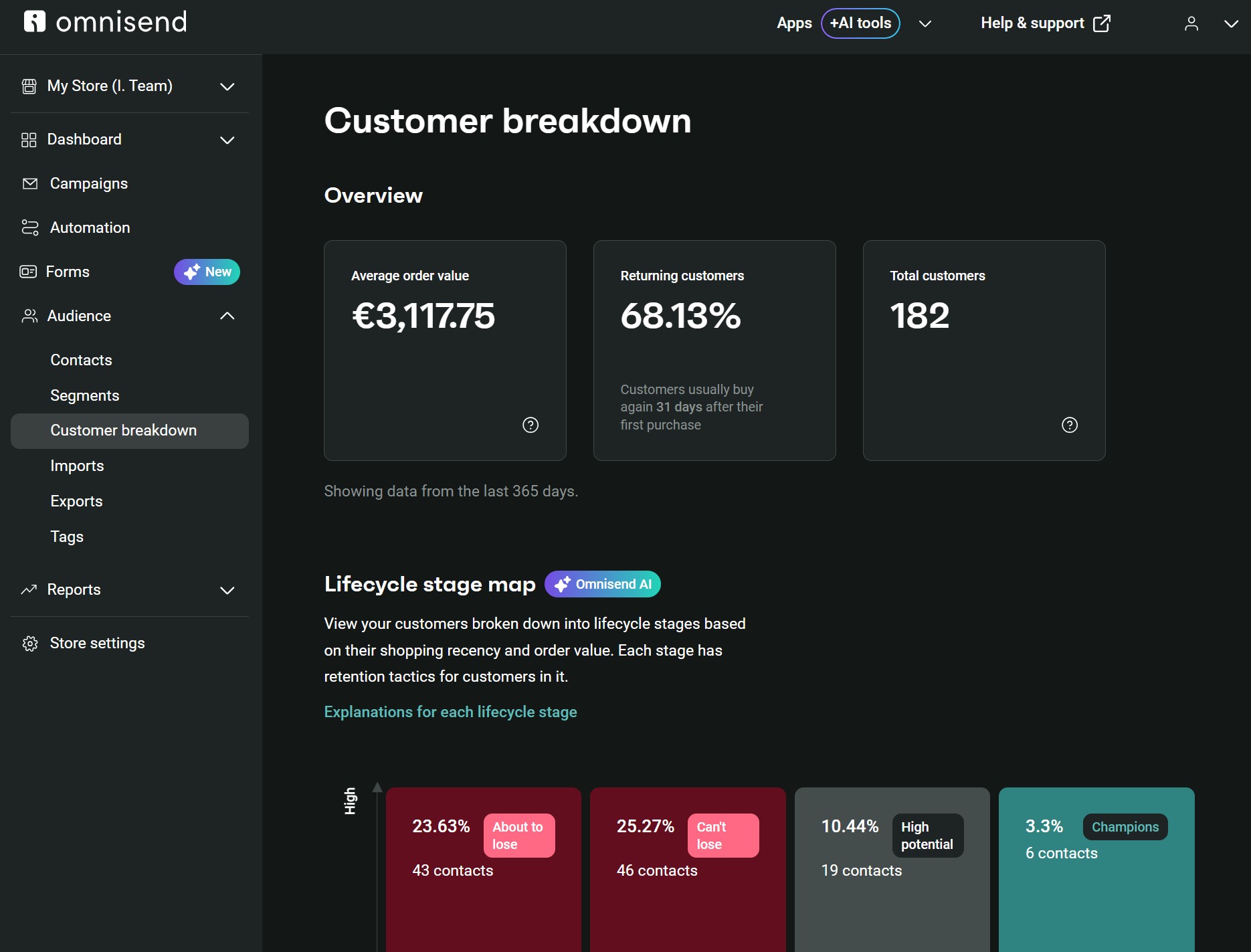
- Powerful AI capabilities: Omnisend’s AI can build forms, create segments, write content, and apply brand assets to templates. It also maps the customer lifecycle and predicts churn using RFM analysis:
Omnisend’s pricing
- Free Forever: Store 250 contacts and send 500 emails/month, plus 500 web push notifications
- Standard: $16/month for 500 contacts, lets you send 6,000 emails and unlimited web push notifications
- Pro: $59/month for 2,500 contacts, unlimited emails, and SMS capabilities
- Custom: This one’s a plan-by-quote for your enterprise store; you’ll get an account expert and free migration
The table below compares Omnisend with Klaviyo’s pricing per 1,000, 10,000, and 25,000 contacts:
| Platform/contacts | 1,000 | 10,000 | 25,000 |
|---|---|---|---|
| Klaviyo | $30 | $150 | $400 |
| Omnisend (Standard plan) | $20 | $132 | $282 |
Omnisend’s pros
- Multi-store support with one-click store switching makes it a top option if you have multiple domains
- Global SMS capabilities, letting you reach customers across the U.S., Canada, UK, EU, Asia, and more
- Easier setup and day-to-day use than many advanced alternatives (per user review trends)
- 24/7 support on paid plans (a key differentiator in Klaviyo comparisons)
Omnisend’s limitations
- No built-in CRM (you may still need a separate CRM stack)
- No annual plan discounts
- Fewer integrations than Klaviyo
Watch the video below for a complete comparison between Omnisend and Klaviyo:
 |
Vagari Bags success story
Vagari Bags is a UK fashion brand that switched from Klaviyo to Omnisend. It now sees 40-50% email open rates, 6-7% SMS click rates, and a £121.38 return for every £1 spent across both channels combined, outstripping its results with Klaviyo. Could you realize the same? Read the success story > |
How does Omnisend compare to Klaviyo?
Omnisend is the closest like-for-like Klaviyo alternative for ecommerce stores, combining email, SMS, and web push in a single platform at up to 35% less than Klaviyo (see also the Omnisend vs. Klaviyo comparison). It also has a gentler learning curve but lacks Klaviyo’s custom report builder and deeper analytics.
2. Drip
G2 rating: 4.4/5 (based on 1,110+ reviews) as of July 2026
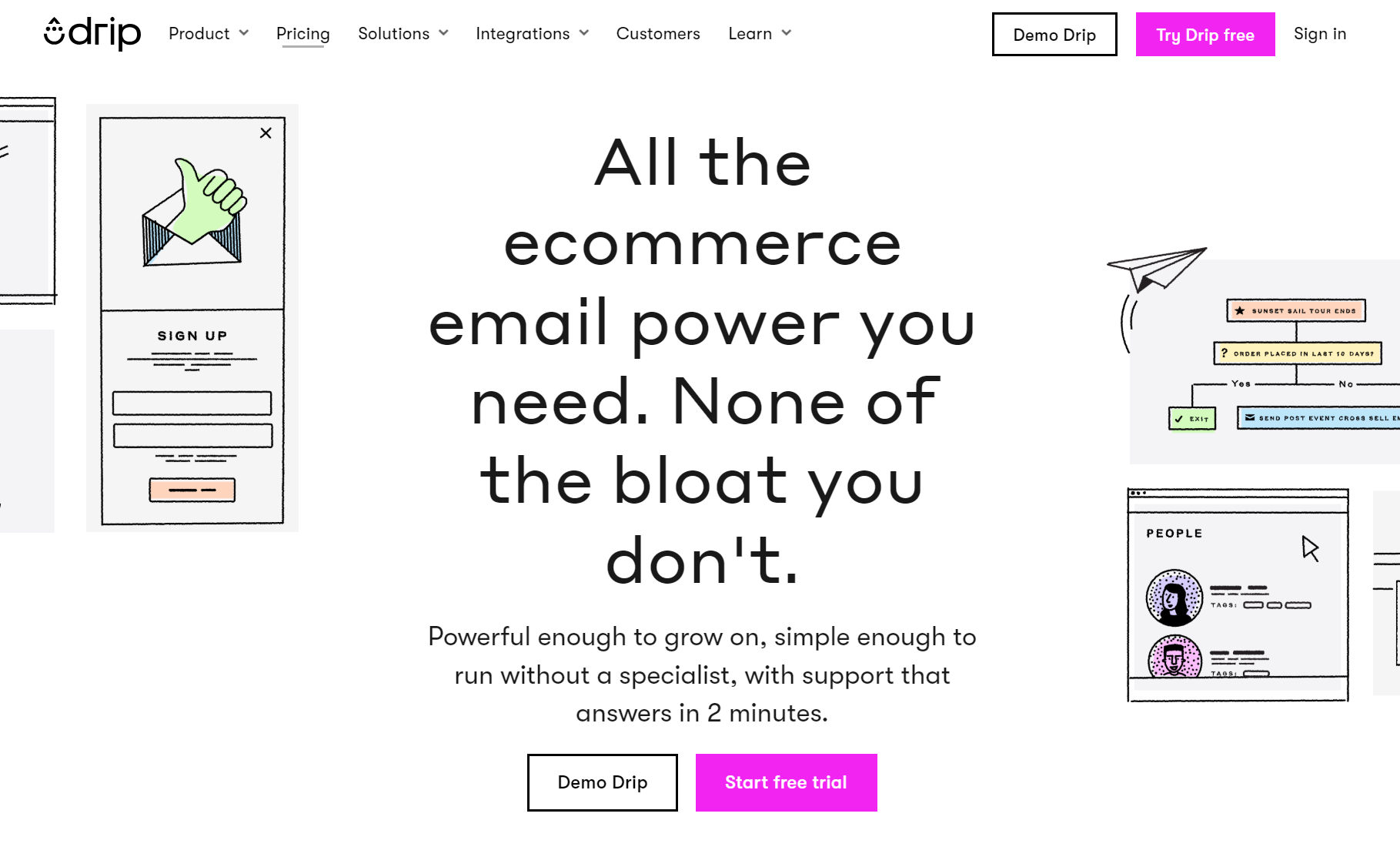
Drip is one of the closest Klaviyo competitors for subscription services and wellness DTCs expanding online.
The whole point of using Drip is to grow your list, email contacts, and refine their customer experience with flows that adapt to their behavior. It’s similar to Klaviyo in that respect, but offers less of a learning curve and quicker setup.
Best for: Growing DTC and subscription model brands that want to keep as much automation across list-building and communication within one tool.
Drip’s key features
- Template library: 50+ pre-built and customizable email designs
- A/B testing: Compare four email content variations or subject lines in one go
- Dynamic content blocks: Including product blocks, available for all email types
- Real-time segmentation: Segments update automatically as customers meet the criteria
- Pre-built flows: For abandoned carts, welcome emails, a win-back series, and more
Drip’s pricing
- No free forever plan, but there is a 14-day free trial
- There’s one plan (and it’s unnamed), starting from $39/month for 2,500 subscribers and unlimited monthly sends
Drip’s pros
- The flows, segments, and customer profiles are decent Klaviyo alternatives, letting you reach customers and refine their experience across most touchpoints
- It’s one of the few email tools that quotes its deliverability rate, which stands at 99.8%
- If you have a list with more than 17,500 contacts, then the Drip team will move you over from Klaviyo or whichever other tool you’re using
Drip’s limitations
- No annual or quarterly plan discounts
- Features suit ecommerce stores, not service businesses
How does Drip compare to Klaviyo?
Drip’s automations and segments can get quite granular and cover most of the scenarios Klaviyo does. Plus, Drip undercuts Klaviyo by $21/month at the 2,500-contact starting point, and its flow depth is more suited to predictable customer journeys. Consider it if you want to automate forms, lists, and marketing in one tool.
3. Mailchimp
G2 rating: 4.4/5 (based on 12,980+ reviews) as of July 2026
Mailchimp’s appeal as a Klaviyo alternative is that it covers a bit of everything, without specializing in anything. You can create email campaigns and flows, and even add SMS to your plan. If it’s only transactional email you need, there’s separate pricing for that, too.
So, why are we recommending Mailchimp? We’re doing so because it’s familiar, easy to learn, and has a lower entry price than Klaviyo. You’ll appreciate it for its popups, subject line helper, contact profiles, and built-in surveys, all of which are available for free.
Best for: Your small store, startup, or service business, but definitely not if you’re a growing store or have complex customer journeys.
Mailchimp’s key features
- Campaigns: Build and send emails on every plan tier
- SMS and MMS: Add texting on paid plans across the U.S., Canada, Australia, and much of Europe
- In-email surveys: Ask questions recipients answer from their inbox
- Contact profiles: Track per-contact activity, with predictive analytics on Standard+ (connected store required)
Mailchimp’s pricing
- Free plan: Yes, for 250 contacts and 500 emails/month
- Essentials: It’s $13/month for 500 contacts
- Standard: $20/month for the same contact limit as the Essentials plan, with that extra $7 providing dynamic content and letting you use 200 steps in automations
- Premium: A much more expensive plan, starting at $350/month with a 10,000 contact baseline, also gives you phone support and migration services
Mailchimp’s pros
- Cheaper than Klaviyo, albeit with feature restrictions
- All plans let you create landing pages and popup forms
- Provides a mobile app for managing your campaigns on the go
Mailchimp’s limitations
- The Free plan has feature limits, with no SMS marketing, email scheduling, A/B testing, or send time optimization
- Even if you pay for the Essentials plan, you don’t get predictive segmentation, send time optimization, or custom reports (basically, only the Standard and Premium plans provide anywhere near the capabilities of Klaviyo)
How does Mailchimp compare to Klaviyo?g
Mailchimp is a stellar Klaviyo alternative for your small business if it primarily runs campaigns and only needs basic flows. It focuses more on campaigns than on automation depth, and offers a much shorter learning curve for general email marketing features.
4. Brevo
G2 rating: 4.5/5 (based on 2,600+ reviews) as of July 2026
Brevo is a Klaviyo alternative worth considering for teams that want a broader marketing suite in one platform, not just ecommerce email automation.
It combines email, SMS, WhatsApp, and transactional messaging with a basic CRM suitable for organizing your business and consumer subscribers.
Best for: Small to mid-sized businesses that want email + CRM + multichannel messaging in one tool (including some ecommerce use cases).
Brevo’s key features
- Multichannel flows: Build across email and SMS for ecommerce with real-time event triggers available in all plans
- WhatsApp campaigns: Available in the Professional plan for 1:1 conversations
- Sales packages: For open deals and meeting scheduling, higher-tier plans include sales automation
- AI capabilities: Product recommendations, generative content, segmentation, and send time optimization
Brevo’s pricing
- Free plan: Yes, for 300 emails/day and 500 contacts
- Starter: The cheapest paid plan, from $9/month
- Standard: Necessary for marketing automation and A/B testing; it’ll set you back at least $18/month
- Professional: A minimum of $499/month
- Enterprise: Custom pricing and only suitable if you have more than one million contacts
Brevo’s pros
- Handles transactional email and SMS across all plans
- The analytics covers heatmaps, geography, and device reporting, which you can use to refine your templates for more clicks
- Easier to budget for some teams because pricing is send-based, not purely contact-based
Brevo’s limitations
- The ecommerce automation triggers and retention workflows are less specialized than Klaviyo for DTC stores
- Back-in-stock alerts and AI product recommendations are only available from the $499/month Professional plan
- Analytics are solid, but often not as ecommerce-deep as Klaviyo-style reporting
How does Brevo compare to Klaviyo?
Brevo provides less automation and segmentation depth, but it’s affordable entry point and send-based pricing work better than Klaviyo if you send infrequently to a large list. Plus, if you also provide services, you can make use of its B2B capabilities. For a deeper comparison, see our Brevo vs. Klaviyo guide.
5. ActiveCampaign
G2 rating: 4.4/5 (based on 14,700+ reviews) as of July 2026
ActiveCampaign gives you comparable visibility over customer lifecycles to Klaviyo, with additional CRM and sales automation options.
Best for: SMBs, ecommerce brands, and marketing agencies looking for one of the most scalable email marketing alternatives to Klaviyo.
How ActiveCampaign compares to Klaviyo
ActiveCampaign’s flows are highly granular and data-rich, similar to Klaviyo’s, and it provides additional B2B features, such as pipeline management and deal records.
ActiveCampaign’s key features
- Business Goals: AI-powered goals that show your progress, outcomes, and recommend next steps for your email marketing
- Advanced CRM add-ons: For deal records, pipelines, account records, and lead scoring, an alternative to Klaviyo’s Data Platform (KDP)
- WhatsApp chatbox: A hub to communicate with customers from WhatsApp campaigns
- AI-suggested segments: To help you manage your audience and adapt quickly to behavioral changes
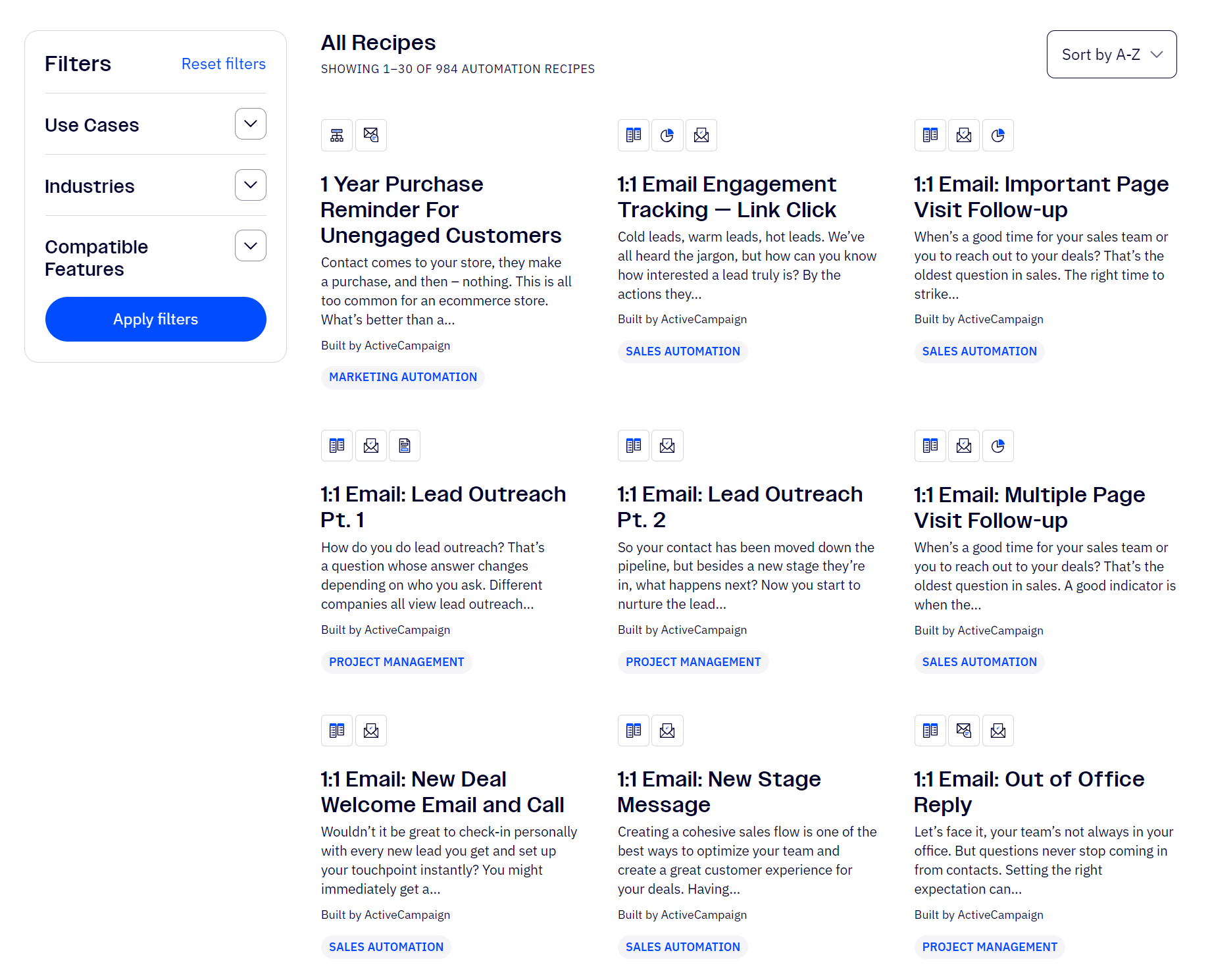
- 950+ automation recipes: More than Klaviyo and all the other alternatives on our list
ActiveCampaign’s pricing
- Starter: $19/month for 1,000 contacts, billed month-to-month
- Plus: $59/month for 1,000 contacts, billed month-to-month
- Pro: $89/month for 1,000 contacts, on an annual commitment paid monthly
- Enterprise: $159/month for 1,000 contacts, on an annual commitment, adds SSO
ActiveCampaign’s pros
- Provides automation depth for lifecycle marketing
- Large integrations ecosystem with 1,000+ apps and counting
- One platform for email + automation + CRM-style workflows
ActiveCampaign’s limitations
- Steeper learning curve than simpler ecommerce tools; smaller teams often need more setup time to use it well
- No free plan, which makes testing less flexible for early-stage brands
- Key functionality can depend on plan tier and add-ons (for example, enhanced CRM options are add-ons)
Verdict: ActiveCampaign’s flow depth is a decent alternative to Klaviyo, although the pricing works out around the same at scale. There’s a bit less of a learning curve and more AI tools. See our full guide on ActiveCampaign vs. Klaviyo.
6. MailerLite
G2 rating: 4.6/5 (based on 1,100+ reviews) as of July 2026
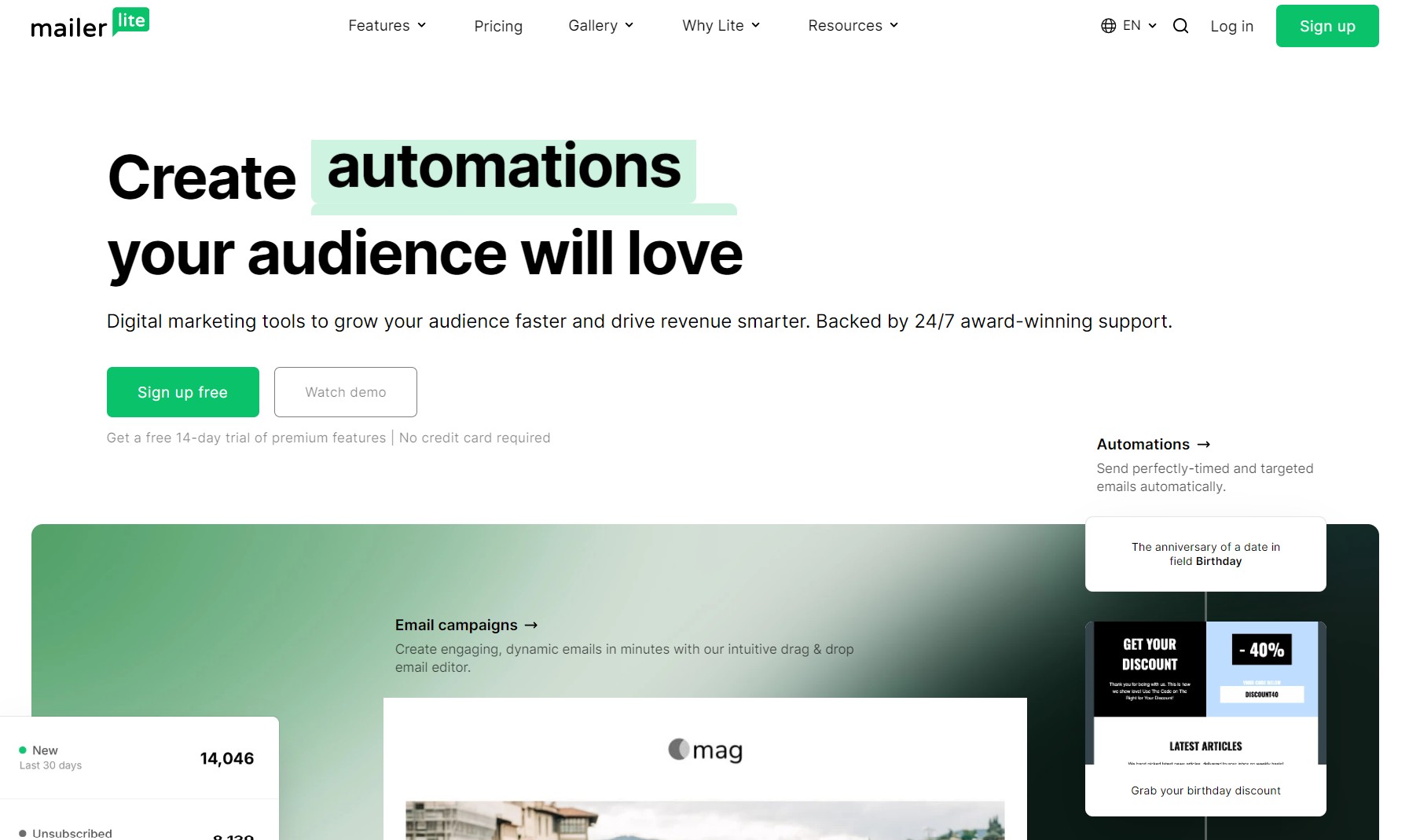
MailerLite has a completely different value proposition to Klaviyo, trading away the data and complexity in your customer journey for simplicity. Its pre-built automations, segments, email templates, and other elements work well for small ecommerce stores, micro businesses, bloggers, and startups.
Best for: Your first foray into email marketing without a steep learning curve, or sending mass texts to your list thanks to its generous send limits.
MailerLite’s key features
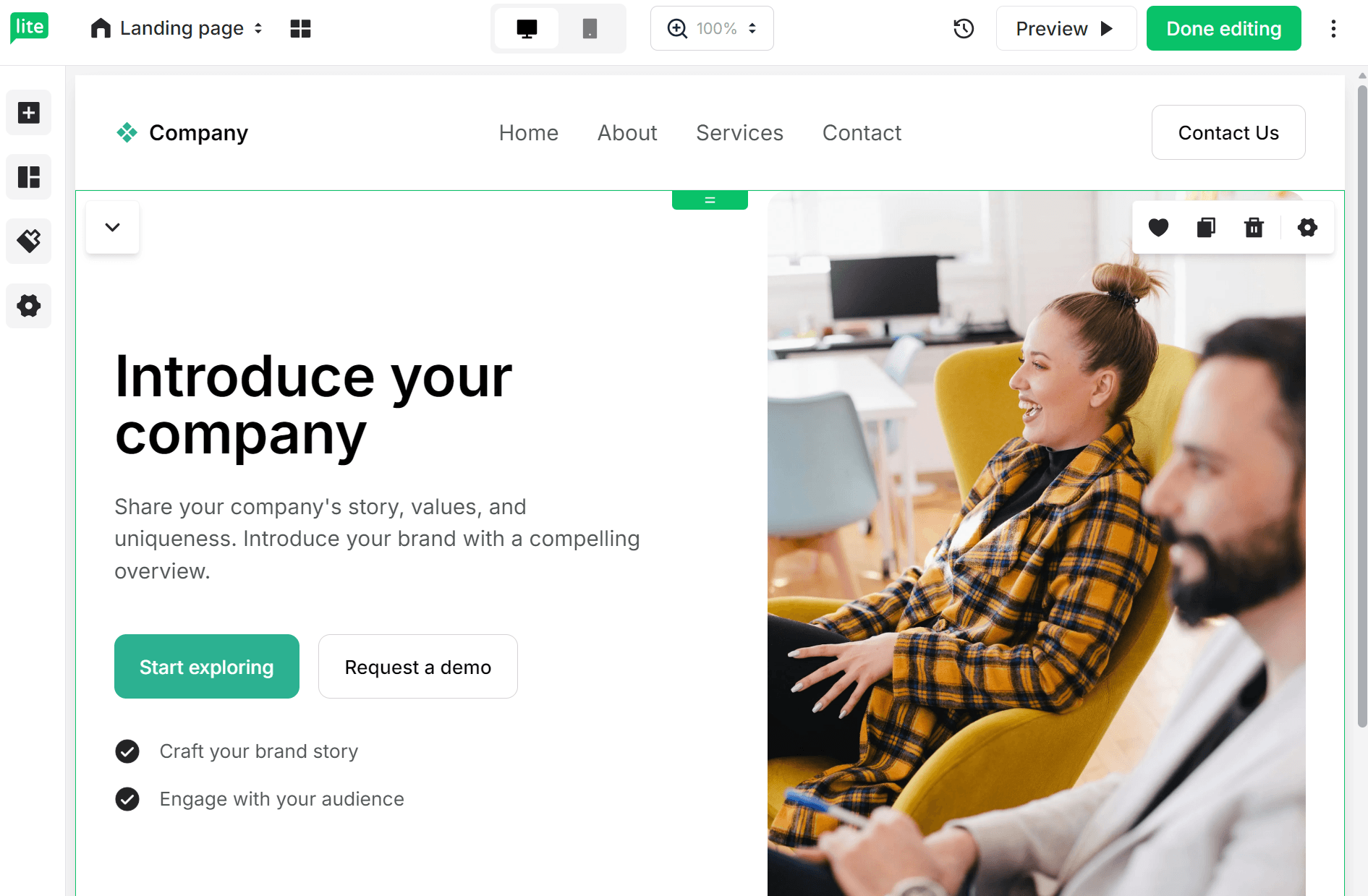
- Store builder: Sell digital and physical products without a separate platform
- Landing pages: Build pages, signup forms, and popups in one place
- Surveys and quizzes: Embed them directly into your emails
- Split testing: Run A/B and multivariate tests on your campaigns
- Free-tier automation: Access flows and templates without committing to a paid plan
MailerLite’s pricing
- Free: Yes (up to 250 subscribers and 2,500 emails/month)
- Comfort: From $12/month (500 subscribers)
- Power: From $25/month (500 subscribers)
MailerLite’s pros
- Intuitive interface and quick setup
- 100+ email templates covering newsletters and ecommerce scenarios
- Analytics go into reasonable depth, spanning list growth, email click maps, sales tracking, and comparative reports
- The free plan has enough features to get your store growing its list and sending emails to customers
MailerLite’s limitations
- No native SMS marketing, which limits multichannel ecommerce retention use cases
- Ecommerce workflows are less advanced than Klaviyo’s (fewer specialized triggers and retention-first automations)
- The reporting lacks Klaviyo’s depth of revenue attribution, and there isn’t a predictive element for your customer lifecycle
How does MailerLite compare to Klaviyo?
MailerLite is a top Klaviyo alternative if you want to send loads of emails to your list and not have to pay for large send limits. Klaviyo’s flows and segments are undoubtedly more capable but come at a higher cost.
For a deeper comparison, see our MailerLite vs. Klaviyo guide.
7. Campaign Monitor
G2 rating: 4.1/5 (based on 730+ reviews) as of July 2026
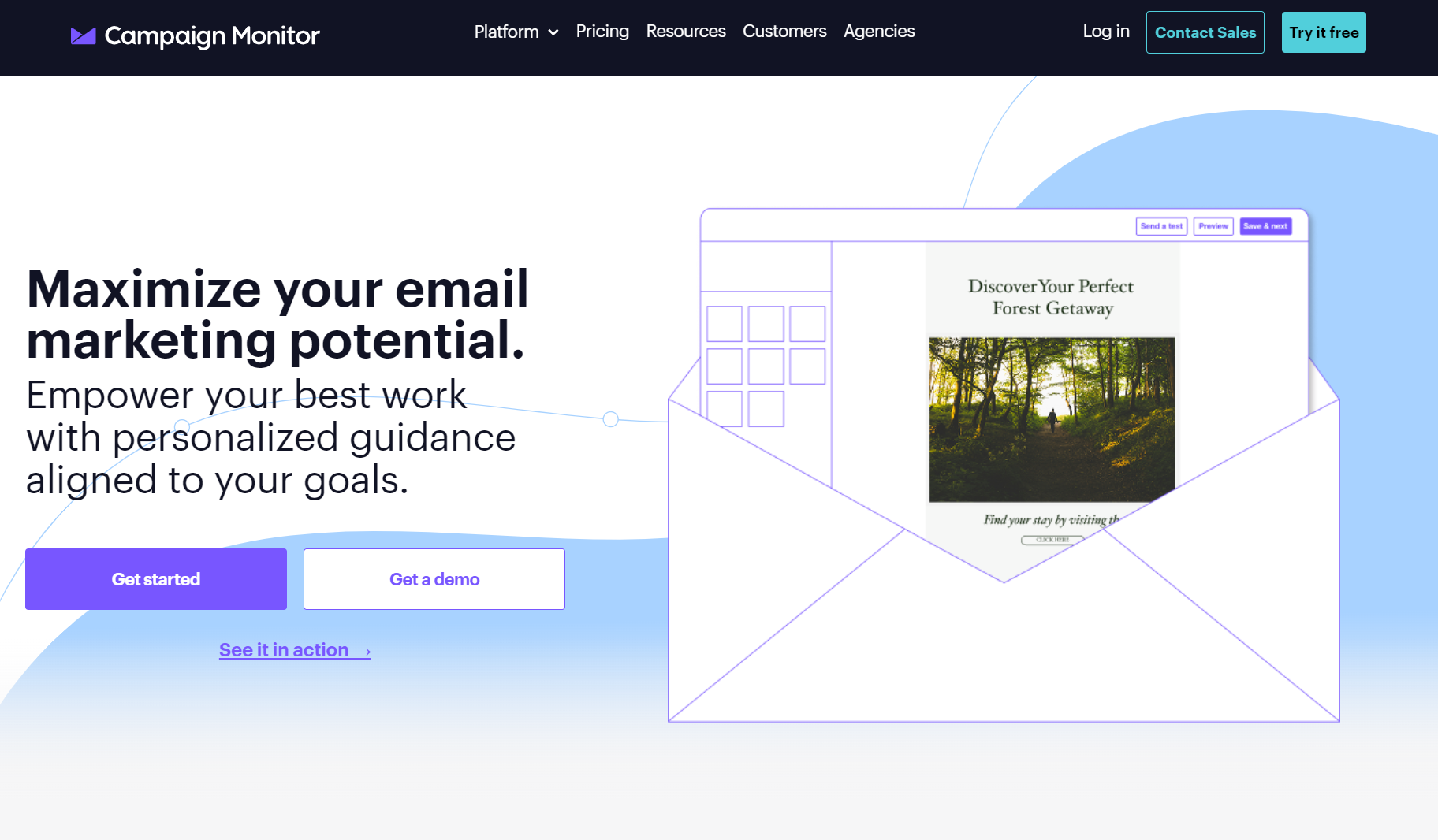
Campaign Monitor approaches email marketing from the opposite side of Klaviyo, prioritizing on-brand campaigns rather than ecommerce data. It still manages core automation with pre-built journeys and provides unlimited email sends in its Essentials plan.
Best for: Marketers wanting campaigns and automations without complexity. Also agencies with private labeling requirements.
Campaign Monitor’s key features
- 100+ pre-built email templates: Spanning newsletters, deals and offers, transactional messages, and more categories
- Marketing Monitor: Benchmark your open, click, and bounce rates against your industry
- Campaign Score: Rate campaigns against industry standards, with fixes to improve them
- Image gallery: Built-in stock library with over two million images
- Testing tools: Built-in A/B testing on subject, sender, and design
Campaign Monitor’s pricing
- Lite: The starting point at $13/month for 500 contacts, limits your email sends to 5x contacts
- Essentials: $31/month, removes that send limit with unlimited sends, and includes all core features
- Premier: $171/month, pitched for enterprise stores needing phone support, send time optimization, and more advanced features
- Enterprise: Custom pricing with an account manager, customer success partner, plus proactive monitoring and optimization
Campaign Monitor’s pros
- Supports transactional email in addition to marketing email
- Intuitive drag-and-drop email builder with multiple blocks and sections
- The AI features, when available in your plan, help you create segments and review email content and designs
- You can add markups to base prices, manage bills, share dashboards, and set tiers for sub-accounts as part of the agency capabilities
Campaign Monitor’s limitations
- No free plan, only a free trial
- AI features restricted to the Essentials plan
- No landing page builder
- The website builder costs an extra $10/month unless you have the Enterprise plan
How does Campaign Monitor compare to Klaviyo?
Campaign Monitor suits you more than Klaviyo when campaigns and newsletters are your primary marketing channel. It lacks advanced workflow logic and behavioral triggers, so is less suited to ecommerce than Klaviyo overall.
8. HubSpot
G2 rating: 4.4/5 (based on 14,860+ reviews) as of July 2026
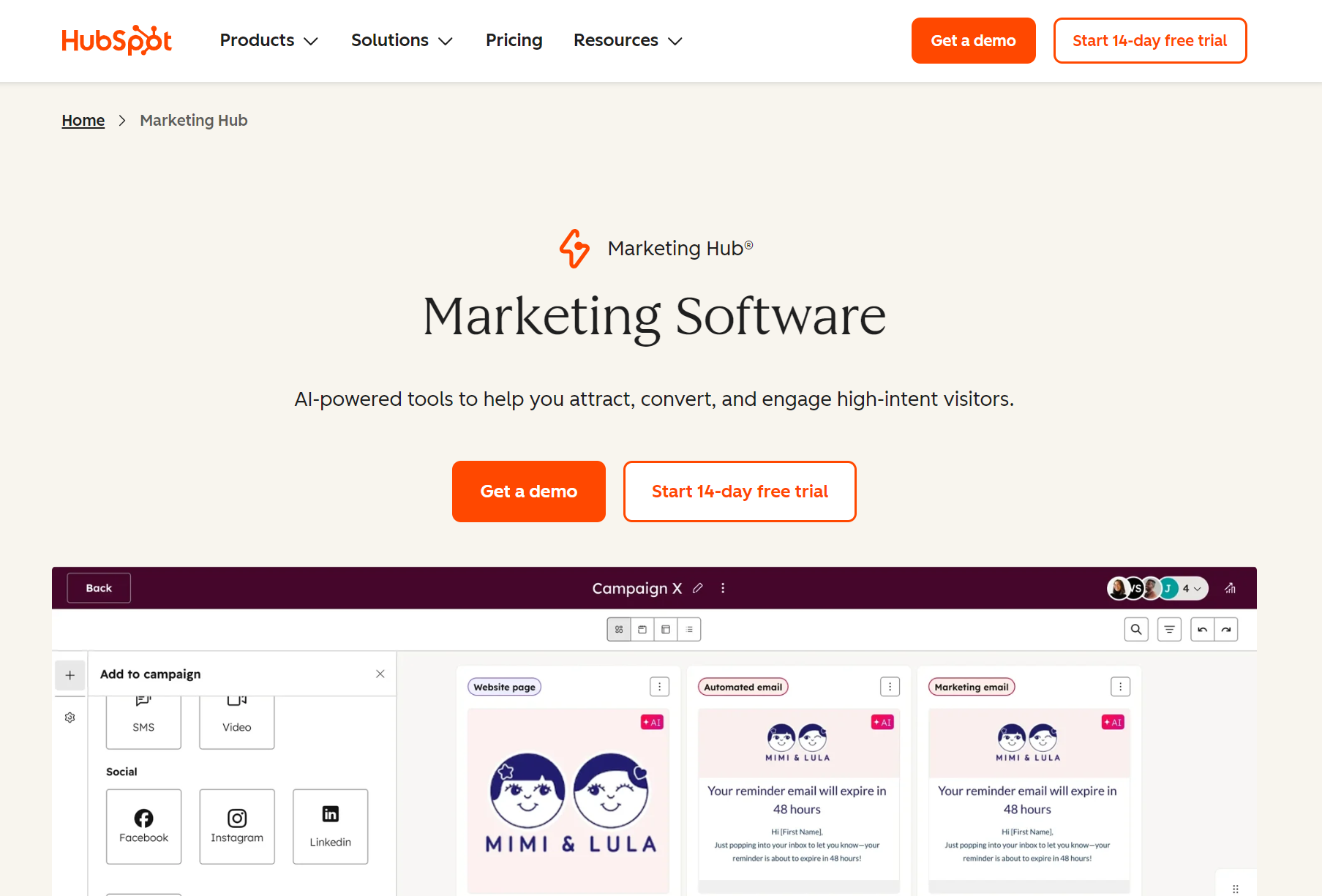
HubSpot is a CRM-first tool for all business types, offering email, SMS, and inbound marketing capabilities that tie into data-rich customer profiles.
Best for: Businesses already tied into the HubSpot ecosystem, or those looking for one tool to manage marketing, sales, service, and CRM.
HubSpot’s key features
- Smart CRM core: Tie every email and form to a contact record
- 2,000+ integrations: Connect apps across your marketing and sales stack
- Lead scoring: Rank contacts, with predictive scoring on Enterprise
- Custom reporting: Build up to 500 reports with multi-touch attribution
- Lead capture: Grow your list with landing pages, forms, and live chat
HubSpot’s pricing
HubSpot’s pricing has the widest range of any tool on our list across a free plan and three paid tiers. The Free and Starter plans provide the email-ready tool. The more expensive plans, from Professional, are where the automation, reporting, and campaign features live.
- Free: For up to two users, with storage for 1,000 non-marketing contacts
- Starter: $20/month per seat, with 1,000 marketing contacts and a 5x send limit
- Professional: $890/month for three core seats, also requires a one-time $3,000 onboarding fee, provides a 10x contact tier send limit
- Enterprise: $3,600/month, gives you five core seats and a 20x contact send limit, but also requires a $7,000 one-time onboarding fee
HubSpot’s pros
- Low learning curve for email campaign features
- Forms, basic marketing automation, and CRM segments in all paid plans
- Deep reporting capabilities via custom reports, multi-touch revenue attribution, and customer journeys (Enterprise)
- There’s a bundle builder, which lets you select your email marketing capabilities and then add sales, service, content, and other HubSpot capabilities
HubSpot’s limitations
- Per-seat and credit-based pricing quickly adds up
- Less email marketing depth than Klaviyo
- The Free and Starter plans lack A/B testing and advanced personalization, and customer journey analytics is Enterprise-only
How does HubSpot compare to Klaviyo?
HubSpot’s email marketing and automation features are more lightweight, but with a more complete CRM for deal stages, pipelines, and support history. They’re more suited than Klaviyo’s for full-funnel business growth.
9. Privy
G2 rating: 4.6/5 (based on 120+ reviews) as of July 2026
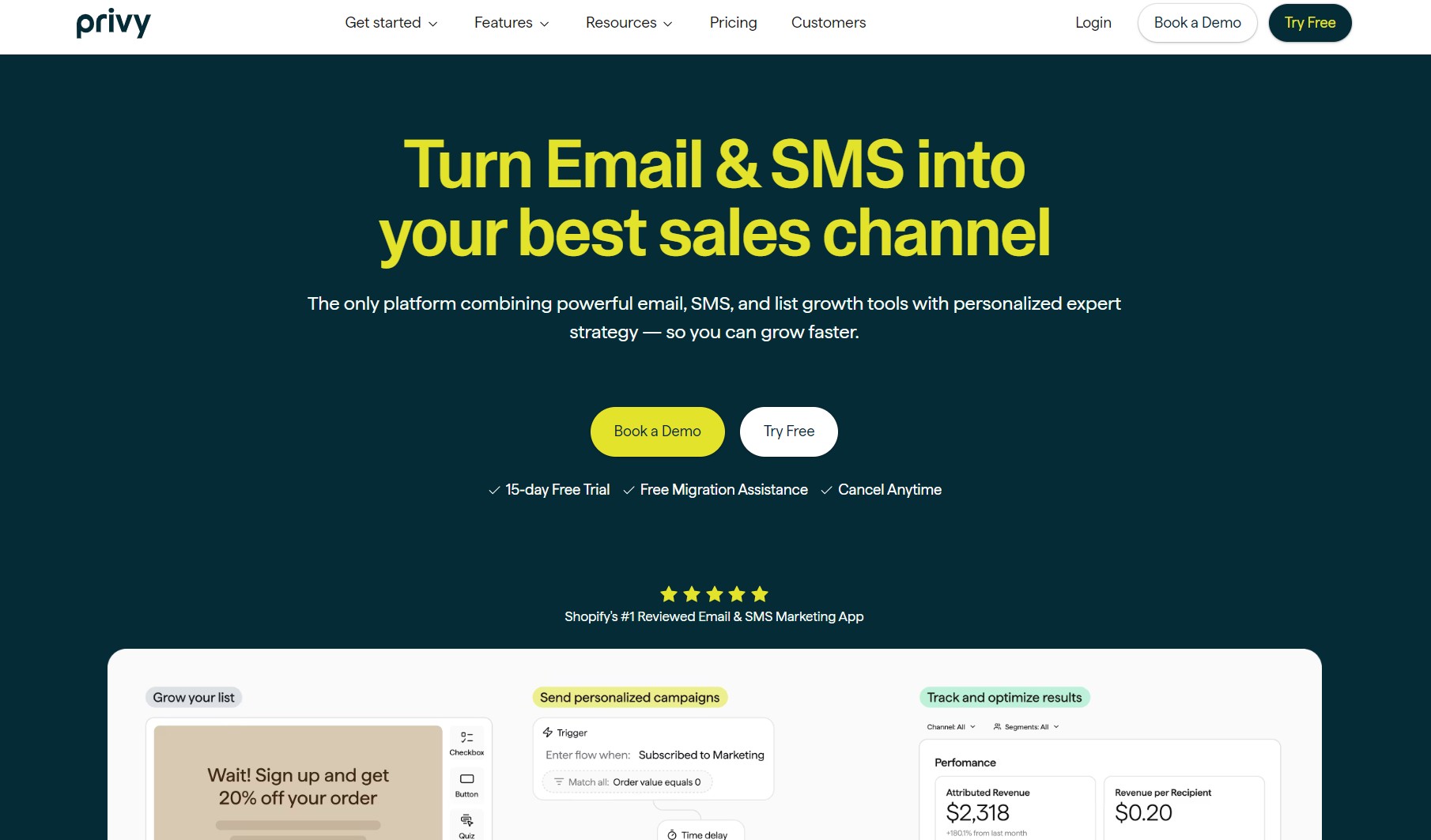
Privy is for small Shopify stores needing one tool to automate email and SMS for predictable customer journeys. It handles campaigns and flows, and syncs to Shopify via a native app rated 4.5/5 on the Shopify App Store.
Best for: Early-stage stores looking for list-building tools and email + SMS automations for predictable customer journeys.
Privy’s key features
- Multi-step forms: Capture email, SMS, and customer preferences
- Behavior triggers: Fire on exit-intent, scroll, time, and pages viewed
- Drag-and-drop editor: Customize pre-built templates without code
- 100+ templates: Pull live product data, coupons, and dynamic variables into any
- Pre-built flows: Abandoned cart, welcome series, and winback ready to run
- Behavioral segmentation: Segment by cart value, lifetime spend, and purchase history
Privy’s pricing
- The Email plan starts from $30/month for 1,500 mailable contacts, unlimited sends, and 250 SMS credits. Additional SMS credits start from $15/month for 1,250 U.S. credits.
Privy’s pros
- The contact limit is based on mailable contacts, so customers who purchased without opting into marketing don’t count toward your quota
- Smaller learning curve than Klaviyo
- Reports include deliverability insights, time-based analysis with revenue attribution, and all flows and campaigns generate real-time data
- Supports both one-time SMS and email campaigns, plus flows
Privy’s limitations
- It lacks the advanced behavioral and engagement-based triggers of Klaviyo
- Falls short on multi-store and scaling opportunities
- Flows trigger limitations mean they can cover fewer moments in your customer journey than Klaviyo
How does Privy compare to Klaviyo?
Privy has a much greater focus on list-building and lead capture, and it undercuts Klaviyo by $15/month starting at 1,500 contacts. Because of this, it suits small ecommerce stores, with adequate email and SMS flows, segments, and reports for basic customer journeys.
10. GetResponse
G2 rating: 4.3/5 (based on 1,130+ reviews) as of July 2026
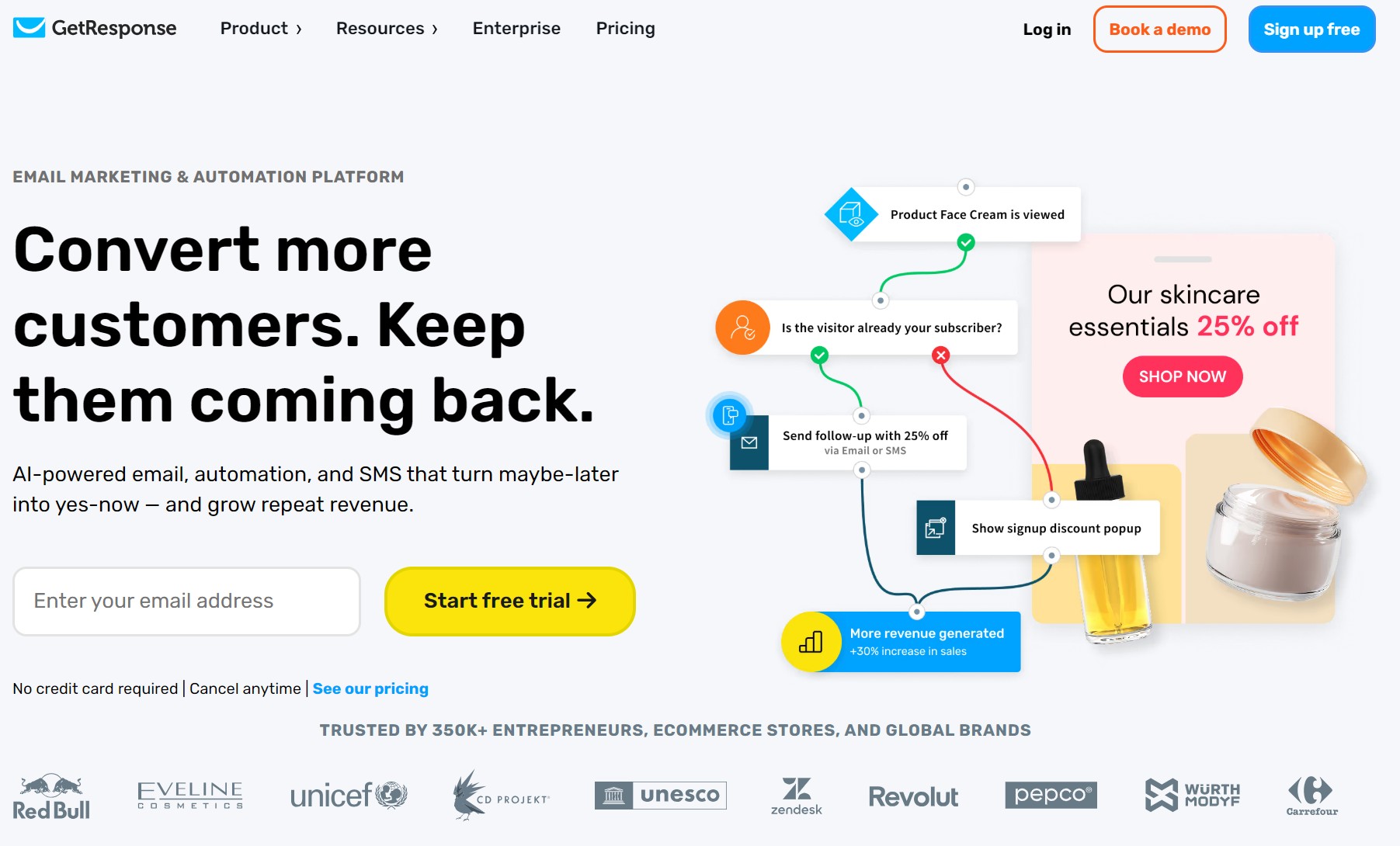
GetResponse is a Klaviyo competitor that puts webinars, premium newsletters, and courses in your creative toolkit alongside email marketing. It’s not a traditional Klaviyo alternative, but rather a better-suited tool if content is part of your business model.
Best for: Basic email campaigns at the low end, with higher-tier plans suitable for large marketing teams, and the Creator plan is best for bloggers, podcasters, and content creators.
GetResponse’s key features
- Email and automation: Create campaigns and behavior-triggered workflows
- Webinars: Host live and on-demand sessions to nurture leads
- Course creator: Build and sell courses, up to 500 students on Creator
- Conversion funnels: Start from 30+ ready-made sales and lead scenarios
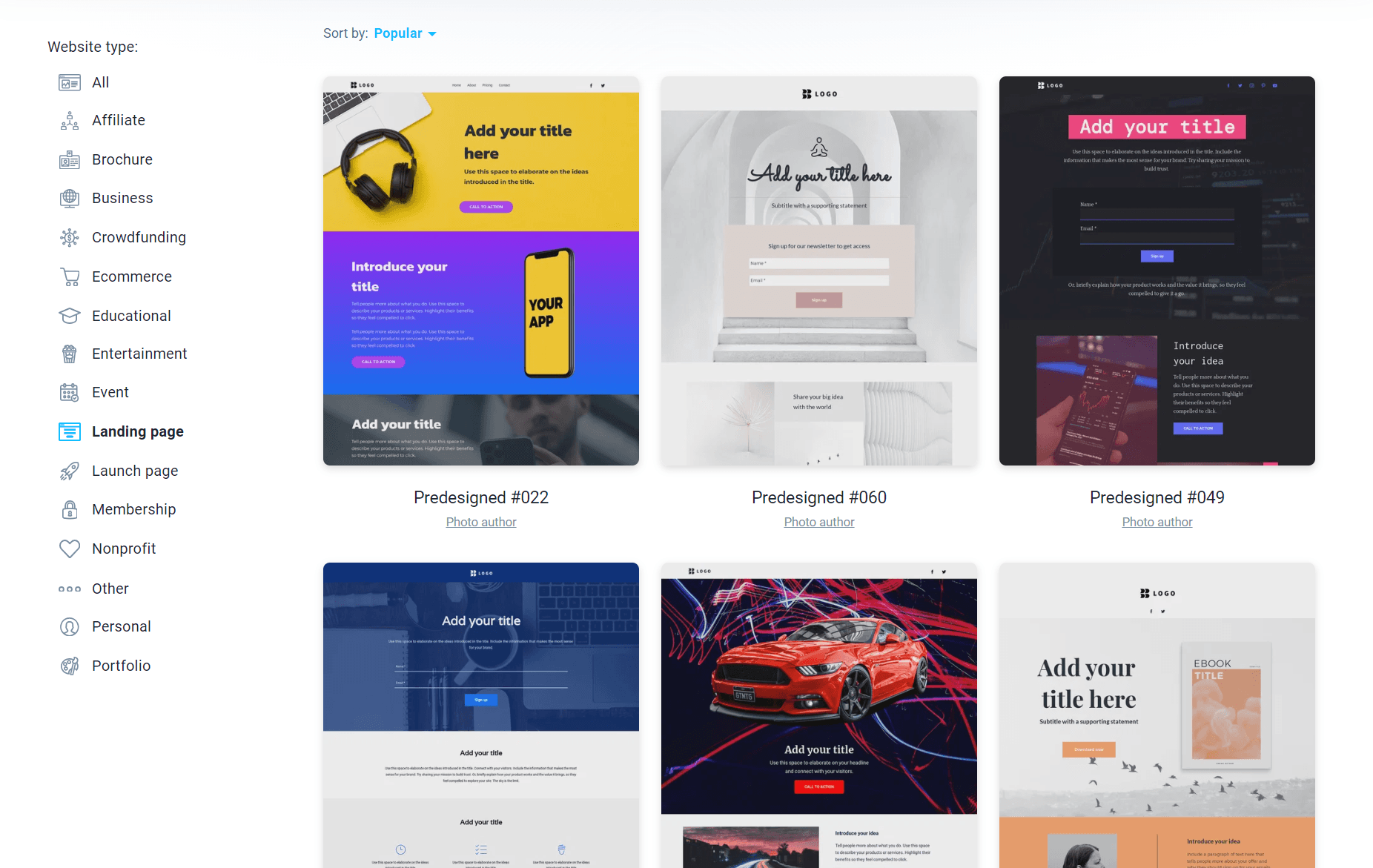
- 200+ templates: Customize emails, popups, landing pages, and workflows
GetResponse’s pricing
- Free: For 500 contacts and 2,500 email sends/month
- Starter: It costs $19/month for 1,000 contacts and unlimited email sends, but doesn’t include the features you need for your ecommerce store
- Marketer: $59/month for 1,000 contacts and unlimited automations, sales funnels, and advanced segmentation (essential for ecommerce)
- Creator: $69/month for 1,000 contacts, adds webinars, a course creator, website builder, and paid newsletters
GetResponse’s pros
- Onboarding is included in all plans
- Provides popups, embedded banners, and form templates
- The automations cover abandoned carts, welcome and thank-you emails, and additional touchpoints common in ecommerce
- You can create an autoresponder series, which tracks ecommerce and uses a feature called Time Travel to deliver at local times
GetResponse’s limitations
- Ecommerce flow depth is thinner than Klaviyo’s for DTC retention
- If you’re not a creator, then it doesn’t offer value for money versus Klaviyo
How does GetResponse compare to Klaviyo?
GetResponse is the perfect Klaviyo alternative if content and paid courses are your business’s primary revenue channels. It provides monetization capabilities for creators and service businesses, and it tracks your sales, leads, and lead magnets, plus webinar funnels on the right plans. Otherwise, it lacks Klaviyo’s flow depth for ecommerce.
See Klaviyo vs. GetResponse for an in-depth comparison.
Why are ecommerce brands leaving Klaviyo in 2026?
Ecommerce brands are leaving Klaviyo to save money on their marketing and receive more helpful customer support. Also, not every store needs such advanced email flows, segments, and reporting capabilities.
We know these are the reasons why people leave because we analyzed 300 Klaviyo reviews for user sentiment across G2, Trustpilot, and Capterra.
Pain points summary: A quantitative look from review sites
Pricing is the main pain point across G2, Trustpilot, and Capterra, mentioned as a con in 118 of 300 reviews, or roughly four in 10.
Interestingly, the complaint was rarely the price tier, but how pricing is calculated based on active profiles, which inflates plans without ongoing list management.
Customer support was the second most common pain point at 58 mentions. Reporting and attribution came third with 38 mentions, then integrations fourth at 36 mentions, followed by billing and account trust at 34 mentions.
Klaviyo’s least-cited pain points were its learning curve at 30 mentions, and technical bugs at 22 mentions.
The results in full:
| Rank | Pain point | Mentions (of 300) | Approx. share |
|---|---|---|---|
| 1 | Pricing | 118 | ~39% |
| 2 | Customer support | 58 | ~19% |
| 3 | Reporting and attribution | 38 | ~13% |
| 4 | Integrations | 36 | ~12% |
| 5 | Billing and account trust | 34 | ~11% |
| 6 | Learning curve | 30 | ~10% |
| 7 | Technical bugs and reliability | 22 | ~7% |
Klaviyo pricing: why it doesn’t always represent good value
There are pricier email tools than Klaviyo, but sometimes, businesses feel like they’re paying a lot of money in return for features they rarely use.
In r/Klaviyo, u/Whitezine pays around €40,000 a year for 277,000 active profiles and estimated under €12,000 on Shopify Email for the same 13 million sends.
On G2’s pros/cons page, the platform says that users find Klaviyo “to be expensive with limited support, which can be overwhelming for beginners,” with pricing/value concerns appearing repeatedly.
Klaviyo made it so that plans must match or exceed active profile counts in February 2025. Previously, you could stay on a lower tier with inactive profiles, but that has changed, and large lists pay more.
Over in r/ecommerce, u/Frequent_Funny_6632 posted that Klaviyo had overcharged him, refused a refund, and that moving to Omnisend would save $50 a month while adding SMS.
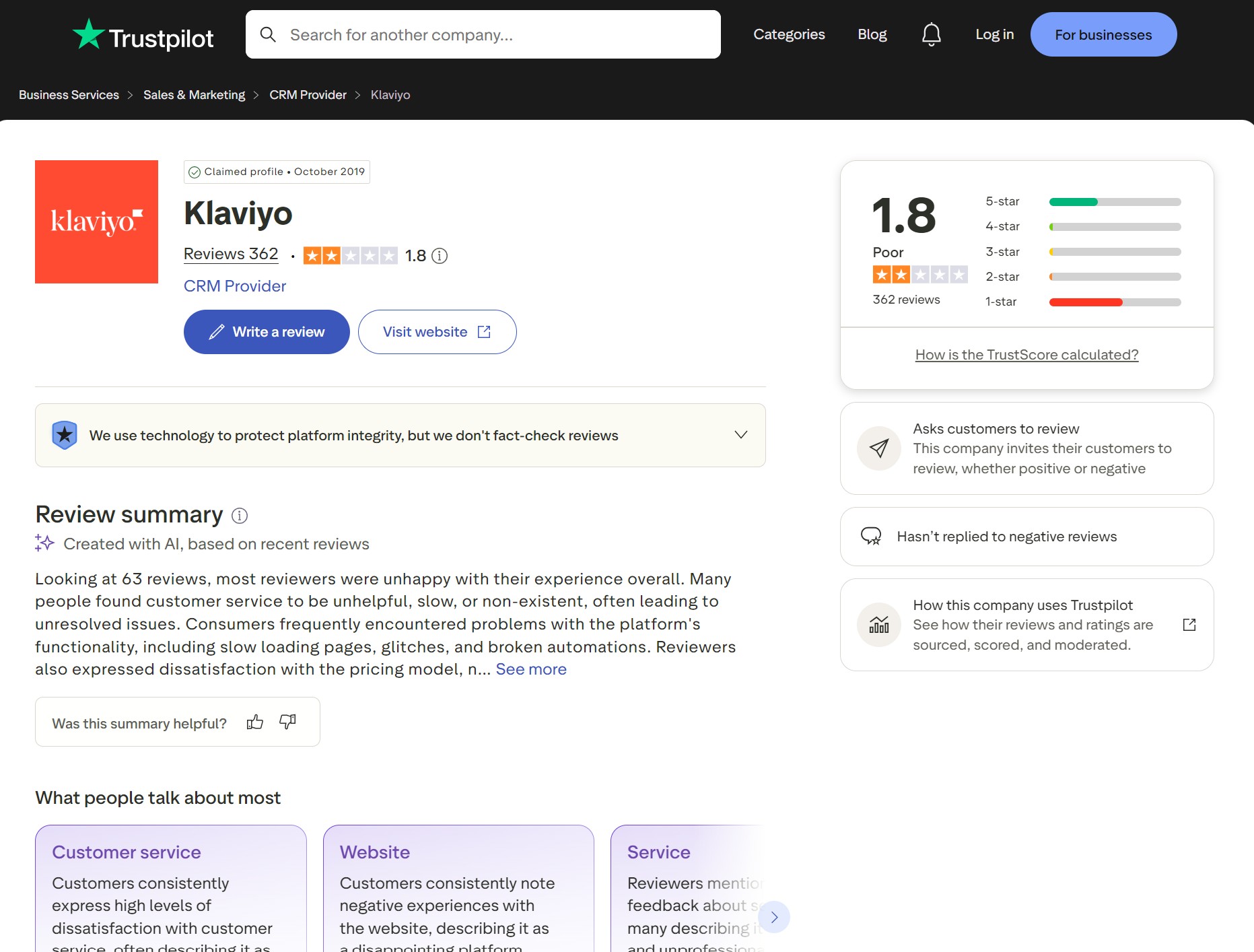
Elsewhere, on Trustpilot, one reviewer wrote that Klaviyo “keeps changing its pricing policies” and criticized the move toward paying for inactive profiles. Additionally, Klaviyo’s overall rating on Trustpilot stands at 1.8/5, which is lower than several competitors:
Capterra reviews show the same theme in a more balanced way: one reviewer called Klaviyo “Powerful and advanced… if you’ve got the budget,” while adding that it is “VERY expensive.”
Klaviyo’s pricing page confirms it uses profile-based pricing plus SMS credits, which is exactly where many smaller brands feel cost pressure as lists grow.
Klaviyo’s learning curve is steep for smaller teams
For lean ecommerce teams (roughly up to 10 people), Klaviyo’s depth can be a real setup burden. G2’s review summary flags a recurring “steep” learning curve and notes that users can find initial setup and navigation challenging.
Migration is the part some brands underestimate. In a r/Klaviyo thread, u/Joebiwan13 moved a 40,000-contact list from Flodesk to Klaviyo in December and had deliverability issues.
Capterra includes similar feedback from a positive reviewer who still noted a “steep learning curve, especially for beginners.”
Chris D., a G2 user and director, had been on Klaviyo for years and switched to Omnisend, finding that campaign builds that used to take four to five hours now take one.
Klaviyo support response times frustrate fast-moving teams
G2 highlights complaints about “lengthy response times” in its review summary, with 40 reviewers mentioning poor support.
Trustpilot reviews contain a few direct complaints about “slow support,” with one reviewer saying, “When a flow or automation stops working due to Klaviyo fault, customer support is truly useless,” which isn’t great to hear.
Deliverability is also a complaint for G2 user Nicolas B., who says Klaviyo’s delivery rates are “not so good,” and the team can’t always tell him why.
Of course, support is subjective, and no two people’s experiences are the same. So take support complaints with a pinch of salt.
Klaviyo’s SMS and channel coverage is still limited
For some brands, the issue is SMS and channel availability. Klaviyo’s SMS is only supported in select countries (the current list totals over 20 countries). Additionally, Klaviyo doesn’t natively support web push notifications, only mobile push.
Omnisend offers global SMS coverage in comparison, and also web push notifications, letting you combine all three channels in your flows.
Looking for a leaner email marketing tool? Switch from Klaviyo to Omnisend
Omnisend provides a complementary migration service if you have 250+ contacts. Switch, and we’ll move over your contacts, recreate up to four workflows, five forms, and five segments within five business days.
Learn more about our migration service >
Our verdict: the best Klaviyo alternative for ecommerce stores in 2026
For most ecommerce stores, especially Shopify and WooCommerce brands, Omnisend offers the best toolkit as an email marketing platform.
However, the best Klaviyo alternative depends on how complex your customer journey is and the extent of segmentation, flows, and reports you need to maximize revenue.
Some brands need custom reports for analysis, others need everything pre-built, and many want more predictable pricing as their list grows.
On the numbers, Omnisend runs up to 35% less than Klaviyo at comparable contact tiers. If you’re already on Klaviyo, the switch is taken care of as well: our migration team rebuilds your setup by hand in five business days, available for all customers with 250+ contacts.
If you’re a Shopify or WooCommerce store and want to see how Omnisend compares to Klaviyo, start for free or book a demo.
A note on authorship: This guide is written by the Omnisend team. We’re a Klaviyo alternative ourselves, so we have a stake in how this comparison reads. To keep it honest, every price, feature, and rating below is verified against current source data and our editorial verification process. We also flag where Klaviyo genuinely outperforms the alternatives, including us.
Frequently asked questions about Klaviyo alternatives
What’s cheaper than Klaviyo?
Omnisend, MailerLite, Brevo, and Mailchimp are cheaper than Klaviyo. Of these Klaviyo alternatives, Omnisend offers better value at all tiers with comparable ecommerce features. For pure sending limits, MailerLite and Brevo will suit your budget best.
Can I migrate from Klaviyo to another platform without losing my data?
Yes, using an import tool that connects to Klaviyo or by exporting your contact data from Klaviyo and adding it into your new email tool. The caveat is that your assets, such as flows, won’t port over as these need rebuilding using your tool’s editor.
Which Klaviyo alternative is best for Shopify?
Omnisend is the best Klaviyo alternative for Shopify. Its 4.8/5 rating on the Shopify App Store and enterprise features show that it’s the best alternative to Klaviyo. Brevo and Mailchimp equal Omnisend’s total rating, but can’t match its ecommerce depth for segments, flows, and reports.
Does Klaviyo have deliverability problems?
No, not generally because only a small percentage of users have Klaviyo deliverability problems. Complaints around Klaviyo center around costs, learning curves, and poor customer support rather than deliverability problems.
What is the biggest Klaviyo competitor for ecommerce?
Omnisend is Klaviyo’s biggest competitor for ecommerce, with similar depth across flows, segments, and reports for most of your customer journey. Additional competitors include Drip for more basic flows, and ActiveCampaign for CRM features.
Are there any free Klaviyo alternatives?
Yes, Omnisend, Brevo, MailerLite, Mailchimp, HubSpot, and GetResponse have free plans available. Of course, they differ in contact quotas, send limits, and features, so compare them thoroughly before investing your time.
How to migrate from Klaviyo to Omnisend?
Omnisend provides a free Kickstart service if you have 250+ contacts. It includes workflow recreation, segment builds, form setup, contact migration, and email templates. You can also use the self-serve Klaviyo Data Import Tool to move contacts, their data, and most segments over, requiring your Private API key in Klaviyo. Check out our guide on migrating from Klaviyo to Omnisend for more information.