Can AI run your social media better than a human? We tested this out.
We gave the same fictional chocolate brand to 7 Instagram accounts, some run by human social media managers, some run by AI. And we let them compete.
The humans won. They out-engaged the AI accounts 2.45x, a 1.88% engagement rate versus 0.77%, even though the AI accounts had no shortage of reach to work with. The gap came down largely to conversation.
How all 7 accounts finished
The brand: one fictional chocolate brand (same logo, colors, and design system) across all 7 accounts. Only the name varied slightly (Chocco Bubu, Chocco Luli, Chocco Popi, and so on), so each account was distinct on Instagram while staying visibly the same brand.
Score = 50% engagement rate + 30% comments + 20% follower growth, each normalized to the top account in the study.
Methodology: Check out how we ran this experiment in the methodology section.
Bubu, human, no AI
ER: 2.34%
Comments: 70
Followers: 77
93
Runaway winner. Top engagement rate, and 70 of the study’s 90 comments. No AI touched it. A giveaway and live comments did the work.
Luli, human, AI-assisted
ER: 1.89%
Comments: 12
Followers: 116
63
Second best account and the biggest following, but lighter on conversation (12 comments). Human judgment + AI production helped to ship.
Popi, human, no AI
ER: 1.21%
Comments: 6
Followers: 103
46
The third human account still beat the best AI account. The human edge is skill, not luck.
Mufi, Claude, short brief
ER: 1.13%
Comments: 1
Followers: 70
37
The top bot, off the shortest brief. But one comment all month shows where the real gap sits.
Zumi, Claude, detailed brief
ER: 0.84%
Comments: 0
Followers: 55
27
Claude’s other account: steady and self-correcting, but zero comments, and the detailed brief didn’t help.
Dudi, ChatGPT, short brief
ER: 0.76%
Comments: 1
Followers: 67
28
ChatGPT’s stronger account: middling engagement, one comment, and it skipped scheduling entirely.
Bufi, ChatGPT, detailed brief
ER: 0.36%
Comments: 0
Followers: 22
11
The flashiest demo, the worst result: a one-click campaign with no conversation, last place.
The read
Runaway winner. Top engagement rate, and 70 of the study’s 90 comments. No AI touched it. A giveaway and live comments did the work.
The read
Second best account and the biggest following, but lighter on conversation (12 comments). Human judgment + AI production helped to ship.
The read
The third human account still beat the best AI account. The human edge is skill, not luck.
The read
The top bot, off the shortest brief. But one comment all month shows where the real gap sits.
The read
Claude’s other account: steady and self-correcting, but zero comments, and the detailed brief didn’t help.
The read
ChatGPT’s stronger account: middling engagement, one comment, and it skipped scheduling entirely.
The read
The flashiest demo, the worst result: a one-click campaign with no conversation, last place.
So who won, and by how much?
Did AI or humans win engagement?
Humans won, and it wasn’t close:
Across the run, the human accounts averaged at 1.88% engagement rate. The AI accounts managed to get 0.77%. That’s 2.45x more engagement for the humans.
Here’s the part we didn’t expect:
AI didn’t lose for lack of exposure. The AI group logged more reach in total (41,261 vs 36,434) but that’s largely a headcount effect, since there were 4 AI accounts to 3 human accounts. Per account, human reach was actually slightly higher (~12,100 vs ~10,300).
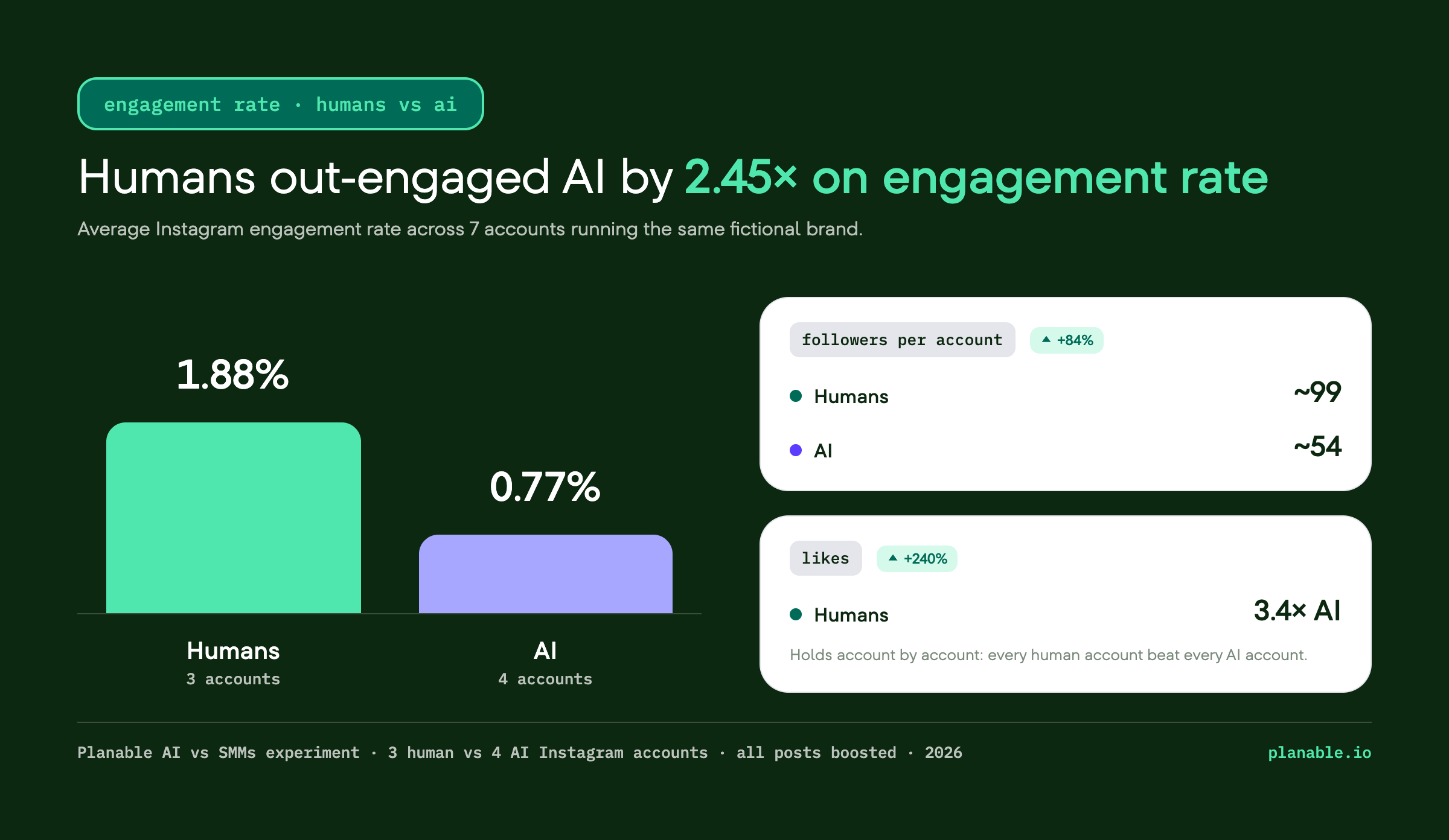
Here’s how we calculated engagement rate:
Engagement rate = total engagement ÷ reach × 100
- Humans: 686 ÷ 36,434 × 100 = 1.88%
- AI: 317 ÷ 41,261 × 100 = 0.77%
So both sides had a fair shot at being seen. The gap opens up after the impression: humans turned reach into likes, comments, and shares; AI mostly turned reach into a scroll.
Who won more comments, likes, and shares?
On all three, humans came out ahead.
Human posts pulled 88 comments. The four AI accounts pulled 2, combined, across the entire run. It’s a 44x gap, and it’s the sharpest split in the whole experiment.
Break engagement into its three parts and the picture gets specific:
Likes leaned human, and shares were a coin flip. Then you hit comments, and the floor drops out.
So why did the split run this wide?
The AI accounts asked for comments running the textbook play, like “drop your vote” or “tell us your favorite.” The humans earned them:
- Bubu’s SMM (human, no AI) ran a giveaway and that single post pulled 33 comments (more than 16x what all four AI accounts managed put together).
- Popi’s SMM (human, no AI) spent their time in other brands’ comment sections, not just their own.
All three managers replied to people. The bots replied to no one.
Bubu’s SMM (human, no AI) named the gap herself:
The thing AI couldn’t do was engage with comments or followers.
Popi’s SMM had a rule for it:
The post is 30% of the work. The other 70% is active distribution.
The AI accounts did the 30% and skipped the 70%.
Did anyone actually build an audience?
Humans did. And their accounts kept growing after the posting stopped.
By the end, the human accounts held 84% more followers on average, 99 per account versus 54 for the AI accounts.
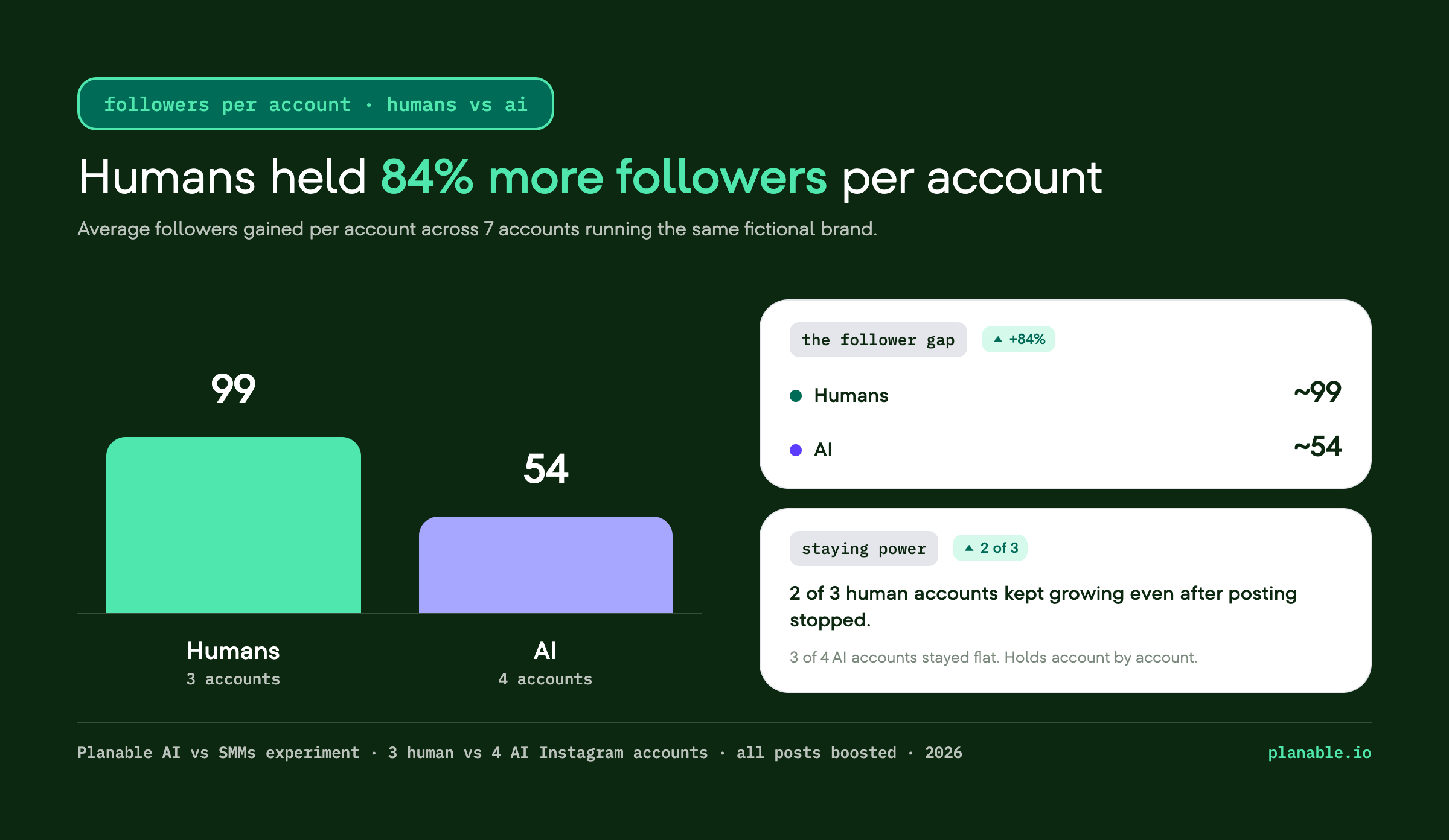
The louder part is what happened after the last post went out.
Two of the three human accounts kept climbing with nothing new being published:
- Chocco Luli (human, AI-assisted) went from 83 followers to 116
- Chocco Popi (human, no AI) went from 55 to 103
Three of the four AI accounts sat flat over the same stretch.
That’s the difference between renting attention and building an audience. Engagement spikes when the post is fresh and the boost is running, then it’s gone. Followers are what’s left over once the noise dies down. The human accounts left something behind that kept working on its own. The AI accounts mostly stopped the day the posts did.
Is Claude or ChatGPT better for social content?
Our data shows that Claude brought better results.
Pooled across both accounts each ran, Claude posts got an average 0.98% engagement rate to ChatGPT’s 0.58%. That’s 1.7x.
Chocco Dudi
ChatGPT
0.76%
Chocco Bufi
ChatGPT
0.36%
Claude posts built a bigger following too: 125 followers across its accounts versus 89 for ChatGPT.
So why the split?
It came down to how each model works:
- Claude behaved like a strategist: it planned the campaign and handed back prompts, but you had to take those prompts to a second tool to actually make the images.
- ChatGPT went end to end: one of its accounts produced a whole campaign, captions and finished visuals and all, in a single reply. The catch is what was baked into that one-shot output.
Do detailed prompts help?
You’d think so. The data says the opposite.
Two of the AI accounts got a short, generic brief (a couple of sentences). The other two got a rich brief (detailed audience, tone, and format direction). The thin briefs won.
Generic got a 0.93% engagement rate. Rich reached 0.60%. That’s 1.6x in favor of less instruction. And it held in both models.
Generic
Claude (Chocco Mufi)
1.13%
Rich
Claude (Chocco Zumi)
0.84%
Generic
ChatGPT (Chocco Dudi)
0.76%
Rich
ChatGPT (Chocco Bufi)
0.36%
Model
Claude (Chocco Mufi)
Model
Claude (Chocco Zumi)
Model
ChatGPT (Chocco Dudi)
Model
ChatGPT (Chocco Bufi)
Keep in mind that this is just one account per model per brief, so don’t take that vague prompts win as a rule. But the direction is interesting: more instruction didn’t make the AI better, but it made it safer (which on social usually means boring).
What AI was actually good and bad at
The scoreboard says AI lost. This is where it did, and where it didn’t.
Where AI held its own
Let’s give the bots credit where it’s due:
- Chocco Mufi (Claude, short brief): 1.13% engagement rate off a three-sentence brief, within a whisker of Popi (human, no AI) at 1.21%. On raw output, one of the bots basically matched a person.
- Chocco Bufi (ChatGPT, detailed brief): built an entire 9-post campaign in a single reply with captions, hashtags, strategy, and 9 finished visuals, zipped and ready, in about three minutes. It even knew which AI video tools were still running and which had shut down.
- Chocco Zumi (Claude, detailed brief): handed over platform strategy nobody asked for, and locked the brand’s hex codes so the colors stayed consistent.
The calendar problem
Every AI account got scheduling wrong:
- Chocco Bufi (ChatGPT, detailed brief) dated all 9 posts a day off and only caught it on the last one.
- Chocco Mufi (Claude, short brief) needed 3 rounds of corrections and stumbled mid-fix. Two of its posts still landed after the experiment had ended.
- Chocco Zumi (Claude, detailed brief) built a schedule that didn’t match the calendar and dropped a post entirely. To its credit, it fixed itself once flagged.
- Chocco Dudi (ChatGPT, short brief) skipped dates altogether and left the math to the manager.
So, 3 of the 4 needed a human to catch the mistake, and the fourth didn’t try.
The brand problem
The AI also couldn’t be trusted to stay on-brand without a babysitter:
- Chocco Mufi (Claude, short brief) called the brand’s red “orange.”
- Chocco Zumi (Claude, detailed brief) shipped a caption with “[insert fourth flavor name]” still sitting in it.
- Chocco Luli (human AI-assisted) had a problem with AI mangling the logo and the slogan, so the manager had to redraw them by hand in Canva every time.
What did the experts think, blind?
We showed all seven accounts to five social media experts: Annie-Mai Hodge, Amy Watts, Sophie Miller, Jon-Stephen Stansel, and Fab Giovanetti. We asked them to rate the content and guess which accounts were run by AI. Nobody told them the split.
3 of 5 jurors mistook an AI account for human at least once. Here’s what we found:
The experts couldn’t reliably tell AI from human. But when they did spot AI, it was the visuals that gave it away
The guesses were all over the map, and the misses are the interesting part. 5 of 20 AI assessments were misread as human (25%). Chocco Luli (human but AI-assisted) got mistaken for a machine, while Chocco Zumi (Claude, detailed brief) got mistaken for a person.
Jon-Stephen’s feedback on Chocco Luli was straight:
This is clearly AI. Not only does it have that AI gloss and glow, there are several telling clues from random watermarks in the bottom corners, hands with extra fingers, and blurred words. Additionally, there were a few comments slamming the use of AI, showing the general public’s distaste for it.
Amy had it exactly backwards with Chocco Zumi (Claude, detailed brief):
I feel like this was made by a human but with the support of AI in captions etc. I like the choices made and think it works overall.
Sophie caught Chocco Bufi (ChatGPT, detailed brief) the same way, on craft rather than concept:
The spacing is the giveaway, text colliding with caption bubbles, lines buried behind the product, garbled wrapper text on the reel, all the kind of thing a person would catch and fix.
The account most experts would keep was run by AI
We asked each expert a final question: if you could keep just one of these seven accounts running, which would it be? All five picked a different account, no consensus at all. But 3 of the 5 jurors chose a fully AI-run account (Chocco Zumi, Chocco Dudi, and Chocco Bufi). Only two kept a human-run one.
So the AI didn’t just pass as human in places. Sometimes it was the one the expert actively wanted to keep. Amy chose Zumi:
The content has a clear direction and visual style, and just needs a couple of tweaks to make the account stronger overall and build that momentum for launch.
Jon-Stephen kept Bufi (ChatGPT, detailed brief), fully aware of its flaws:
Chocco Bufi is the most flawed in terms of visuals, but the ideas feel stronger and more likely to engage a community behind a chocolate brand.
The three AI accounts were the bottom three on engagement. Zumi (Claude, detailed brief), Dudi (ChatGPT, short brief), and Bufi (ChatGPT, detailed brief) finished fifth, sixth, and seventh of seven, Bufi last, at a 0.36% engagement rate. The accounts that looked most keepable to a trained eye were the ones the audience engaged with least.
The experts think nobody fully nailed it
The panel criticized both sides.
And several experts pointed at the real challenge: it’s hard to create good content for a brand that doesn’t exist. Which is fair. Everyone was selling a chocolate bar nobody can taste, for a company that isn’t real. The humans still came out ahead where it counted: engagement.
So was the AI actually cheaper?
Probably to run. Not per result.
The easy assumption is that AI is the budget option, just a subscription. And on paper, sure. Our AI accounts took less human time to run than the humans did.
Human SMM hours
55.5 hours across 3 accounts, 18.5h average:
- Chocco Bubu (human, no AI): 10.5h
- Chocco Luli (human, AI-assisted): 31h
- Chocco Popi (human, no AI): 14h
AI hours
21.5 hours across 4 accounts, 5.4h average:
- Chocco Mufi (Claude, short brief): 5h
- Chocco Zumi (Claude, detailed brief): 6.5h
- Chocco Dudi (ChatGPT, short brief): 4h
- Chocco Bufi (ChatGPT, detailed brief): 6h
So AI took roughly a third of the human time per account (5.4h vs 18.5h).
But “cheap to run” and “cheap per result” are different questions, and social media only pays you back on the second one. A cheap account that earns almost nothing isn’t a bargain, it’s just a small bill for a small return.
The AI accounts cost less human time. They also earned a fraction of the engagement: about 79 interactions per account versus 229 for the humans (317 across four AI accounts, 686 across three humans).
We’re not going to hand you our cost-per-engagement number, because ours won’t help you much as it’s built on a flat volunteer fee and a made-up brand. Your rates, your tools, and your ad budget are the only ones that matter.
Here’s the math to run on your own numbers
- Work out what one account really costs:
Cost per account = (hours × your hourly rate) + tool subscriptions + ad spend
For example: (20 hrs × $50) + $200 tools + $150 ads = $1,350
- Then divide by what it actually earned:
Cost per engagement = total account cost ÷ total engagement
Example: $1,350 ÷ 250 engagements = $5.40 each
Cost per follower = total account cost ÷ net followers gained
Example: $1,350 ÷ 40 followers = $33.75 each
- Run it twice: once for a human setup, once for an AI one.
The hypothesis is that the AI setup will almost certainly win on cost per account but it may still lose on cost per engagement, because the human earns so much more per post that the higher input cost gets spread across far more return.
What this means for social teams
So what do you do with all this on Monday morning? A few things the experiment actually backs up.
Let AI draft. Let a human decide
AI is a fast way to get to a first version, but it’s a bad way to decide what’s good. One of the best accounts in the experiment was run by a human who used AI to produce and then used her own judgment to pick what shipped and make final edits. So, keep a person on the final call.
Keep the conversation human
The entire human-vs-AI gap lived in comments. This means that community is the part of the job you can’t hand to a model: the replies, the DMs, the showing up in other people’s comments. If you’re going to spend your time anywhere, spend it there.
So what earns a reply?
Spending your time there is one thing. Knowing what to say is another, and Fab Giovanetti, one of the five experts who judged these accounts blind, teaches exactly that in a free training on the behavioral science of why people reply👇
✨ Get the free training
Budget for the hours, not just the subscription
If you do go AI-assisted, staff it like real work. The human who leaned hardest on AI in our experiment produced the best-scoring assisted account — and logged the most hours of anyone, more than all four fully-AI accounts combined. AI shifts where the time goes (less blank-page drafting, more directing, fixing, and taste), but it doesn’t remove it. A tool subscription is not a substitute for a person’s time; it’s a change in how that time is spent.
Put human and AI in one workflow
AI can produce, but a human has to direct it, catch its mistakes, approve it, and do the talking. That hand-off needs somewhere to happen, which is what Planable is built for:
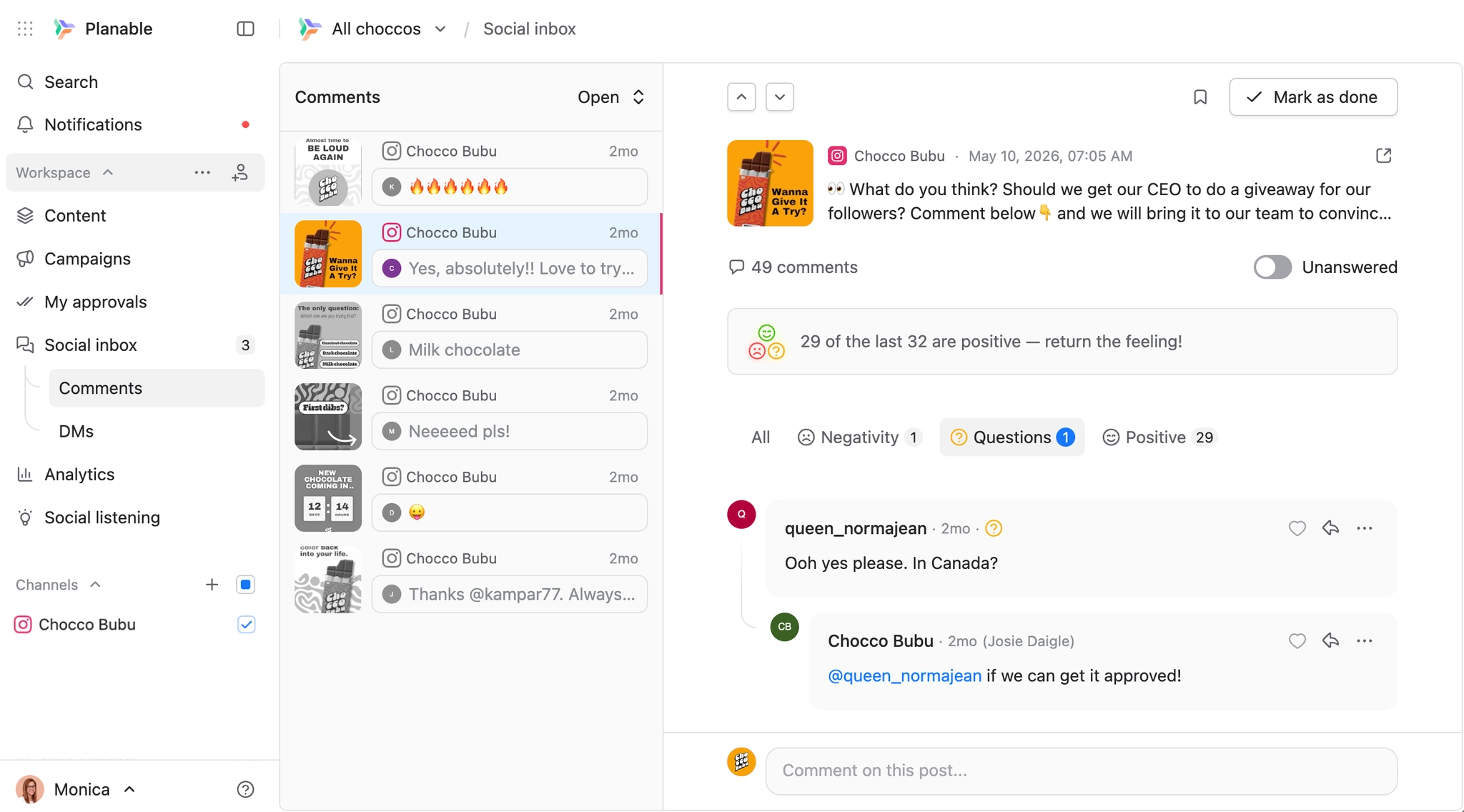
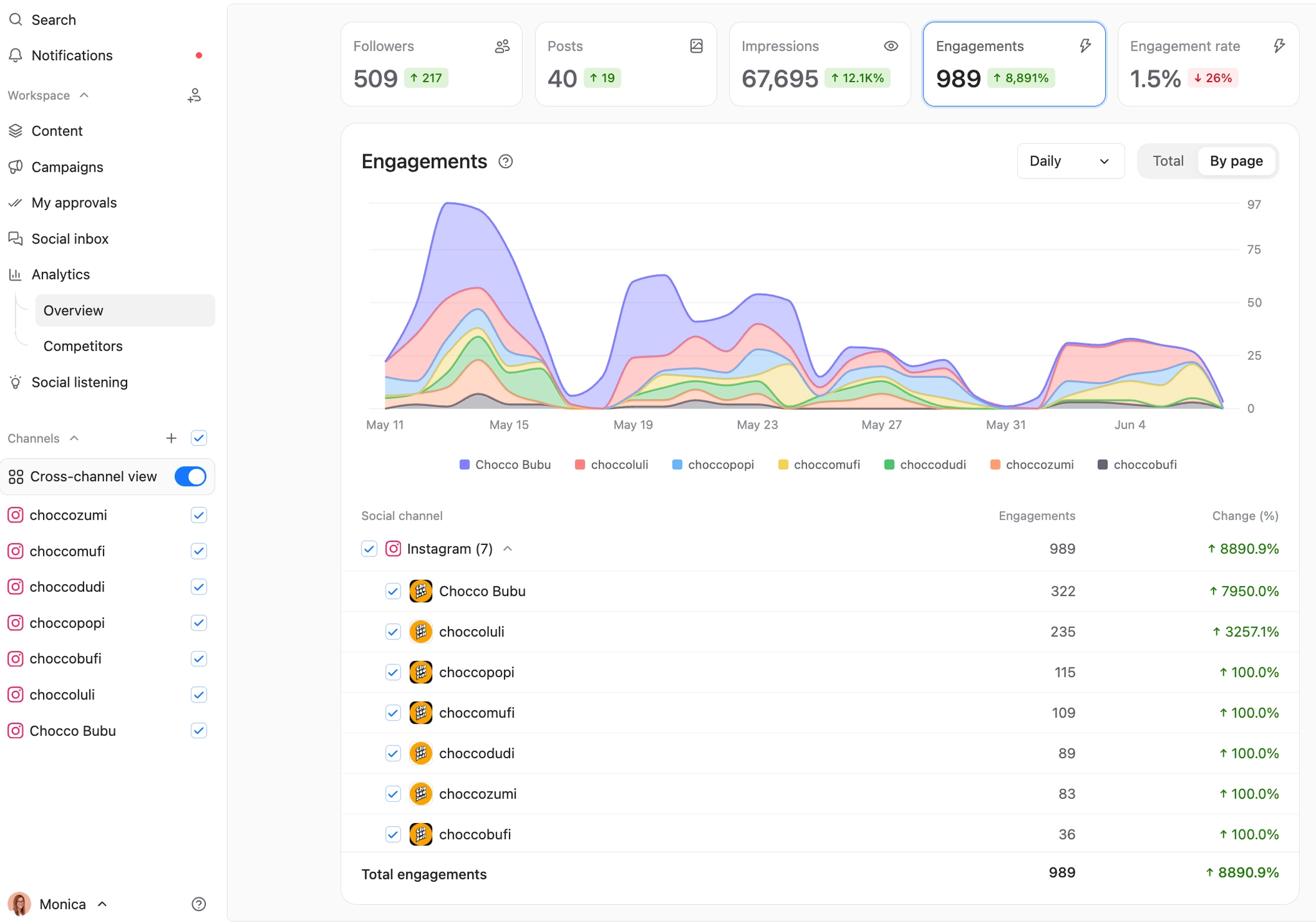
- Planable’s Social Analytics gives you numbers and performance metrics to ground you decisions (also available through the same Claude MCP integration)
How we ran this experiment
The idea
We built one fictional chocolate brand and gave it to seven Instagram accounts (some run by human social media managers, some by AI), then had them compete on equal terms.
The brand
Every account promoted the same fictional chocolate brand: playful, retro-coded chocolate for millennials and Gen Z, with one shared positioning, audience, and design system. Only the name varied (Chocco Bubu, Chocco Luli, Chocco Popi, and so on), so each was distinct on Instagram while staying visibly one brand.
The accounts
We started with 8 accounts; one human manager dropped out partway through, so that account was excluded and the results shared cover the 7 that finished all four weeks.
4 setups:
- Human, no AI: 2 accounts (Chocco Bubu and Chocco Popi), run by professional social media managers under a strict no-AI rule. Stock libraries, non-AI design tools, and their own brains were fair game.
- Human, AI-assisted: 1 account (Chocco Luli), run by a professional who could use any AI tool freely, but logged which tools she used, how, and what they rejected.
- AI: 4 accounts (Chocco Mufi, Chocco Zumi, Chocco Dudi, Chocco Bufi), operated in-house by Planable. ChatGPT and Claude each ran 2 accounts: one from a short brief (a couple of sentences), one from a rich brief (detailed audience, tone, and format direction).
The human managers were external volunteers, compensated with a flat fee, with full creative control: content calendar, formats (no Stories, excluded for everyone), captions, hashtags, bios, and posting times were their choice. They never saw each other’s accounts.
The AI accounts were run by Planable’s Senior Content Marketing Manager, George Danaila (models, visuals, replies).
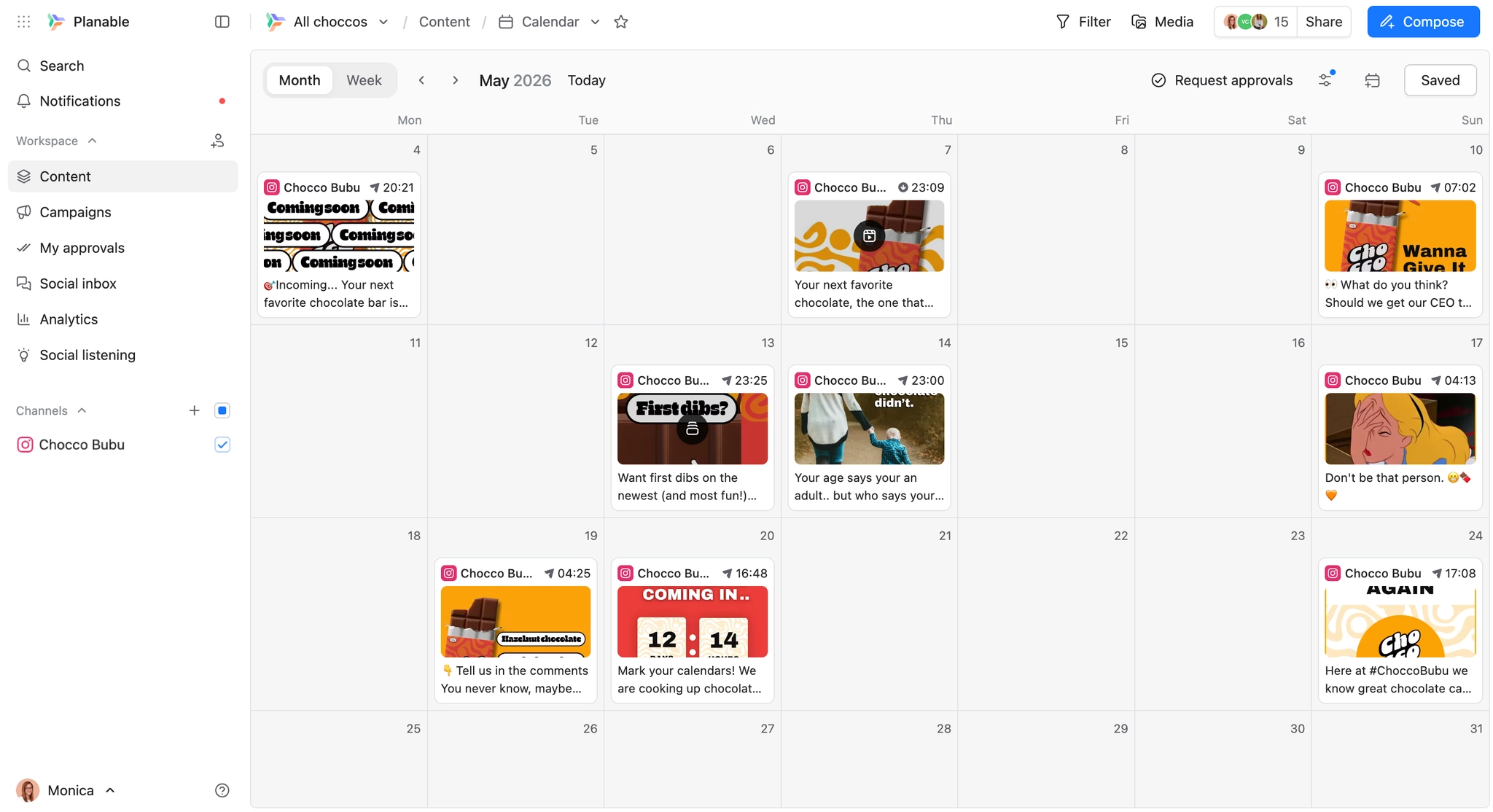
All accounts were created in-house, started at 0 followers, and were scheduled through Planable (except Reels, posted natively).
The posts
Every account published 9 posts (63 total), on the same cadence:
- 2 posts in week 1
- 2 posts in week 2
- 2 posts in week 3
- 3 posts in week 4
Posting times were each manager’s choice.
Posting ran April 28 – May 25. Two of Chocco Mufi’s (Claude, short brief) posts slipped to early June because of the AI’s own scheduling errors, and we kept them in.
Measurement ran through July 7, 2026.
The boosting
Boosting began in week 2, with every post treated identically: about $10 per post (~$2/day over 5 days), roughly $615 total across the 63 posts.
Targeting was the same for all accounts:
- US, UK, Canada, Australia, Ireland, and five Western European countries
- Ages 25–45
- Interests around candy, snacks, and ’90s/2000s nostalgia
Late posts got the same 5 days before cutoff.
The metrics & score
Engagement Rate was a key metric. We report totals. Paid interactions are counted throughout.
Engagement rate = total engagement ÷ reach × 100.
The composite score weighs engagement rate at 50%, comments at 30%, and follower growth at 20%, each normalized to the top account in the study.
The evidence
What this experiment can’t tell you
- It’s 7 accounts, not 700. A real experiment, not a meta-analysis. Results will vary with your brand, audience, and niche.
- We didn’t split organic from paid. Every account was fresh and every post was boosted, so the numbers blend the two. Don’t read them as organic results.
- Human + AI rests on one account. The AI-assisted setup finished second, but it’s a single data point. Treat it as a direction, not a conclusion.
- Brief and model comparisons are directional. One account per model per brief means “short briefs won” and “Claude beat ChatGPT” are signals, not rules.
- The brand is fictional. Everyone was selling a chocolate bar nobody can taste — a constraint all seven accounts shared equally.
FAQ
Can AI replace a social media manager?
Not on this evidence. Across a 7-account experiment on the same brand, the human-run accounts out-engaged the AI-run ones 2.45x (a 1.88% engagement rate versus 0.77%). The AI could write captions and generate images quickly, but it didn’t engage in comments, run giveaways, or catch its own scheduling mistakes. The stronger pattern was AI as an assistant, not a replacement.
Is ChatGPT or Claude better for social media content?
In our experiment, Claude’s accounts out-engaged ChatGPT’s 1.7x (a 0.98% engagement rate versus 0.58%), and both Claude accounts beat both ChatGPT accounts. The two behaved differently: Claude worked like a strategist, planning the campaign and handing back prompts you then took to a separate image tool, while ChatGPT produced a whole campaign (captions and finished visuals) in one reply. ChatGPT’s one-shot output was faster to get, but more of it was wrong underneath. This is a small sample (two accounts each), so treat it as directional.
Do longer, more detailed prompts make AI content better?
Not in this test. The AI accounts given a short, generic brief out-engaged the ones given a detailed brief 1.6x, and it held for both models. More instruction seemed to make the AI play it safe and land somewhere forgettable, while a looser prompt left room for something with more edge. It’s a thin slice of data, so it’s a signal, not a rule.
How much engagement does AI-generated content get vs human content?
In this experiment, human content earned 2.45x the engagement of AI content (a 1.88% engagement rate versus 0.77%) — and it did so even though the AI accounts had no shortage of reach. The gap was concentrated in comments: human posts drew 88, the four AI accounts drew 2. Likes were closer (200 versus 59) and shares were near-even (6 versus 5). So AI lost on conversation, the part that needs a real person replying.
Is AI cheaper than a human social media manager?
Cheaper to operate, yes. Cheaper per result, no. Running an AI account took less human time than a human-run one. But social media pays back on return and the AI accounts earned a fraction of the engagement (317 interactions across four accounts versus 686 across three humans). Once you divide cost by results, a cheap account that earns almost nothing may cost more per engagement than a pricier human who earns a lot.
How much time does AI actually save a social media manager?
In our experiment, the fully-AI accounts took about 5 hours each to run, versus roughly 18 hours for the human-run accounts (including one AI-assisted). So on raw hours, AI cut the time to about a third. But the account that used AI as an assistant tells a different story: that manager logged around 31 hours, more than anyone else in the study, because the AI kept needing direction and fixing, all of which she corrected by hand. So AI saves the most time when it runs unsupervised, which is also when it performs worst.
Can people tell AI content from human content?
Not reliably. We showed five social media experts all seven accounts blind and asked them to guess which were AI. The guesses ran both ways: Chocco Luli (human AI-assisted), got mistaken for a machine, while Chocco Zumi (Claude, detailed brief) was read as human. When the experts did correctly spot AI, it was almost always the visuals that gave it away.
Relentless advocate and practitioner of putting users before Google algorithms since 2016. Geeks out over everything tech SEO. Dabbles in photography and is a natural-born reader.