Gamification Email Marketing: Examples, Techniques (2026)
Key takeaways
Gamification in email marketing involves adding interactive elements such as spin wheels, quizzes, and more. Usually, these experiences can earn more attention than static discounts.
Match the right gamification techniques in email marketing to your goal. Use wheels for sign-ups, quizzes for zero-party data, and points or badges to build loyalty over time.
Strong email gamification marketing strategies support every stage of the customer lifecycle. They help acquire, convert, reactivate, and retain customers.
Omnisend pairs email with landing pages or forms to create a gamified marketing experience that engages customers.
Gamification in email marketing is used to improve engagement by enticing customers to interact through a moment of play or mystery. Using a spin-to-wheel, a scratch card, or a quiz can add playfulness to your campaigns and generate more opens or clicks.
This guide explores proven gamification techniques email marketing teams use, with real brand examples. It shows where each one fits across the customer lifecycle and how to build your first gamified email in Omnisend.
Build a gamified flow with Omnisend and start growing your contact list today
Quick sign up | No credit card required
What is gamification in email marketing?
Gamification in email marketing is the use of interactive, game-like moments to foster engagement and drive purchases. The experience can happen inside the email or on the landing page it links to.
Common techniques include spin-to-win, scratch-to-reveal, quizzes, mystery offers, hidden-code puzzles, and points or badges. Each one trades a small, enjoyable effort for a reward.
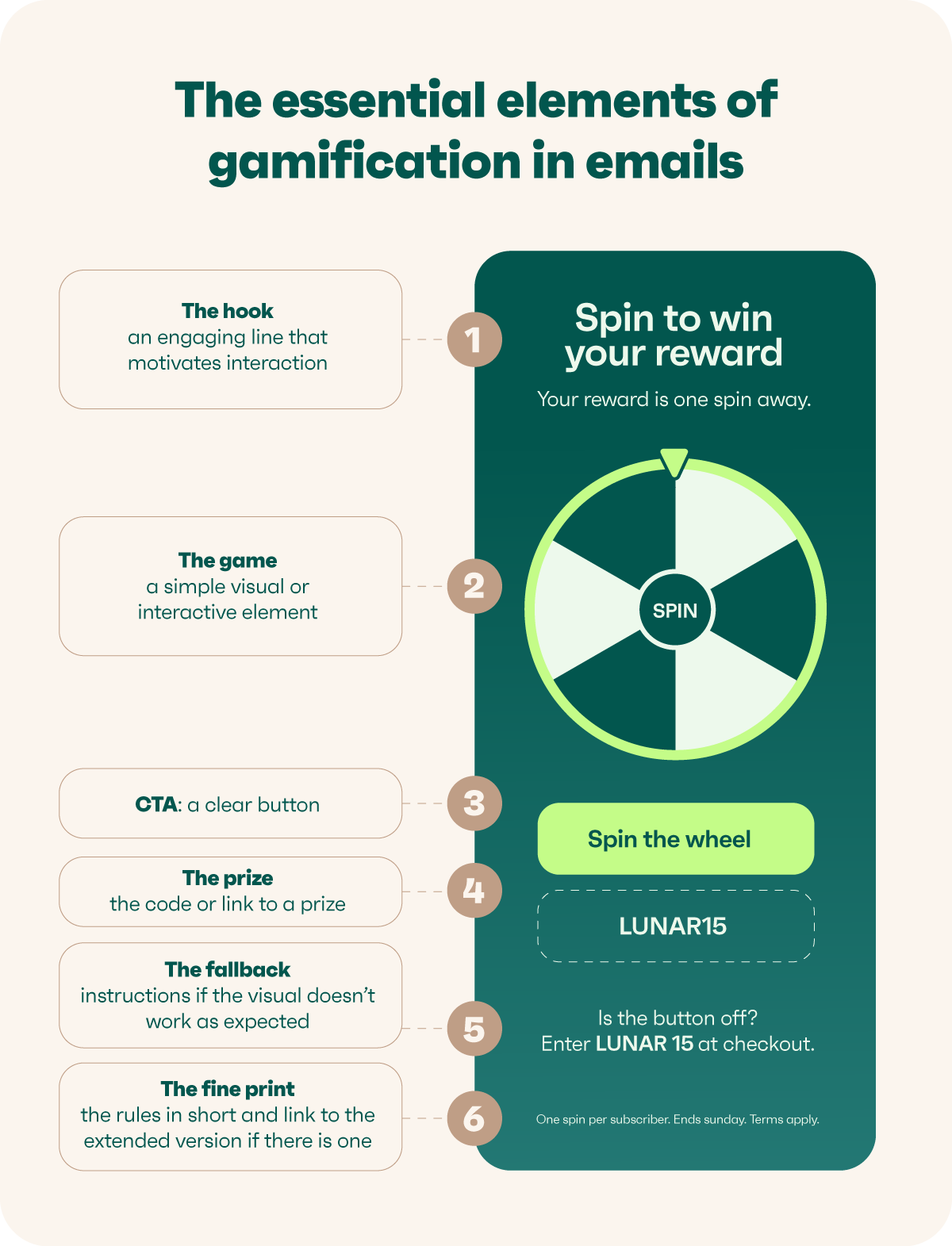
Email gamification techniques with examples
We’ve seen these techniques show up across the best gamified emails. Grouped by the job they do, they fall into three buckets:
- Growing your list and learning about subscribers
- Converting a single promotion
- Building loyalty over time
Each example below begins with the principle, presents a real brand case, and concludes with three practical notes.
Build suspense before the offer with scratch-to-reveal
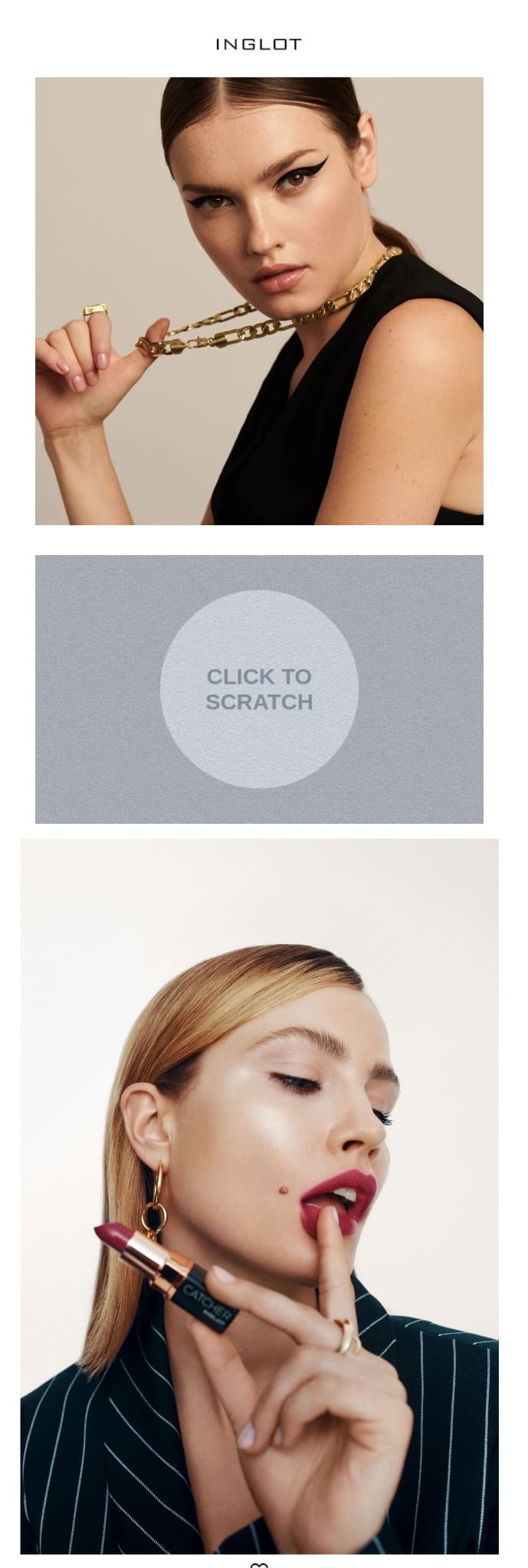
By including a scratch card in your email, you build suspense. By pairing the discount with the emotional aspect of discovery, you make the discount feel more memorable and leave a positive impression of your brand.
Example: INGLOT Canada
Type of email: Scratch-and-win
INGLOT Canada uses a scratch-and-win promotion in which the reward appears on the card and can be used at checkout as a code. The fun part comes first, and the offer comes after.
Best practices to consider:
- Tease the scratch, not the discount, because curiosity is what encourages subscribers to interact
- Every reward, however small, should feel worthwhile, as insignificant prizes can leave your subscribers disappointed
- Make sure the code is easy to copy and apply, as customers might fail to use it
INGLOT’s email and SMS cart recovery drove a 2,130% increase in revenue per message and converted at a 117% higher rate than email alone
The brand runs its campaigns on Omnisend, where automation and SMS sit alongside email.
Read the INGLOT case study
Turn a sign-up into a game with spin-to-win
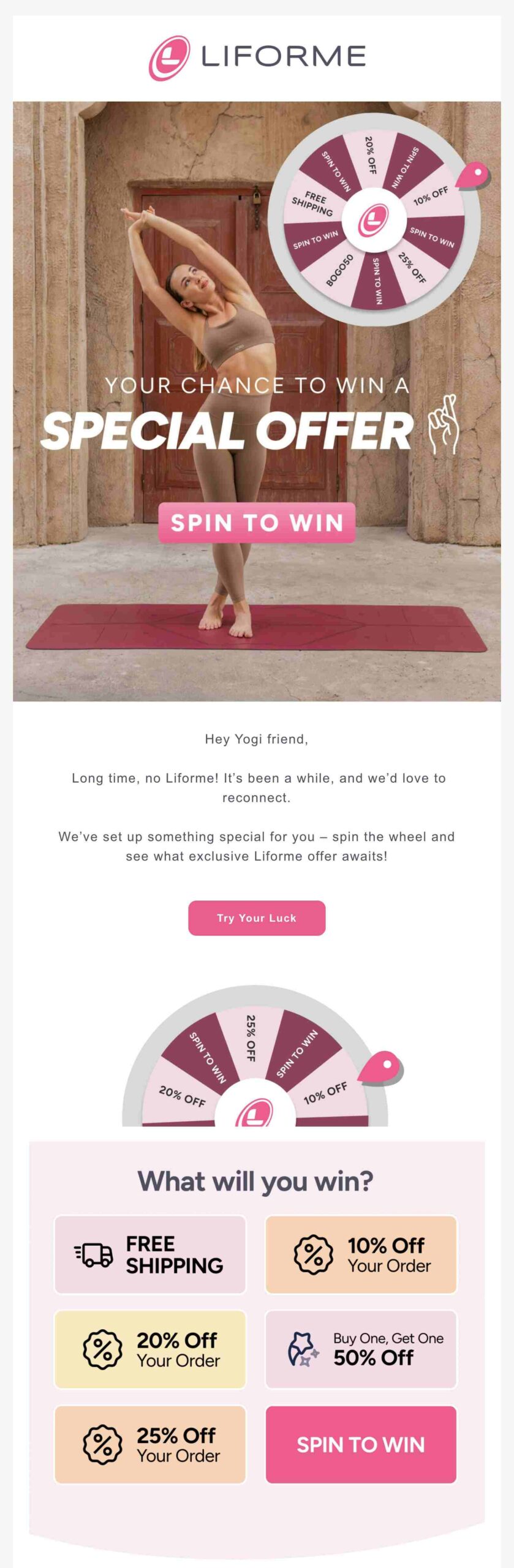
A spin-to-win trades a fun moment for an email address or a click. The wheel offers a sense of chance, and the prize is a code the reader wants to use.
Example: Liforme
Type of email: Spin-to-win
Liforme asks inactive subscribers to spin for rewards like discounts or free shipping, which makes the invitation to reconnect feel rewarding.
Best practices to consider:
- Add a wheel image in the email to tease the spin, then link it to a live wheel on the landing page
- Keep the odds fair, because once your customer feels that the game is unfair, it damages trust
- Route each spin outcome into a segment, so that the next email picks up where the game left off
Sort and entertain readers with a quiz
A quiz asks a few light questions and returns a result. The reader gets a recommendation, and you learn a preference you can act on later.
Example: Rouje
Type of email: Style quiz
Rouje’s campaign leverages principles of consumer psychology, which state that personalization can increase engagement. Their style quiz not only helps people discover more about themselves but also suggests relevant products. Plus, the quiz can be used to collect useful data for future segmentation.

Best practices to consider:
- Design each question around the audience segments you want to create, not just for fun or entertainment
- Keep quizzes short, as completion rates fall the more questions you add, plus you can always learn more later
- Match the recommended products to each result so you deliver on your promise, and the experience feels relevant
Reward the click with a mystery discount
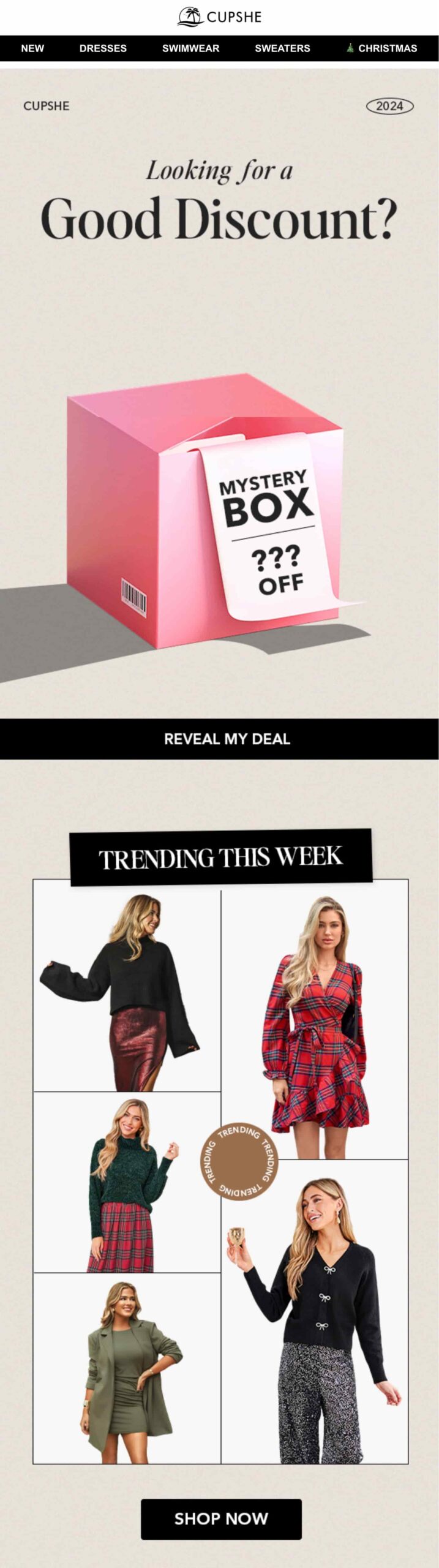
A mystery discount keeps the exact amount hidden until the reader takes action. Curiosity encourages them to click, and the reveal gives them their reward.
Example: CUPSHE
Type of email: Mystery deal
CUPSHE teases a mystery deal and reveals it on the way to the store. Its gamified email increases clicks without showing the discount upfront.
Best practices to consider:
- Set a worthwhile minimum reward so even the smallest reveal still feels worth the click
- Show the code in one move and ready to apply, since a reveal that takes two steps loses people
- Hold the strongest tier for the segments you most want to convert, since that tends to get more from the same spend
Make the item itself the reward with a mystery product
Unlike a discount, including a mystery item creates a sense of thrill that’s much more impressionable. As the buyer waits for the item until the day of delivery, they keep thinking about it and about your brand too.
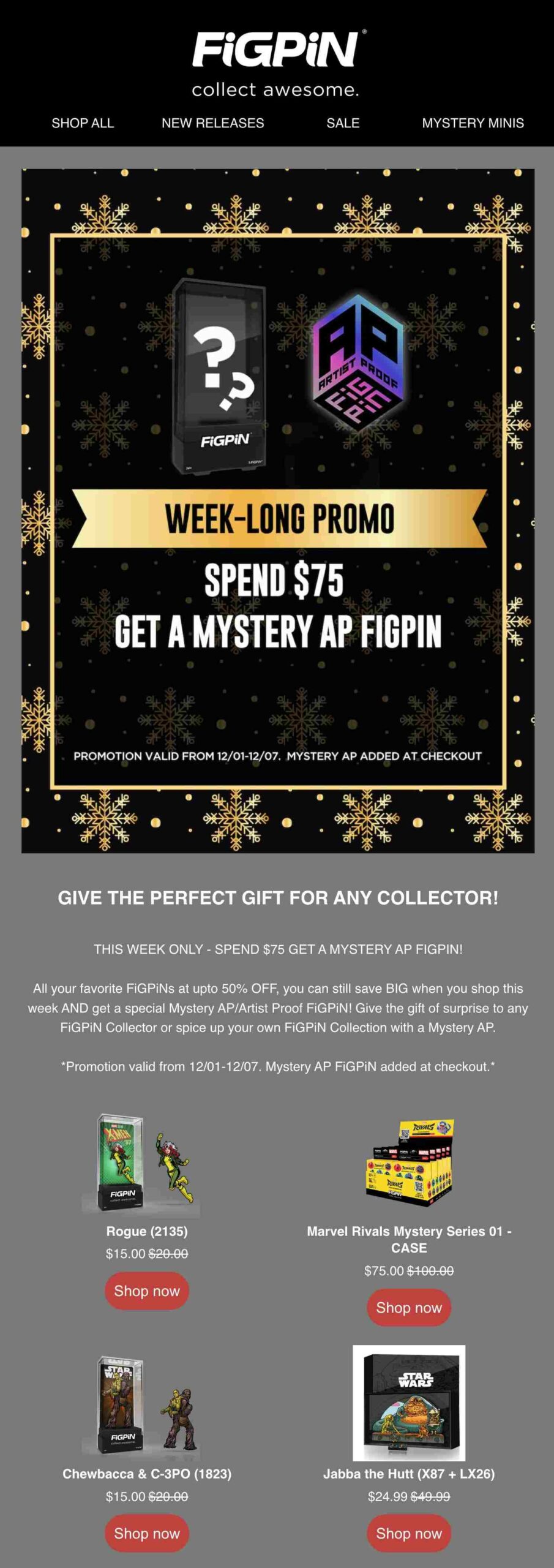
Example: FiGPiN
Type of email: Spend-and-get mystery product
FiGPiN offers a mystery Artist Proof item when customers spend a certain amount during a limited promotion. The unknown reward encourages people to spend more without using a regular discount.
Best practices to consider:
- Clearly explain the spend threshold, promotion dates, and how shoppers receive the reward, so the surprise feels fair
- Instead of simply discounting, tie the mystery reward to a spending goal to raise the average order value
- Use this tactic if your brand has a loyal audience that trusts and wants your products
FiGPiN’s automated emails drive 24% of its email revenue from about 9% of sends, with an 87% conversion rate on abandoned-cart emails.
Running a small team, the brand also sees a 22% conversion rate on its three-part welcome series.
Read the FiGPiN case study
Turn the hunt into the reward with a word search
A word search or hidden-code puzzle asks the reader to find something before they can claim it. The effort is the fun, and the payoff is a code only players know.
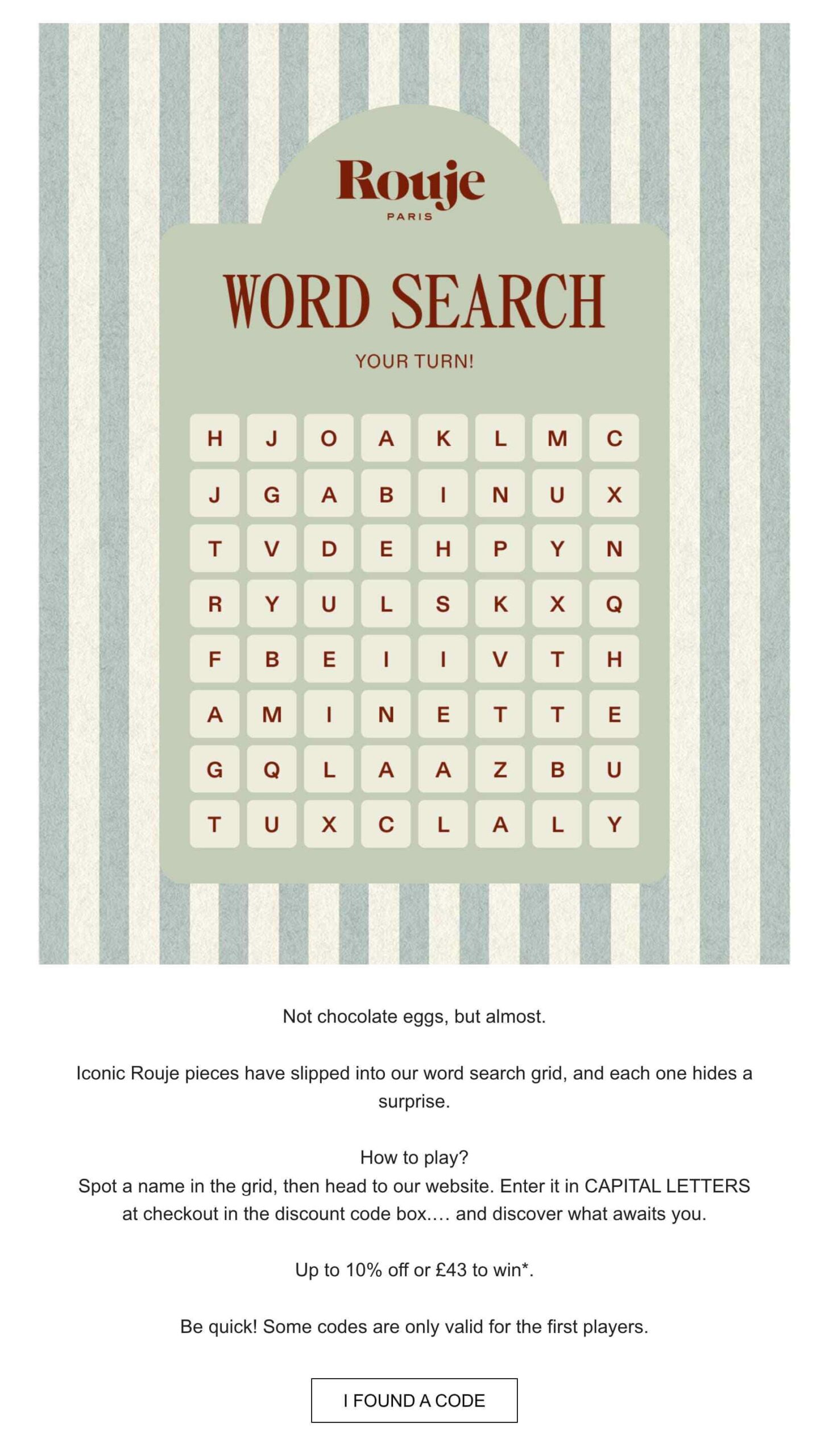
Example: Rouje
Type of email: Word search
Rouje hides its product names in a grid. Readers spot one, enter it in capital letters at checkout, and take a set amount off.
Best practices to consider:
- Create the hidden words as valid discount codes before sending the campaign, as the grid is just an image
- Explain the game in one clear sentence, because if it needs more, it’s too complex to play at a glance
- Cap the strongest codes for early players to keep the hunt fair and encourage faster action
Turn one purchase into a habit with points and badges
Using points, badges, and challenges can motivate continuous engagement from your customers. They become reasons for them to come back to your brand, purchase more, and build loyalty.
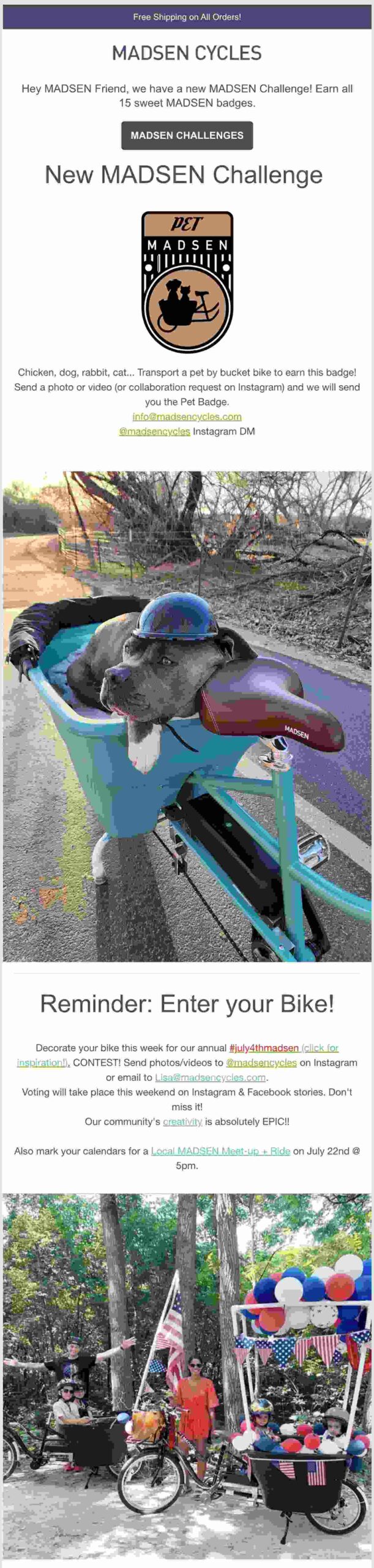
Example: MADSEN Cycles
Type of email: Badge challenge
MADSEN Cycles invites riders to earn badges by completing challenges and sharing photos for rewards. In the same campaign, they promote a contest and a meet-up. This helps create a stronger community and brand loyalty instead of just offering impersonal discounts.
Best practices to consider:
- Define what counts toward each badge or point before launch, so progress feels tied to a specific action
- Automate milestone rewards and segment by progress to deliver more relevant follow-up emails
- Extend the loyalty program across SMS marketing and social media to engage your community everywhere
Stack two gamified techniques in one email
You can mix and match some techniques as long as they complement each other. For example, a mystery box rewards the click with a deal, and the giveaway adds a bigger, time-bound prize.
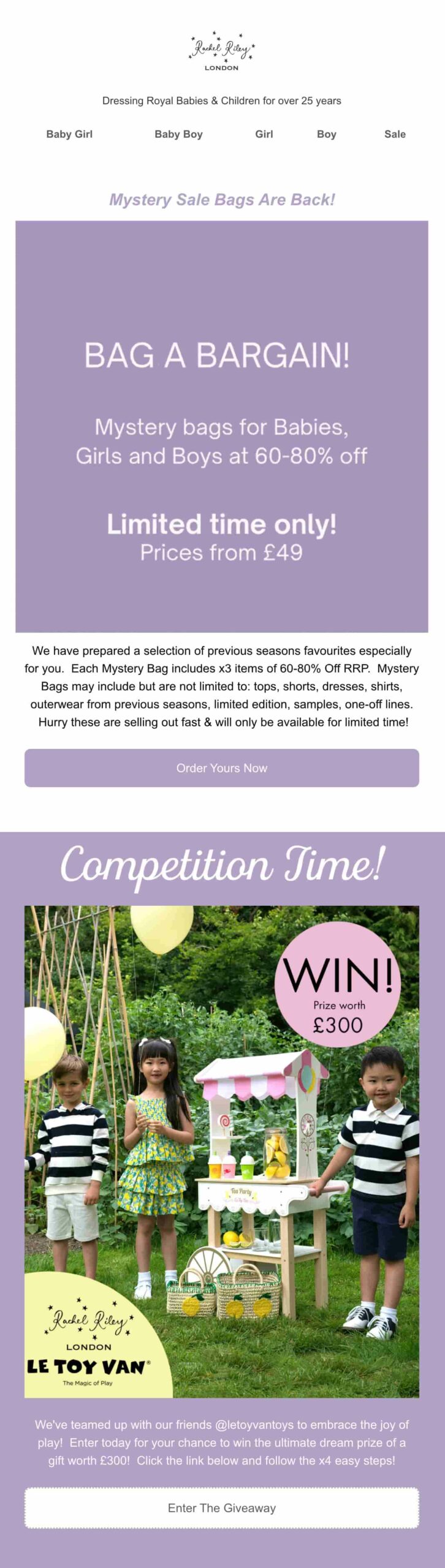
Example: Rachel Riley
Type of email: Mystery bags and competition
Rachel Riley combines mystery sale bags with a £300 giveaway in partnership with another brand. The mystery offer encourages purchases, and the competition helps reach more people.
Best practices to consider:
- Give each technique its own section and call to action to avoid overlap or the stronger one burying the other
- Let the mystery offer drive sales and the giveaway grow reach, then segment entrants for follow-up
- Keep the terms covering what’s in the bags, the prize, and the dates plain for both techniques to build trust
Where gamified emails fit across the customer lifecycle
Treat each game as an opportunity to learn about subscribers, then use that insight to drive smarter lifecycle segmentation. Each stage below is judged by the outcome that proves it worked, not by the open rate.
- Acquisition: A spin or quiz turns a first visit into a subscriber while collecting useful preferences. Pair it with your welcome emails, then track sign-up rates and the subscribers who join the right segment.
- Conversion: A scratch card or mystery reveal can revive stalled purchases. Add it to your cart abandonment flow and measure recovered revenue.
- Reactivation: A spin or mystery offer gives inactive subscribers a reason to return. It fits naturally into a win-back email campaign, where the metrics that matter are reactivations and repeat purchases.
- Retention: Points and badges reward repeat behavior across the customer lifecycle. Measure long-term repeat purchases instead of opens.
One caution: Every technique fades. Review performance beyond the first campaign, and refresh your approach before engagement starts to decline.
How to protect margin, trust, and brand fit with gamified email marketing
A game can end up costing more than it brings in if the economics, odds, or brand fit aren’t right. Here are the key things to consider:
- Pay for the prize out of your profit margin: Put the best reward behind a spending threshold, so bigger orders cover the cost.
- Don’t teach your list to wait for deals: Change up your techniques and timing, and make sure some offers stay at full price.
- Design honest odds: Set a value you’re comfortable with, but make even the smallest reward worth claiming.
- Protect rendering and deliverability: Use a static fallback and plain-text code, and gradually increase your sending volume before major contest sends.
- Know when to skip gamification: Keep transactional emails simple, use it less for premium brands, and always check the rules before running prize draws.
How to build a spin-to-win email in Omnisend
While Omnisend emails can’t run a live spin-to-win game yet, you can create a teaser email that links to the actual experience. In other words, you can add an image or an animation to the email itself, and then host the live spin on a sign-up form or landing page.
Here’s the explanation of how to do it in six short steps that any beginner can follow.
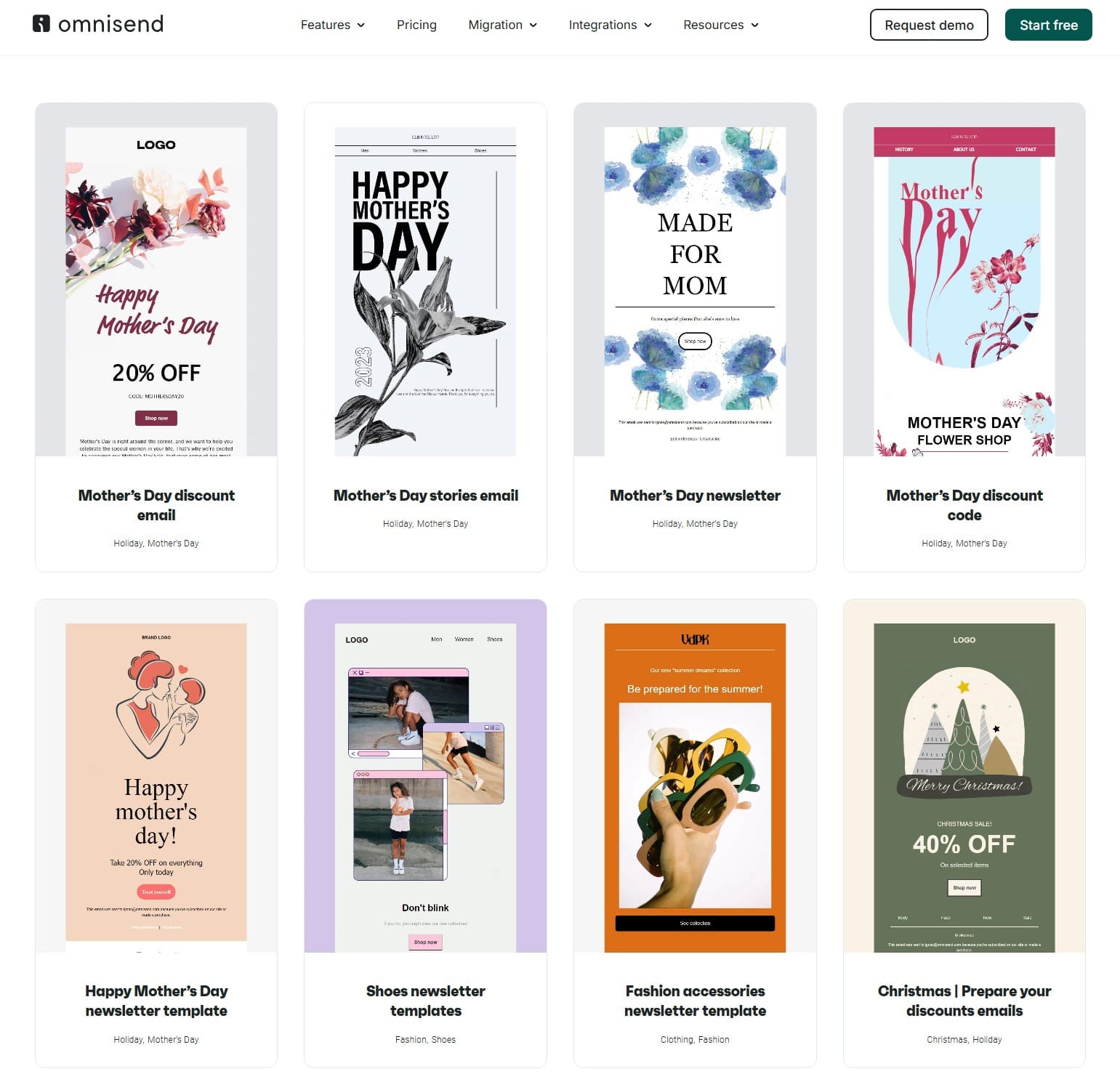
Start from a template
Select a clean promotional layout from the template gallery as your starting point. This will allow you to focus on customizing the design rather than building the email structure from scratch.
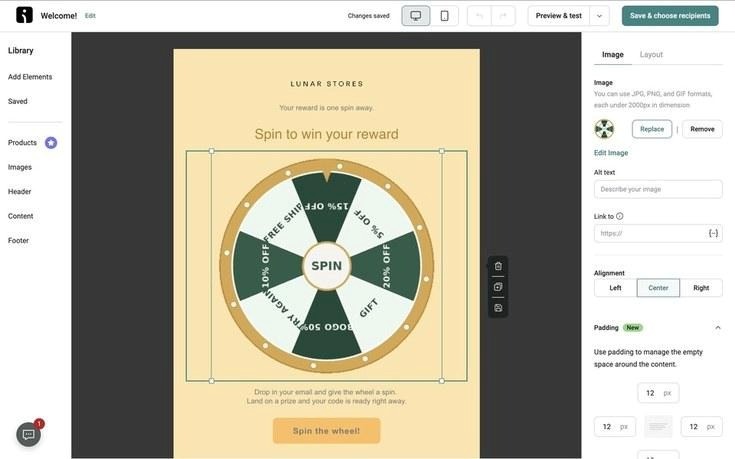
Add the wheel
Upload a static or animated wheel into an Image block. The email teases with the idea of the game without running it directly.
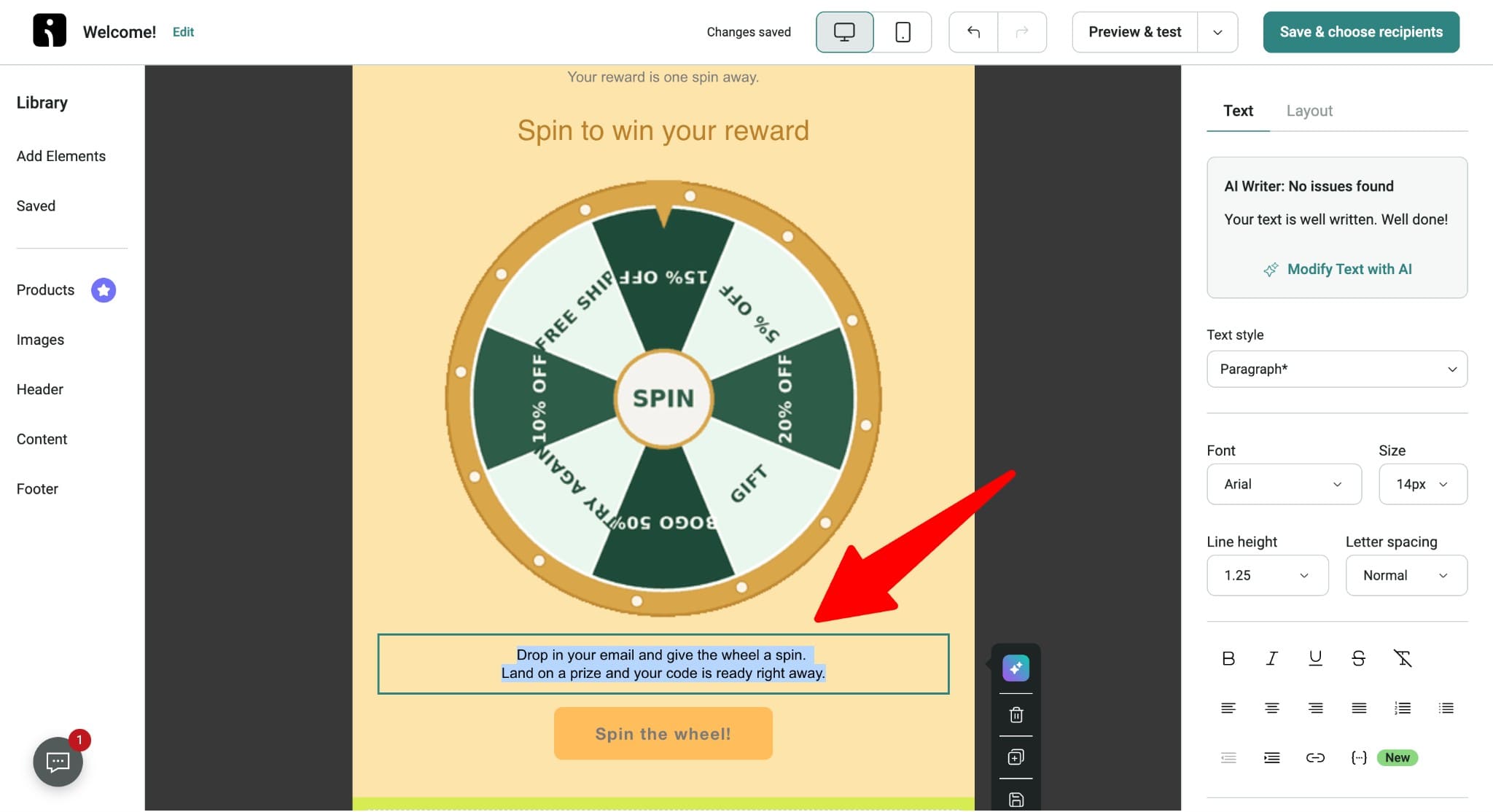
Customize the content
Update the copy, backgrounds, and fonts using the drag-and-drop builder to align with your campaign.
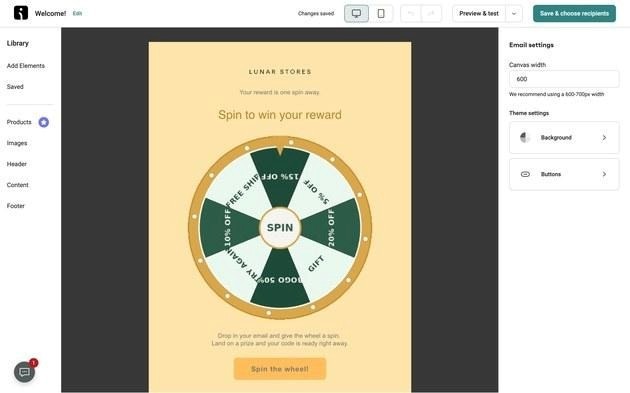
Add the call to action
Insert a Button block below the wheel image. Label it to reflect the game and link it to the landing page where the spin takes place.
Set the reward
Choose the reward, such as a discount or free shipping, to be revealed on the landing page.
Omnisend’s Discount block can auto-generate unique codes for Shopify, BigCommerce, and WooCommerce stores. Alternatively, you can insert a code manually.
Save and preview
Test the email across devices, send a preview to yourself, and confirm that the wheel image and button link both work correctly before scheduling your campaign.
A note on true in-email interactivity: Omnisend supports the Playable integration via the Custom HTML block to enable richer experiences. But for most stores, the image-and-button approach is simpler and renders consistently across email clients.
Build a gamified flow with Omnisend and start growing your contact list today.
Quick sign up | No credit card required
Frequently asked questions
Does gamification in email actually work?
Yes, gamification works when it’s set up correctly. Remember to offer novel game experiences and worthwhile discounts. This way, you will ensure that customers are motivated to interact.
Which gamification technique should I start with?
You should choose a technique that supports your goal. A spin-to-win wheel or a quiz will help you grow your list and collect subscriber data. If your goal is to build loyalty, choose points and badges. Finally, mystery offers and scratch cards work best for promotions.
Why do gamification campaigns lose steam over time?
Usually, gamification campaigns lose steam because the novelty wears off. To ensure your customers are excited about your gamified emails, make sure to rotate techniques and review performance regularly.