11 Best Iterable Alternatives in 2026 (Review & Comparison)
Iterable specialises in real-time messaging automation. In late 2025, the platform passed one trillion customer interactions.
I’ve used and reviewed a lot of marketing automation platforms over the years. Iterable is powerful, impressive, and built for the enterprise. But it can also get expensive and complex.
So I’ve hand-picked 11 Iterable alternatives that suit the needs of multiple types of businesses. Because marketing automation doesn’t have to mean enterprise. And even for enterprises, there are other services that do what Iterable does.
11 Best Iterable Alternatives Overview
Platforms like Iterable are usually the more advanced platforms with behavioral targeting and in-the-moment delivery. But they don’t fit everyone. So whether you’re looking for a platform for your mid-market SaaS, enterprise, startup, or ecommerce store, you’ll find one here.
We looked at both enterprise and SMB-friendly platforms. Enterprise services are direct alternatives to Iterable. SMB tools are for businesses that don’t have a huge martech budget or a lot of in-house development resources.
Why do people look for Iterable alternatives?
Iterable gets a lot of labels. Customer engagement platform (CEP). Cross-channel messaging orchestration. Lifecycle marketing platform. In the core, they all have the same functionality: automation and personalization across email, mobile, web, and other digital channels.
There are a few common reasons why people look for alternatives to Iterable:
It’s costly. Iterable doesn’t publish pricing with clear, predictable pricing tiers. You have to go through an application process to get a custom quote. Custom pricing usually signals high pricing. Reports suggest that Iterable subscriptions start at a minimum of $30,000 a year. While common for enterprise software services, it puts off companies working on a budget.
It has technical complexity. Another challenge with Iterable is technical complexity. Iterable isn’t an all-in-one marketing automation platform. It works by connecting to other platforms you use. And pulling in data from there. This means setting up or building the necessary integrations and data pipelines.
The forms and landing pages are pretty basic. This makes it harder to grow your database and use that data to trigger workflows and personalize messages. That’s a barrier for teams that want a platform that works out of the box.
Needs a separate tool for deeper analytics. Yes, it provides insights into campaign performance. Yet, customer reviews show that Iterable users find that the reporting and analytics don’t satisfy their needs completely. So teams still export data to their data warehouse and use BI tools for deeper analysis.
Shopify is the only native ecommerce integration. You could build your own integration if you have another ecommerce platform, through API, Zapier, or n8n. But many rival services have ready-made native connections for all major ecommerce platforms.
What to look for in an Iterable alternative
Here are the main things to consider when evaluating Iterable alternatives:
- Ease of use and implementation. Iterable requires engineering support and an advanced data infrastructure to run effectively. Smaller businesses need an easy-to-use platform. Look for features like visual automation builders. Pre-made integrations with other platforms you use. And onboarding support for getting started.
- No-code marketing automation. Iterable is, at its heart, a highly sophisticated marketing automation platform. Messaging automation is non-negotiable for any alternative. Look for workflow flexibility, event-based triggers, and how the platform automates targeting. These are critical to getting the right message out to customers in real time.
- Strong multi-channel messaging. Iterable supports multiple channels, so a good alternative should too. Email remains essential to marketing. Support for other channels helps you build multichannel customer journeys.
- Data-driven segmentation and personalization. Customer data powers real-time messaging orchestration and effective targeting. Look for how a platform gathers and manages data, whether it’s a CDP or CRM database. Consider how customer data gets used for personalization. How flexible is the segmentation for cohort-level targeting? To what extent can you personalize messaging content?
- Clear pricing and scalability. Cost is a big point of difference when choosing an Iterable alternative. Enterprise CEPs are expensive. If you have the budget, make sure you’re getting the exact tools you need for your investment. If you’re a smaller business, pricing transparency can be as important as features. You want to know exactly what you get for your money. And be able to budget for growth.
11 Best Iterable Alternatives
Maestra Review – Iterable Alternative for Ecommerce Customer Engagement
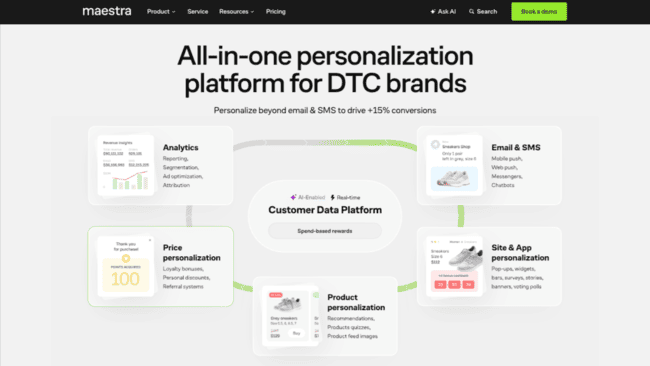
Maestra is a specialist ecommerce marketing platform with white glove service. While ecommerce businesses do use Iterable, it requires additional integrations.Maestra only works with ecommerce brands on platforms like Shopify, BigCommerce, WooCommerce, and Magento. It adds a full marketing suite to your webstore.
Features that make Maestra a good Iterable alternative:
- A built-in customer data platform (CDP) that captures data from every customer interaction. And uses it for personalized campaigns.
- Cross-channel campaigns covering email, SMS, WhatsApp, push notifications, and onsite messaging.
- An intuitive visual workflow builder that helps simplify automations.
- AI-powered personalization, including dynamic email content. Real-time one-to-one messaging. And targeted product recommendations delivered via pop-ups in your store.
- Loyalty program tools, including discount coupons that automatically link to your webstore checkout.
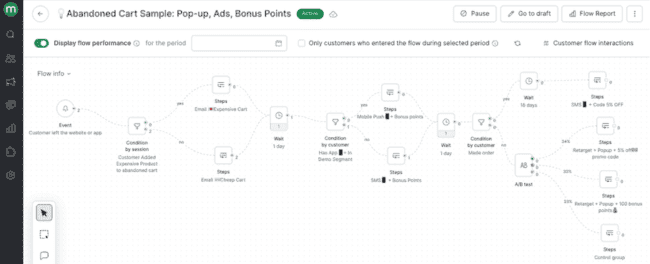
Maestra and Iterable share similar core functions. They let you respond to customer actions with targeted messages in real time. Or what marketers call customer engagement orchestration. But aside from the ecommerce focus, they differ in scope and how they work.
Iterable adds a messaging layer to mature enterprise marketing stacks. It doesn’t have its own CDP. And there are no loyalty program or discount coupon functionalities.
Maestra is the full all-in-one ecommerce marketing platform. This suits mid-market retailers that have outgrown more basic marketing automation platforms and need to make the next step in capabilities. It’s a convenient single-platform package. And you get full service with a customer success manager.
The loyalty program features in Maestra show that it’s also a platform for retention. Its focus isn’t just on sending messages, but on strengthening relationships with existing customers.
Pros
- A convenient single platform for personalized customer engagement.
- Built for ecommerce, with tight integrations to Shopify, BigCommerce, WooCommerce, and Magento. And commerce-focused features like product recommendations and coupons.
- The built-in CDP gives teams the data needed for personalization and event-driven automation.
- Having a dedicated customer success manager makes it easier to get started without relying on developers.
Cons
- Maestra’s flat-rate pricing provides transparency and consistency, but also means it is not for smaller businesses.
- Pre-made workflow templates would make self-service automation even easier to use.
Plans start from $2,990 per month for 150K active customer profiles. Demo and trial are available to try the platform.
Book a Maestra demo or read our full review
Omnisend Review – The Best Alternative to Iterable for Ecommerce Stores
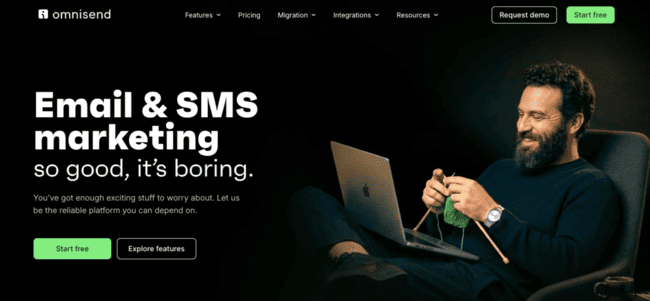
Omnisend is a multichannel marketing platform for ecommerce stores. It connects with all major commerce platforms. And helps businesses use store data to target and automate marketing campaigns.
Features that make Omnisend a good Iterable alternative:
- Quick connections to Shopify, WooCommerce, BigCommerce, Wix, and other popular ecommerce platforms.
- Multichannel campaign automation across email, SMS, and web push. Plus Google and Facebook ad retargeting.
- Customer lifecycle mapping to understand how shoppers engage over time.
- Pre-built automation workflows for abandoned carts, welcome series, and repeat purchase campaigns.
- User-friendly drag-and-drop email builder with 350+ templates.
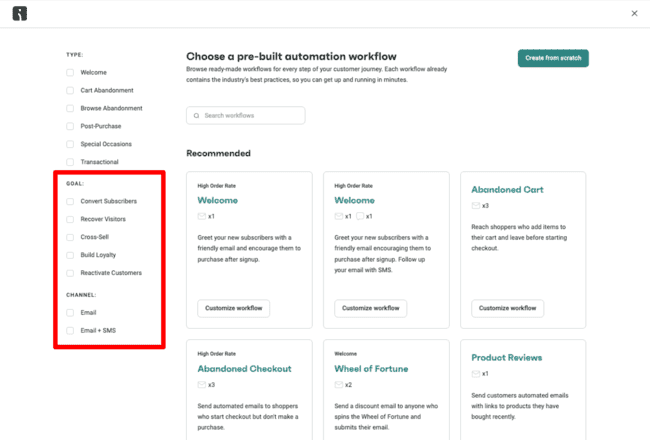
Omnisend is a much more intuitive platform compared to Iterable. It’s perfect for retailers that want to automate customer engagement without any technical complexity. While Iterable is often used by larger teams with very high message volumes, Omnisend is designed to fit the day-to-day needs of growing ecommerce businesses. For many SMBs, that balance makes automation easier to adopt.
Ecommerce integrations make all store data available for segmentation and triggering campaigns. The interfaces are intuitive. With drag-and-drop visual builders for email and automation workflows. To get started, there are 350+ fully designed email designs and 35+ workflow templates.
Omnisend doesn’t shy away from intelligent targeting either. It uses your store data to map out different engagement levels across customers. And recommends tactics for locking in retention or conversion. You can use movement into and out of mapping stages to trigger campaigns. You can use purchase history, behavior tracking, and attributes for segmentation. Plus, you can personalize content with product recommendations or custom offers.
Pros
- Ecommerce specialist with powerful integrations with Shopify and other popular ecommerce platforms.
- User-friendly marketing automation with a visual workflow builder and 35+ templates.
- Intelligent targeting via customer lifecycle mapping, advanced segmentation, and content personalization.
- Affordably priced.
Cons
- It’s an ecommerce specialist, so non-ecommerce companies should look at other platforms.
- Mobile app messaging or a full CDP layer, you’ll need to use an integration. Or look at enterprise platforms with internal CDP.
Omnisend pricing starts at $11.20 per month for 500 contacts and 6,000 emails a month. You can use Omnisend for free with 250 contacts, 500 emails, and all Pro features.
There’s an extra discount, too. Get started here and enter code EVS35 at checkout to get an additional 35% off for 3 months.
Get started with Omnisend for free or read our full review
ActiveCampaign Review – The Best Iterable Alternative for Marketing Automation
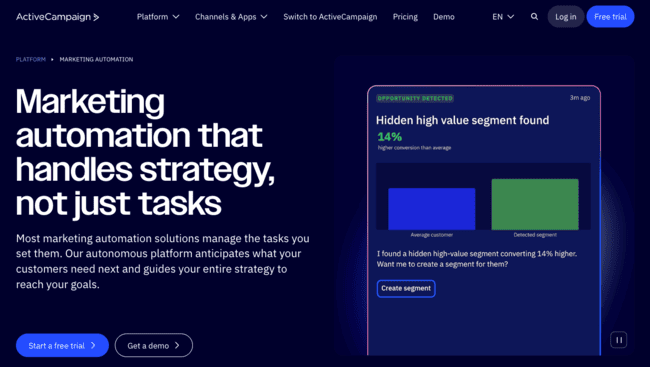
ActiveCampaign is a marketing automation service. It’s one of the most popular platforms in its class. It makes advanced campaign automation accessible to smaller businesses. And it’s great for linking marketing with sales so they complement one another.
Features that make ActiveCampaign a good alternative to Iterable:
- A user-friendly visual automation builder with 1000+ workflow templates.
- Email marketing with a drag-and-drop builder and 250+ responsive templates.
- Built-in CRM for managing leads, deals, and customer relationships.
- Multi-channel messaging, including email, SMS, WhatsApp, and site messaging.
- 1000+ integrations with CRM, ecommerce, and data tools.
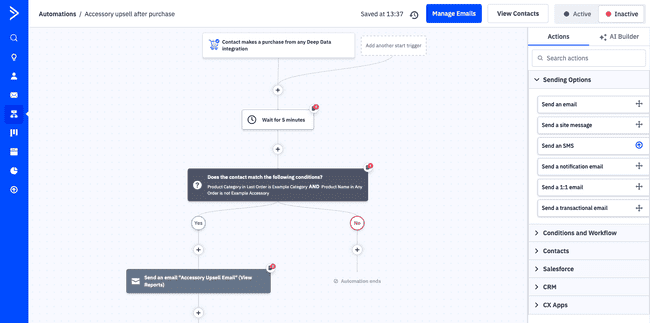
A lot of businesses are drawn to what Iterable offers. But then realise it’s too expensive, or they don’t have the technical expertise to run it. In short, Iterable isn’t SMB-friendly. ActiveCampaign is. ActiveCampaign doesn’t have the orchestration and personalization power of an enterprise CEP. But it automates entire customer journeys across marketing channels. And uses customer behavior to trigger messaging. It backs this up with very detailed segmentation for effective targeting.
ActiveCampaign’s biggest strengths are flexible automation, usability, and it is still affordable. Even if you can’t find the perfect fit from its 1000+ workflow templates, they’re fully customisable. There are no limits on triggers, actions, or conditional rules. And you can join as many workflows as you like together, with events in one triggering another. You can pretty much automate what you want.
Another benefit is that ActiveCampaign has features for the entire customer journey. Landing pages and sign-up forms handle lead capture. Automation templates cross from nurturing into conversion-focused sales workflows. Ecommerce integrations and sales-focused analytics appeal to retail businesses. The built-in CRM makes it suitable for B2B sales teams.
Pros
- Powerful automation at an affordable price.
- All-in-one platform combining lead capture, marketing, sales automation, and CRM.
- User-friendly drag-and-drop workflow builder with 1000+ templates.
- 1000+ integrations.
Cons
- Doesn’t match enterprise CEPs for website personalization.
- Rule-based automation logic isn’t as powerful as some enterprise CEPs.
ActiveCampaign pricing starts from $15 per month for 1,000 contacts. There is a 14-day free trial available to test the platform.
Try ActiveCampaign for free or read our full review
HubSpot Review – The Best CRM Alternative to Iterable
HubSpot is a popular customer relationship management (CRM) platform. A big part of its success is its appeal to businesses of all sizes. Its product list covers sales CRM, marketing, customer service, commerce, and data management.
Features that make HubSpot a good alternative to Iterable:
- Customer database that provides a central data resource for all other tools.
- Marketing automation and multi-channel campaigns, including email marketing.
- A complete sales CRM.
- Customer service, ecommerce, and content management tools. Plus 1,500+ third-party integrations.
- Breeze AI’s chatbot, generative, and agentic AI tools.
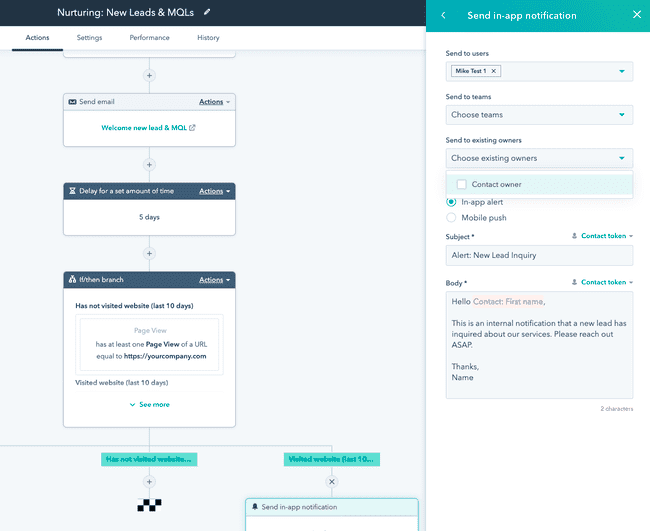
Customer relationship management software and customer engagement platforms sound similar. But a quick comparison between HubSpot and Iterable reveals crucial differences. As a CRM, HubSpot is first and foremost a database of customer interactions. It uses this customer data as a foundation for all its ‘Hubs’. Sales, marketing, customer service, etc. Iterable leaves the data gathering to other applications. It’s all about channeling data into one specific type of action. Personalized, real-time messaging orchestration across channels.
HubSpot can automate and target messaging across channels in a CEP-like way. Its Marketing Hub is an impressive marketing platform in its own right. It’s particularly good for channeling in-depth customer insights into automated actions. But it doesn’t have Iterable’s precision in personalization.
But you can do far, far more in HubSpot. It suits businesses that want customer engagement to be part of a bigger picture. Not the sole focus. Another big strength is HubSpot’s flexibility. You can mix and match features in custom plans. Or choose its all-in-one customer platform products. This starts with an outstanding free plan. This gives you the basics of CRM, sales pipelines, email marketing, and support tickets. As you grow, you can scale this into sales and marketing automation. And place customer engagement in the context of driving sales conversions. And post-sale aftercare and retention.
Pros
- Complete customer platform combining CRM, marketing, sales, service, and more.
- Generous free CRM with 100 contacts and 2K monthly emails.
- Powerful AI and automation features.
- Large ecosystem of 1500+ integrations
Cons
- Pricing and product tiers can be confusing, with lots of add-ons and hidden costs.
- The size of HubSpot means it’s not the easiest platform to get started with.
HubSpot’s free plan is one of the best around. It includes email marketing, sales pipelines, and productivity tools. Plus access to some integrations and Breeze AI. Paid Marketing, Sales, and Customer Platform plans start from $9 per user per month. But prices rise quickly beyond starter tiers.
Sign up to HubSpot for free or read our full review
Klaviyo – Iterable Alternative for Ecommerce Marketing Automation
Klaviyo is a marketing automation platform built for online B2C vendors. It works with major ecommerce platforms. And helps merchants use first-party data from their store to nurture customer relationships.
Features that make Maestra a good Iterable alternative:
- Multichannel messaging across email, SMS, WhatsApp, push notifications, RCS and social messaging.
- Ecommerce integrations with Shopify, BigCommerce, and Magento.
- Visual automation builder and 80+ templates.
- Built-in data management and advanced analytics.
- Lead capture tools with customizable pop-ups and signup forms.
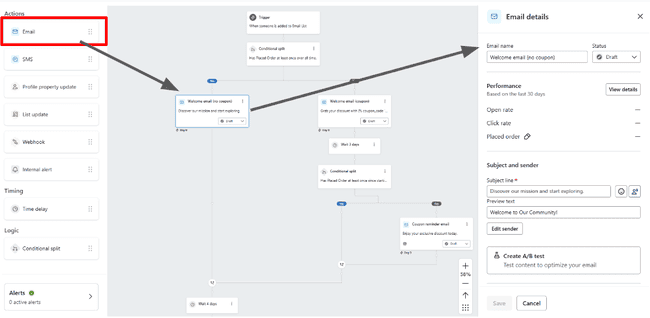
Klaviyo is more of a marketing automation platform than full-fledged CEP. But like Iterable, it uses data to trigger and target customer messaging. One difference is that Klaviyo is ecommerce-specific.
Klaviyo doesn’t match Iterable’s ability to personalize messaging at a very big scale. But the way it uses data to drive engagement is impressive. This extends to a CDP add-on. From this base, Klaviyo operates in more traditional marketing platform territory. It has a drag-and-drop editor and a visual automation builder that lets you create multichannel workflows.
In-store behavior tracking triggers automations in real time. So you get the in-the-moment engagement effect. And the customer data you can collect drives powerful, flexible segmentation. Klaviyo helps smaller businesses drive real-time customer engagement using their store data. But keeps the technical setup to a minimum.
Pros
- Ecommerce integrations allow direct selling via email and other marketing channels.
- Behavior-based automation triggers for real-time messaging.
- Advanced segmentation and targeting based on customer data from your store.
- Free plan with 2,500 emails a month.
Cons
- Attribution reporting can over-credit campaigns, leading to inflated performance.
- Contact and email limits apply to all plans.
Klaviyo pricing starts from $20/month for email, or $35/month for email and SMS with 500 contacts. A free plan is available with up to 250 contacts and 2,500 monthly emails.
Sign up to Klaviyo for free or read our full review
Brevo – The Best Iterable Alternative for Affordable email and Marketing Automation
Brevo is an all-in-one marketing platform for SMBs. It combines email marketing, automation, CRM, and multichannel messaging. It doesn’t match Iterable’s scale and sophistication. But it covers the full customer journey in a single, user-friendly platform. And is a fraction of the cost of Iterable.
Brevo’s superpower is ease of use. Workflows, segmentation, and campaign creation all rely on intuitive visual tools. You don’t need to worry about coordinating data flows across a tech stack. You just need a contact list. It’s ideal if you’re new to marketing automation.
For all its simplicity, Brevo isn’t a basic marketing platform. It supports email, SMS, WhatsApp, web push, mobile push, and live chat. You can use website behavior tracking to create event-based automation triggers. Like Iterable, this means getting your messages out to people in real time. Behavior tracking also feeds into segmentation. So you can target people based on their engagement. You can even automate segmentation with tags. Brevo’s Aura AI also recommends segments you should create based on your data.
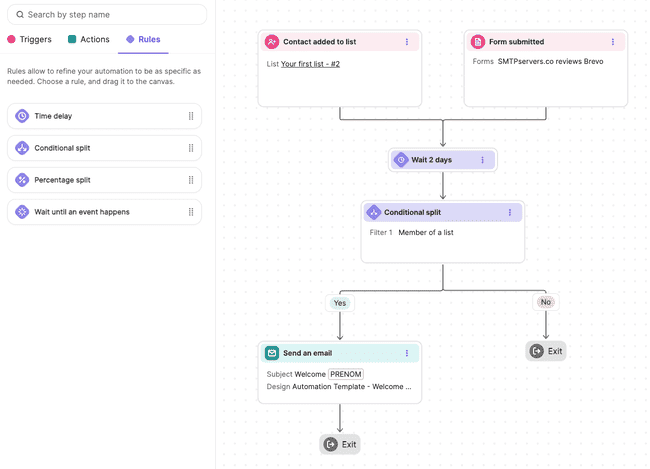
Brevo has one of the most generous free plans. That makes it a great entry point into marketing automation for startups and SMBs. It includes automation and segmentation tools. The main limit is you’re only allowed 300 emails a day. But it’s a great starting point. Paid plans remain affordable and scale in price with the number of emails you send. As you grow, you can add other products like a sales CRM, a customer data platform, loyalty tools, and transactional emails.
Pros
- Accessible and affordable marketing automation with an excellent free plan.
- Scalable pricing and product structure support growth.
- Simple but sophisticated automation with a user-friendly visual workflow builder.
- Event tracking feeds into real-time automated messaging.
Cons
- Doesn’t yet have more advanced features for personalized campaigns.
- It locks some strong features behind its Professional tier. Such as most commerce tools and contact scoring.
Brevo’s paid plans start from $9 per month. This includes 5,000 emails and unlimited contacts. Although you can only reach 2,000 contacts via automated flows. This becomes unlimited on the Business plan ($18/month).
Get started with Brevo for free or read our full review
Braze Review – The Best Iterable Alternative for Enterprise Scale Mobile Messaging
Braze is a customer engagement platform (CEP). It’s all about data-led, real-time messaging orchestration and personalization. At scale and across many channels, including email, SMS marketing, push notifications, and in-app messaging.
That makes Braze one of Iterable’s most direct competitors. Both connect to a wider tech stack and pull in customer data from external sources. Both have visual automation builders to map out why and when you want to trigger messages. Both use customer data to personalize messaging.
Braze has a more mobile-first focus than Iterable, obvious from its in-app messaging features. Interactive message features include surveys, forms, and spin-the-wheel. And there’s a long list of message modes, from full-screen overlays to in-line banners. Content cards provide an alternative to disappearing messages. They let you deliver persistent content via a dedicated inbox. These tools work for any connected app. Braze supports messaging via SMS, WhatsApp, and other third-party messaging apps like LINE.
Braze is more technically sophisticated. You often hear people call Iterable the more user-friendly CEP. Braze requires more technical expertise to run. But its sophistication has advantages. Braze’s data processing model is faster and more powerful. There’s minimal latency in message response times, even at the highest volumes.
Braze has better data tracking capabilities. Including capturing data about anonymous users. Then, automatically integrate it into identified user profiles later. It uses the Liquid template language for personalization. Again, it’s harder to use than the more standard Handlebars tags Iterable uses. But the advanced logic allows for more nuanced personalization at scale.
Finally, Braze is notable for its real-time performance tracking. Rather than post-event reports, you get up-to-date analytics as part of the workflow.
Pros
- Fast and efficient even at the highest messaging volumes.
- Specializes in mobile engagement, including one of the best in-app messaging tools.
- Advanced personalization using Liquid templating.
- Real-time performance analytics delivered within workflows.
Cons
- Requires a significant level of technical know-how.
- Doesn’t publish its pricing and is generally out of the range of smaller businesses.
Pricing for Braze is by quote only. Typical costs usually start in the region of $60,000 a year minimum. Braze does explain that it doesn’t base pricing on customer numbers or user seats. But instead makes a calculation based on projected business impact.
Compare Braze to similar platforms in our review of the best Braze alternatives.
CleverTap Review – The Best Iterable Alternative for Advanced Data Management
CleverTap is an enterprise CEP that ticks all the usual enterprise CEP boxes. It automates real-time, personalized customer messaging at scale. All CEPs do this based on customer data. It’s how they know who to message, when to message, and what to say. But not all of them, Iterable included, have built-in data storage features. CleverTap does.
Iterable relies on connections to external data sources to gather the data it uses. Its Smart Ingest tool integrates with 23 data warehouse platforms. It includes a user-friendly no-code interface for managing the data it pulls in.
CleverTap has its own built-in data warehouse, TesseractDB. It can store up to 10,000 data points per user per month. So what you know about each customer isn’t limited by external platforms. Plus, you get more control over data quality and consistency. Faster processing for complex data queries. And long-term storage for up to 10 years.
Like all CEPs, CleverTap uses this data resource for messaging orchestration and personalization. But CleverTap is ahead of the curve on how it uses AI for both. It has AI agents that help with the whole customer engagement cycle. From developing strategies for improving retention and CLV. To creating personalized content and orchestrating every interaction.
CleverTap’s data resources support an impressive suite of behavioral analytics tools, too. They include cohort analysis, funnel tracking, churn analysis, and behavioral segmentation. This gives you a deep understanding of who your customers are. Real-time performance analytics, meanwhile, support testing. CleverTap encourages constant optimization with A/B testing across messaging content. It automatically uses the best-performing versions in production. While its AI tools predict the performance of different workflow configurations.
Pros
- The native data warehouse helps teams understand each customer in greater detail.
- Agentic AI provides intelligent support for the whole customer engagement cycle.
- Powerful behavioral analytics informs engagement strategy and drives personalization.
- Entry-level tier makes the platform accessible to smaller businesses.
Cons
- Getting the most out of the data warehouse requires technical data skills.
- Doesn’t publish prices for full platform access.
CleverTap’s Essentials plan starts at $75 per month. This is a ‘lite’ version for 5,000 contacts, messaging automation and basic analytics. For the full platform, pricing is by application only. You can test the platform out on a 30-day free trial.
Insider One Review – The Best Alternative to Iterable for AI-Driven Personalization
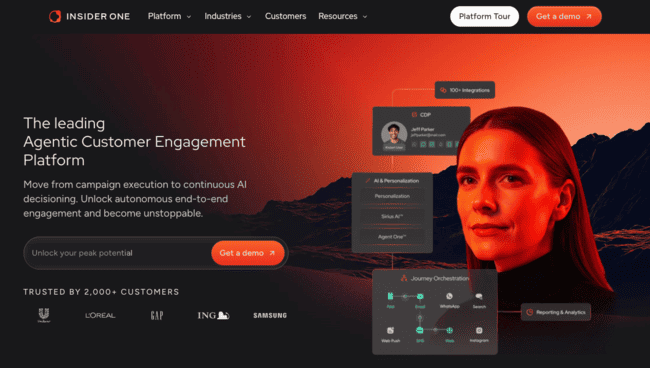
Insider One is another enterprise CEP and a close competitor of Iterable’s. Like Iterable, it sends real-time cross-channel messages based on customer data. But Insider One places a stronger emphasis on AI-powered optimization and on-site personalization.
Insider One has more developed AI tools than Iterable. Sirius AI, its AI engine, combines predictive analytics with generative tools for building campaigns and task-specific AI agents. These include customer-facing agents for shopping and support.
AI plays a key role in Insider One’s personalization features, too. It uses predictive analytics to build customer segments. In this way, you’re not just reacting to events that have happened. But targeting messages based on anticipated customer behavior and likely intent.
Insider One is strong on content personalization, too. It covers 12 channels in total. Including email, SMS, WhatsApp, and in-app mobile and on-page web messaging. Across all, there are 100+ content templates. You can personalize things like targeted offers and product recommendations using dynamic content. It’s particularly good for on-page website personalization.
Powering all of this, Insider One’s built-in customer data platform connects to over 100 external platforms. Including CRMs, data warehouses, and marketing tools. That compares to 23 plug-ins for Integral’s Smart Ingest. This makes it easier to collect customer data from many sources without having to use an API.
Pros
- Predictive segmentation and flexible personalization across channels.
- Advanced predictive, generative, and agentic AI.
- 12 messaging channels, including in-app and on-page web messaging features.
- Built-in CDP with integrations to 100+ data sources.
Cons
- Implementation can be slow as it relies on custom technical setup from Insider One.
- It doesn’t publish its prices.
Insider One only provides custom pricing on request. There is no free plan or trial, but demos are available.
Salesforce Agentforce Marketing (formerly Salesforce Marketing Cloud) Review – The Best Alternative to Iterable for a Complete Enterprise Marketing Suite
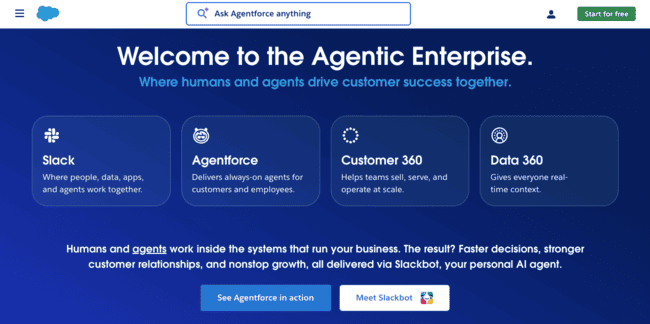
Salesforce Agentforce Marketing is an AI-powered enterprise marketing platform. It’s designed for large organizations that want to run all marketing from a single platform. It does all the things you’d expect from a CEP. Including cross-channel messaging orchestration and automation. But it covers areas of marketing that Iterable doesn’t. Such as more traditional campaign building and creative. Paid media & advertising. And loyalty schemes.
Salesforce Marketing is part of the much larger Salesforce CRM ecosystem. If you already use Salesforce products, Agentforce Marketing makes sense. It ties marketing tightly with sales and support. You get a unified view of your customers across the full customer journey. And you get the benefit of Salesforce’s advanced data capabilities.
Salesforce runs on its own CDP. This integrates data across its own applications. And it connects with 170+ third-party platforms. This data foundation underpins customer profile enrichment. Precise, dynamic segments. And personalizing every interaction, from real-time messaging and campaign content to loyalty rewards.
The single data view aligns sales, marketing and service in the same direction. Real-time analytics assess marketing performance on conversions and expected revenue. Lead scoring automates the handoff of the best prospects to sales funnels. Sales data continuously informs campaign optimization. So you’re not wasting resources on ineffective tactics. And all of this works equally well for B2B as well as B2C operations.
With its ‘Agentforce’ rebranding, Salesforce now positions itself as an AI-first platform. It boasts advanced features like its Agentforce AI agents. These are now presented as the main interface for its marketing tools. They serve as chatbot-like assistants. But they have the power to automate tasks. Advise on strategy and surface data insights. Agentforce is promising, but it’s not always plug-and-play. Teams may need clean customer data, Data Cloud/Data 360, careful governance, and technical support to get real value from it.
Pros
- All-in-one enterprise marketing platform
- Deep integration with Salesforce CRM and wider ecosystem
- Built-in CDP and advanced analytics
- AI-powered agents for campaign optimization
Cons
- Salesforce is a big, complex platform. Even deciding on the best tiers and products can be a challenge.
- Although it has tiers priced for SMBs, they only cover basic CRM functions. Marketing automation features are expensive.
Salesforce Agentforce Marketing pricing starts at around $1,500 per month. Pricing varies across multiple plans and bundles depending on features and scale.
If Salesforce doesn’t sound right for you, check out our review of the best Salesforce alternatives.
Customer.io – The Best Iterable Alternative for User-Friendly Messaging Orchestration
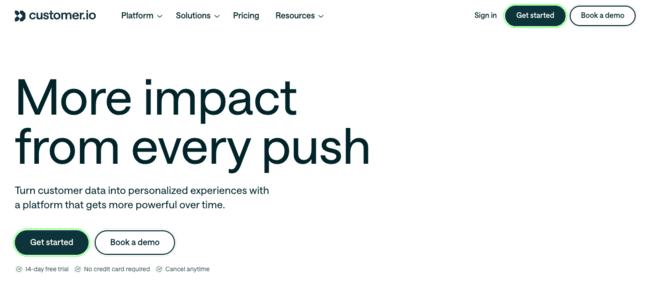
Customer.io is a CEP that suits smaller businesses more than most enterprise rivals. It’s more affordable and easier to use. But it still offers impressive messaging orchestration and personalization.
Like Iterable, Customer.io automates messaging across channels using behavioral and customer data. Channels include email, SMS, push notifications, and in-app messages. It doesn’t support as many as Iterable. But it makes automation straightforward with a visual workflow builder. You simply arrange your messages and corresponding channels in the automation.
Customer.io is particularly strong at email orchestration. It includes a dedicated email builder. And its sending infrastructure supports high volumes with strong deliverability. For growing businesses, this is familiar from more SMB-friendly marketing automation platforms.
Customer.io shows its CEP credentials with its powerful data features. It can pull in your first-party customer data from any source. There are 100+ integrations to simplify connections. And extensive SDK libraries to help developers build their own. The data you import drives segmentation. You get full control over defining custom objects and attributes. Which means you can define segments and target messages anyway you want. Customer.io also tracks customer behavior on your websites and apps. So you can trigger messages based on interactions.
Pros
- User-friendly messaging orchestration for email, SMS, push, and in-app notifications.
- Visual workflow builder and drag-and-drop email editor.
- 100+ integrations and SDK library.
- Clear pricing structure helps growing businesses.
Cons
- Supports fewer messaging channels than many CEPs.
- While more affordable than many rivals, it still requires technical support to use.
Pricing starts at $100 per month for 5,000 customer profiles. There is no permanent free plan, but Customer.io offers a 14-day free trial.
The Best Alternatives to Iterable for Different Company Sizes and Industries
Marketing needs and priorities differ according to business size and sector. Here’s a breakdown of who I see my top 11 Iterable alternatives suiting best.
Iterable Alternatives for Mid-Market SaaS
Iterable’s scale and flexibility attract ambitious mid-market teams. But many then get stumped by the technical infrastructure and engineering requirements. Not to mention the potential for costs to rise steeply.
- ActiveCampaign delivers powerful automation without the heavy data requirements. SaaS companies often benefit from short funnels. ActiveCampaign is excellent for tying sales and marketing tightly together. Its CRM tools make it suitable for B2B businesses, too.
- Brevo is an SMB marketing automation platform. But it scales to suit mid-market needs. Its Professional tier unlocks AI analytics, segmentation, and contact scoring. And you can expand it with an optional CDP and sales CRM.
- Customer.io is attractively priced for mid-market teams. Its transparent pricing model helps with growth and budgeting forecasts. It also hits a sweet spot between user-friendly automation tools and sophisticated messaging orchestration.
- CleverTap’s entry-level plan offers an affordable starting point for small teams.
Iterable Alternatives for Enterprise
Iterable is very much an enterprise CEP popular with big-name companies. But big businesses have different needs, too. Iterable specializes in ‘moments-based’ messaging across the customer lifecycle. But some enterprises want more data capabilities. Or more detailed personalization. Or just more marketing tools.
- Braze is one of Iterable’s closest competitors. It focuses more on mobile channels. And it’s faster and more reliable for very high-volume messaging orchestration.
- CleverTap is the CEP for data buffs that want full control. It includes its own data warehouse. And matches messaging orchestration with in-depth behavioral analytics.
- Insider One stands out for AI-driven on-site personalization. It also uses AI to create predictive segments. Which means you can target messaging based on likely future behavior. Not just what has already happened.
- Salesforce Agentforce Marketing is ideal if you want a complete enterprise marketing suite. Especially if you are already invested in the Salesforce ecosystem. It works with Salesforce’s CRM, analytics, and commerce products.
Iterable Alternatives for Startups
Iterable isn’t a good choice for start-ups because of its high cost. It works best for companies with large datasets and mature lifecycle marketing strategies. New businesses need affordable marketing platforms that help them develop their marketing.
- Brevo is a great pick for start-ups. It has one of the most generous free plans in the marketing automation market. It lets you get started sending personalized email campaigns for no cost. You can then add channels and features with sensible, transparent pricing.
- ActiveCampaign is, for its price, the best value marketing automation service around. Not only is it affordable enough for start-ups. It’s a great starting point for people with no marketing automation experience. Its powerful visual workflow builder requires no technical skills. And there are 1000+ automation templates to work with.
- Omnisend is a great choice for ecommerce startups. Its Shopify integration turns store activity into targeted automated campaigns.
Iterable Alternatives for Ecommerce
Iterable isn’t the best fit if your store runs on anything other than Shopify. That’s the only native ecommerce integrations. Though you can use the API to build connections. But it doesn’t have retail-specific engagement features, either. Things like automated product recommendations, loyalty programs, and discount coupons.
- Maestra is purpose-built for mid-market ecommerce businesses. It’s an all-in-one ecommerce marketing platform with multichannel automation, loyalty tools, and personalization. It has a CDP to collect all your customer data. And uses this to trigger targeted messages based on behavior. All customers get full migration and setup by the Maestra team.
- Omnisend is a very intuitive specialist ecommerce marketing platform. It connects easily to ecommerce platforms like Shopify and WooCommerce. Pre-built workflow templates simplify automations. And it uses your store data to map out stages of customer engagement. With recommendations for activity to help with retention and conversion.
- Klaviyo is widely used by online retailers. It integrates directly with most major ecommerce platforms. It’s excellent for using first-party store data for detailed segmentation. And for setting behavior-based triggers for cross-channel campaigns.
Contact us if you’d like help finding the best Iterable alternative for your business.
Iterable Cost Comparison with Alternatives
At the enterprise level, it’s common for SaaS companies not to publish pricing. They provide custom quotes instead. The rationale is that you get a price tailored to your needs. But it makes budgeting tough. Having upfront, transparent, consistent pricing is always better for the customer. You wouldn’t pick a service when you didn’t know what features it had. Why should cost be any different?
Iterable has a cost-by-quote policy. So do several of its competitors on this list. Below is a breakdown of our top Iterable alternatives that publish pricing details. Quick hint: they all work out considerably cheaper than Iterable.
| Starting price (monthly) | Active customers | User seats | Free plan/trial/demo | |
| Maestra | $2,990 | 150,000 | Unlimited | Demo |
| ActiveCampaign | $15 | 1,000 | 1 | 14-day free trial |
| Omnisend | $16 | 500 | 1 | Free plan |
| HubSpot | $9 | 1,000 | 1 | Free plan |
| Klaviyo | $20 | 500 | 1 | Free plan |
| Brevo | $9 | 500 | 1 | Free plan |
| CleverTap | $75 | 5,000 | Unlimited | 30-day free trial |
| Customer.io | $100 | 5,000 | Unlimited | 14-day free trial |
What are the best Iterable alternatives?
Which Iterable alternative you choose will depend on the size of your business, your budget, and what your marketing priorities are.
As a final summary, here’s my take on the best Iterable alternatives in various categories.
For SMBs, ActiveCampaign is the king of marketing automation. It might not have the messaging scale of Iterable. But you can automate anything. And it makes it easy to do so.
For start-ups and SMBs looking for a first step into marketing automation, Brevo’s free plan is excellent.
If you’re an ecommerce business, Maestra is an outstanding platform. It competes with Iterable on channel choice, automation, and personalization. But ties messaging orchestration into a more complete ecommerce marketing package.
If you’re an ecommerce store and can’t afford Maestra’s price tag, Omnisend and Klaviyo are great affordable platforms.
If you still want real-time messaging orchestration at enterprise scale, CleverTap stands out. Its data capabilities lead the market. And data is what drives personalization and in-the-moment targeting.
Iterable Alternatives FAQ
Who are Iterable’s competitors?
How much does Iterable cost per month?
Iterable doesn’t publish its pricing. You have to contact the sales team to get a custom quote. This is based on the number of customer profiles in your database. And the volume of messages you want to send. Sources suggest that average packages start at around $30,000 a year, or $2,500 a month.
Is Iterable profitable?
Yes, Iterable is widely seen as profitable for its users. Forrester found that, on average, Iterable yields a 700% ROI for customers. The platform also claims that messaging personalization results in 6x more transactions. While behavior-based triggers achieve 5x more conversions.