Your AI Agents, Any Cloud: Building the Agentic Enterprise with Agentforce and Amazon Agentcore
A Customer Asks One Simple Question
Imagine an electricity distributor. A prolonged outage hits a neighbourhood, and under the rules a customer may be owed a Guaranteed Service Level (GSL) payment. The customer asks one simple question: *”Was I affected, and am I owed a payment?”*
Simple to ask — hard to answer. To respond, a case manager has to check the outage management system for how long the power was out, the meter registry for the affected connection, and the billing system for payment status. Today they hop between those systems by hand, or wait on a backend team. The customer waits days.
This is the everyday reality for most enterprises. Salesforce runs the customer relationship, but resolving a single case rarely stays inside Salesforce. The facts and business rules live in operational, billing, and asset systems — on premises, in another cloud, in AWS, or in a SaaS product. The question is not whether AI agents can help. It’s how an agent reaches the systems that hold the answer.
Why the Obvious Fixes Don’t Work
An Agentforce agent already understands the customer, reasons over the case, and acts within Salesforce — all governed by the AI Trust Layer. To resolve the full case, it needs to reach beyond the CRM. There are two common instincts here, and both break down:
Point-to-point integration. You could hardcode a call from Salesforce to each backend system over a REST API. That works for one fixed operation. It does not scale to an agent. An agent decides at runtime which capability to call, based on what the customer asks — a hardcoded call gives it no way to discover which systems exist, what inputs they take, or what they return. Every new system means more integration code, auth wiring, and error handling, repeated for every agent and every direction.
Copying the data into Salesforce. You could replicate the backend data into the CRM. But that creates two sources of truth that drift apart, and it duplicates regulated data you then have to secure and reconcile.
Neither is the answer. What you want is for the agent to fetch a live, cited answer during the conversation — without custom plumbing for every system.
The Pattern: MCP as the Open Standard, Agentcore as the Orchestration Layer
This is where Agentforce MCP integration with Amazon Agentcore comes in.
The Model Context Protocol (MCP) is an open standard that presents any enterprise capability to an agent as a discoverable, self-describing tool. Think of it as a universal API layer for the agentic world. Amazon Agentcore is where those tools are published and governed — a single, secure endpoint that fronts the systems holding your data and business logic, wherever they run: SAP, mainframes, databases, SaaS APIs, custom services.
Each system is wrapped once as an MCP tool. Any approved agent then reaches every connected system through the same front door — no custom adapter per backend, per agent. Agentforce MCP integration lets the Salesforce agent discover and call those tools as naturally as any built-in action.
The division of labour is the point: Agentforce owns the customer conversation, the reasoning, and the trust controls. Agentcore is the orchestration layer that extends that agent’s reach to the rest of the enterprise.
Two Directions, One Governed Door
Inbound: Agentforce calls Amazon Agentcore
The customer asks their question in Salesforce. The Agentforce agent uses a built-in MCP Client to find the right tool, authenticates securely via OAuth2 and Amazon Cognito, and calls the Agentcore Gateway. The Gateway routes to the agent on Agentcore runtime, which reaches the connected system — say, the outage and eligibility data — and returns a cited answer. The customer gets a live determination in the same conversation, in seconds rather than days.
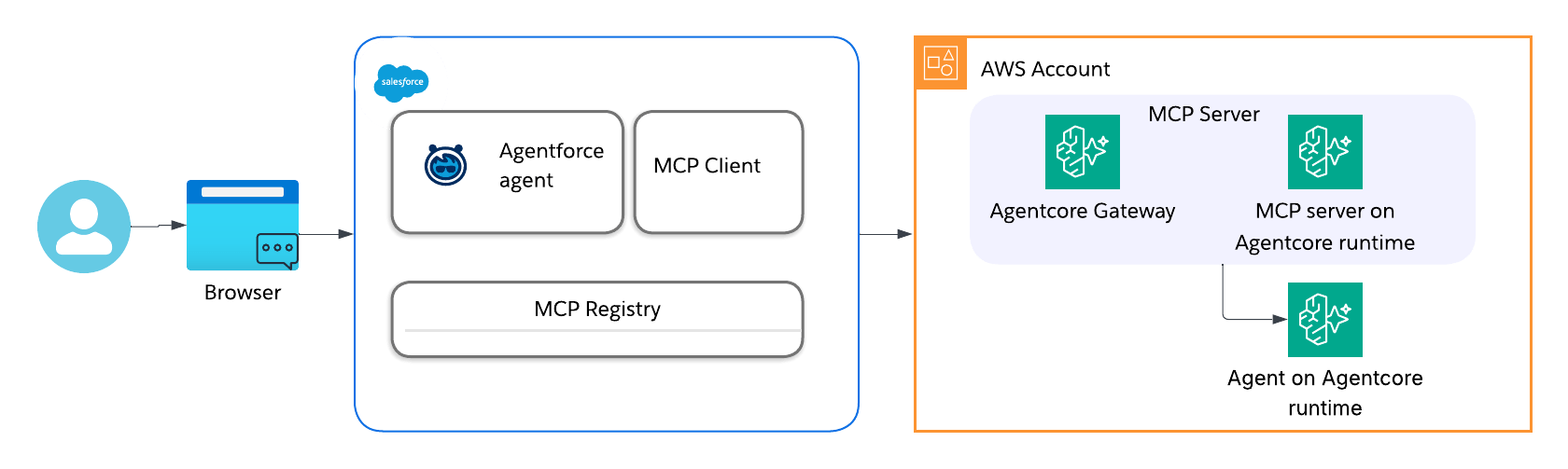
Outbound: Amazon Agentcore calls Agentforce
The reverse works the same way. An agent on Agentcore calls out through a second Gateway to an External Client App on Salesforce, which routes the request via the Agent API or a Hosted MCP Server to an Agentforce agent. This lets an AWS-side workflow draw on the customer context and actions that Agentforce manages.
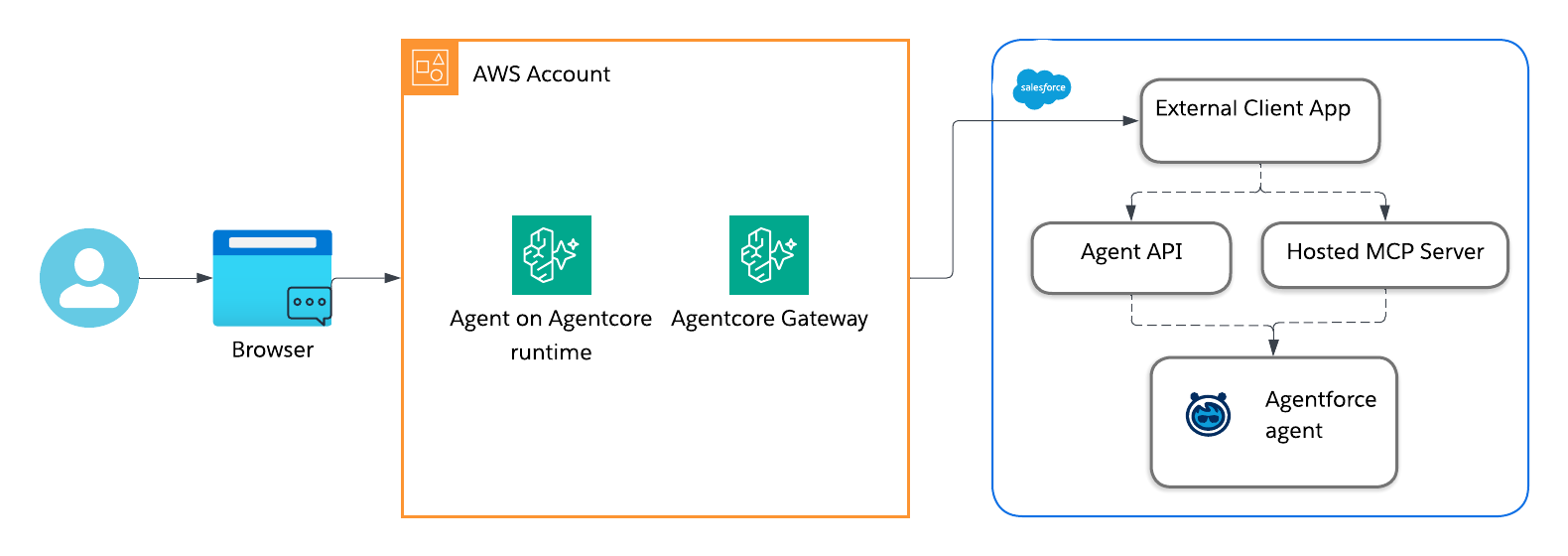
Both directions share one pattern — MCP over an Agentcore Gateway, authenticated by Amazon Cognito. You reason about, secure, and operate them the same way.
Who This Is For, and Why It Matters
This pattern matters for any organisation that runs Salesforce for customer engagement but whose real work spans systems it doesn’t own end-to-end — banks, insurers, utilities, government, healthcare. The people who feel the difference are the ones on the front line: the case manager who no longer swivels between five screens, and the customer who gets an answer now instead of next week.
A few implications stand out for leaders building an agentic strategy:
- Open systems give you portfolio flexibility — and pricing leverage. You don’t have to consolidate onto a single platform to go agentic. Keep Salesforce for the customer-facing workloads where it’s strongest, run backend and infrastructure workloads on AWS or wherever they’re most cost-effective, and let agents collaborate across them. That’s the quiet power of building on open standards rather than a closed stack: you choose best-of-breed for each workload, optimise cost across providers, and keep the freedom to shift the mix as your needs and the market change — instead of being locked into one vendor’s roadmap and price list.
- Security and governance travel with the agent. Scoped, short-lived OAuth2 tokens on every call; the AI Trust Layer governing every interaction on the Salesforce side. Governed, auditable, enterprise-grade.
- No data duplication. Each answer is read live and cited, keeping one source of truth and shrinking the data you have to secure.
- MCP is becoming the connective tissue of the agentic world. Just as REST APIs standardised how services talk to each other, MCP is emerging as the standard for how agents talk to tools — and to each other. Agentforce MCP integration is an early proof of that, and building on open standards future-proofs your architecture.
Welcome to the Agentic Enterprise
An outage-compensation question that once took days of manual investigation becomes one governed call — with no data copied between clouds. But the larger value is the pattern, not the single connection. Register more enterprise systems as tools on the Gateway, apply it to other regulated processes, and the same governed door serves Agentforce today and any agent or channel you add tomorrow.
This is what the Agentic Enterprise looks like in practice: humans, agents, and platforms driving customer success together. It’s an enterprise that is customer-first — the person asking “am I owed a payment?” gets an answer now, not next week. It’s agent-first and conversational, where reasoning agents act on the customer’s behalf across systems. And critically, it runs on trusted, insight-driven context — every answer read live and cited, every interaction governed by the AI Trust Layer, no matter which cloud the data lives in.
Cross-cloud interoperability is what makes that vision real. An agent is only as capable as the context and systems it can reach — and in a real enterprise, those systems will never all live in one place. The walls between cloud AI ecosystems are coming down, and open standards like MCP are what bring them down safely. The organisations that embrace open standards and cross-cloud agent design now will be the ones that lead as the Agentic Enterprise becomes the norm.