
How well does marketing technology empower the CMO? Does martech deliver something the boardroom asks for? We all agree that marketing technology has never been more powerful. We have more customer data, more automation, better measurement, and now AI.
Yet while the technology keeps expanding, something rather strange is happening to the function using it: the CMO is disappearing. And some CEOs are taking marketing into their own hands. That creates an uncomfortable question for martech.
Will this shift make martech more or less relevant?
Will martech disappear with the CMO? Or become more important than ever? And can martech continue to do business as usual? If marketing itself is moving beyond the marketing department, who will decide which martech is needed, or what all that marketing technology is actually supposed to do?
1. Congrats, marketing got promoted. finally!
“The CEO, not the marketing team, is responsible for the brand.” That was the recent argument from former ING & UBS CEO Ralph Hamers. His reasoning is simple: a brand is not a logo, campaign, or tagline. It is the experience people have with a company. And that experience is shaped by strategy, behavior, investments, and trade-offs across the entire organization. The idea itself is not new.
“Marketing is too important to be left to the marketing department.”
David Packard, co-founder of Hewlett-Packard
In both cases, the point is not that we don’t need marketing. It is that marketing, with a capital M, is bigger than the marketing department.
Think about it, marketing’s traditional mandate has already eroded over the decades. Of the original four Ps, marketing often only holds on to Promotion. Price moved to Sales, Place to Trade marketing or Channel, and Product to Product Management.
Now that erosion appears to have reached the CMO role itself. Forrester’s 2026 analysis of the Fortune 500 found that only 36% of companies still use the chief marketing officer title, down sharply from 49% in 2025. Marketing representation at the top is falling too: only 52% have a marketing executive on the executive team and/or reporting to the CEO, down from 58%.
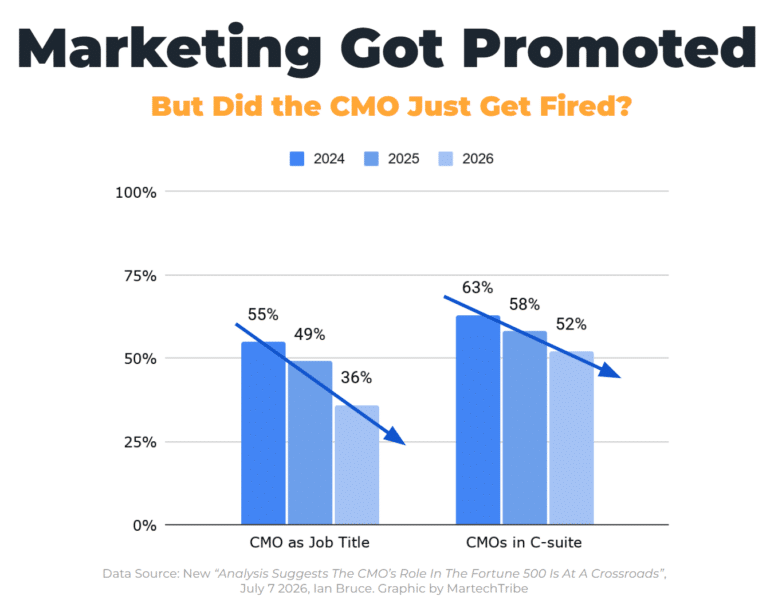
At first sight, that looks like marketing is losing.
Forrester’s Ian Bruce offers another interpretation: reinvention. Traditional marketing, sales, and customer success responsibilities are increasingly combined under broader roles such as chief growth officer, chief commercial officer, and chief customer officer. The mandate is moving beyond the traditional marketing promotional activities toward accountability for growth across the customer lifecycle (re)incorporating the other Ps, like Price, Place, and Product.
That sounds less like a demotion and more like a promotion. Marketing finally becomes a business responsibility, not a department. There is just one rather important question: When marketing gets promoted, who is equipped to lead it?
The world’s most powerful SEO platform, purpose-built for Enterprise.
@media (max-width: 768px) {
.headline-responsive {
font-size: 30px !important;
line-height: 1.3 !important;
}
}
2. But who is going to lead marketing?
Promoting marketing to the enterprise level solves one problem. It creates another: Who is actually equipped to take the marketing initiative?
Option 1: The CEO? The CEO owns the business, so if marketing becomes a business responsibility, marketing ultimately belongs there too. There is just one problem: most CEOs have very little marketing experience. According to McKinsey, only 10% of Fortune 250 CEOs have marketing experience, and just 4% have previously held a CMO-like role. More than 70% of Fortune 100 CEOs come from operations or finance. Mind the gap.
Option 2: The CMO? There is a problem on this side, too. The McKinsey CMO Growth Research Survey found a striking difference in how CEOs and CMOs measure marketing. In 2024, 70% of CEOs measured marketing by revenue growth and margin, up from 50% a year earlier. Among CMOs, that number barely moved: from 33% to 35%. That is quite a gap.

The CEO increasingly looks at marketing and asks: Did we grow? Did we make money? The CMO often answers with ROAS, CTR, CAC, CLV, brand awareness, MQLs, and another three-letter acronym before breakfast.
None of those marketing metrics are wrong. The problem is translation. Marketing metrics need to connect to the business outcomes the CEO ultimately owns.
So we have an interesting navigation problem:
- The CEO has the business experience, but often lacks the marketing experience, i.e., more operational and less customer-focused.
- The CMO has the marketing experience, but too often struggles to translate it into business outcomes.
Firing the CMO and handing marketing to the CEO, therefore, feels a little like firing your co-driver while racing because the driver ultimately decides where the car goes. The answer is not choosing between CEO and CMO. It is closing the gap between them.
3. The CMO needs to earn the promotion
Keeping the CMO in the room is not enough either. If marketing is being promoted from a department to a business responsibility, the CMO needs to make that same transition. And there is evidence that this is not happening fast enough.
The McKinsey CMO Growth Research Survey shows that 79% of CMOs say they understand how their marketing KPIs align with company KPIs. That sounds reassuring, until you ask a more fundamental question: What is the return? Only 30% say their organization has a clear definition of marketing ROI.
That is a 49-percentage-point accountability gap.
CMOs believe their metrics are aligned with the business, but most organizations cannot clearly define what that alignment is worth. More concerning, the gap is getting worse. KPI alignment fell from 88% to 79% in one year, while clarity around marketing ROI fell from 40% to 30%. Both dropped by around 10 percentage points.

This is not a stable weakness. It is active erosion.
And it helps explain the changes we saw in the previous sections. If marketing cannot demonstrate its contribution in terms the business understands, it should not be surprising when responsibility starts moving elsewhere. But replacing the CMO with a chief growth officer or chief commercial officer does not magically solve that problem. Changing the title does not create accountability. Neither does moving marketing underneath a CEO with little marketing experience.
The capability has to change. A broader marketing mandate requires a broader marketing leader: someone who understands customers and brands, but can also connect them to business outcomes like revenue, margin, growth, and ultimately enterprise value.
That is why the real question is not whether the CMO title survives. The real question is who takes responsibility for marketing, and whether that person can combine marketing expertise with business accountability.
Maybe the CMO isn’t being fired. Maybe the job description is being rewritten.
And that makes martech more relevant, not less. But its job description is being rewritten, too. If marketing becomes accountable for revenue, margin, growth, and customer value, martech can no longer justify itself through features, adoption, or marketing efficiency alone. It has to connect technology decisions to those same business outcomes.
Marketing got promoted. Now martech needs to earn the promotion too.
The post What happens to martech when the CMO disappears? appeared first on MarTech.