Meta adds new AI subscription packages
Meta announced two new subscription tiers for its artificial intelligence tools as the company looks to build a viable path to monetizing its increasingly expensive AI developments.
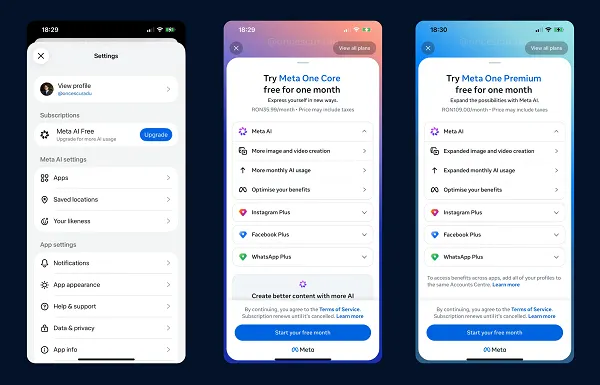
As shown in these images, posted by app researcher Radu Oncescu, Meta recently launched new Meta AI Core and Meta AI Premium subscription packages. Both new tiers offer expanded access to Meta’s AI tools, including more image and video creation capacity, albeit at higher price brackets.
As reported in May by TechCrunch, Meta AI Premium was previously made available to some users. However, the new Core package offers a middle ground alternative for people who want to make more use of Meta’s tools, but who may not need full access, and may not want to pay the premium price.
Both packages also include access to Meta’s Facebook Plus, Instagram Plus and WhatsApp Plus profile verification packages, which also provide access to improved account support, among other benefits.
Meta announced a major expansion of its paid subscription offerings back in May, which the company hopes will provide a more direct means of monetizing its AI offerings.
Meta has committed more than $600 billion to AI infrastructure development in the U.S. alone over the next three years, and that investment has put more pressure on the company to implement revenue strategies tied to its AI offerings, in order to offset these costs, and show investors that there will be some kind of return for its rising development outlay.
But thus far, Meta’s AI tools haven’t driven a lot of demand as standalone products.
Meanwhile, reports suggest that even internally, Meta staff are growing less confident about the prospects of its AI systems in driving value and efficiency.
According to Reuters, earlier this year, Meta staff pushed back against a plan to replace up to 60% of the company’s staff with AI agents and systems.
The company had hoped to cut human staff as a means to showcase the value of its AI developments, and force its workplace into an AI-native state. Meta’s employees, however, opposed the change, with Reuters reporting that many of the company’s employees don’t believe that Meta’s AI systems are as beneficial, and capable, as Meta has been projecting.
As per Reuters: “Employees’ use of AI had resulted in a vast increase in the code they generated, but with questionable impact on productivity, according to internal posts seen by Reuters. For instance, code changes made to the internal software platforms and infrastructure employees use on the job were up 220% year-over-year, according to a post by Bosworth in early June. But changes that led to new or upgraded features reaching Meta users were only up 36%.”
Meta employees also raised questions about the reliability of AI-sourced code. Staff said that enabling AI agents to undertake roles traditionally done by humans had led to various technical and security incidents, including service disruptions and possible data leaks, both of which were up 40% year over year, according to Reuters’ reporting.
One of those incidents was the widely reported Instagram account breach in June, which saw 20,000 Instagram profiles accessed by unauthorized users.
Given these concerns, along with skepticism about Meta’s ability to convince more people to give over more of their personal data to it, in order to power its personal superintelligence agents, it’s increasingly looking like the company’s massive bet on AI won’t pay off. Or at least, it seems unlikely that projected interest and investment will be able to reach the levels that Meta needs in order to justify its spend.
That could change, however, if Meta is able to produce an all-powerful AI agent that does display genuine utility for users.
However, right now, Meta’s failure to demonstrate the real-world value of its AI tools, outside of some niche use cases, is limiting investor and consumer optimism about its prospects.
Either way, Meta needs to make at least some of its money back, which is why it’s now rolling out more AI subscription options to steadily build a revenue pipeline for the tech.