10 Best MailerLite Alternatives for 2026
MailerLite is a solid starter tool. But if you’re running an online store, you’ve probably hit its ceiling faster than you expected. Thin ecommerce automation, a free plan that keeps shrinking, and reporting that tells you who opened an email but not who actually bought.
So you’re shopping for something better. The trouble is, half the “alternatives” out there are just other newsletter tools wearing a different logo.
The short answer? If you sell products online and want a platform that turns customer data into automated revenue, Drip is the best MailerLite alternative. For everyone else, this list covers nine other strong options and exactly who each one fits.
What You’ll Find in This Post
Why People Look for MailerLite Alternatives
MailerLite built its name on being cheap and easy. And for a simple newsletter, it still is.
But easy has a cost. The automation builder handles basic sequences well, yet it struggles once you want branching logic tied to what people actually buy and browse. For an online store, that’s the whole game.
Then there’s the free plan. In June 2026, MailerLite cut it from 500 subscribers to 250, and from 12,000 monthly emails down to 2,500. If you built your list expecting that headroom, the goalposts just moved.
The bigger issue is measurement. MailerLite reports opens and clicks. It doesn’t natively tell you the revenue each email, flow, or segment generates. So you’re optimizing for vanity metrics instead of sales.
Segmentation is another common sticking point. Once you want to target people by what they’ve bought, how much they’ve spent, or what they’re browsing right now, basic list-based tools start to feel rigid.
That’s the gap most people are trying to close. They don’t want a prettier newsletter tool. They want a platform that treats email as a revenue channel.
So as you read this list, keep three questions in mind. Does it connect deeply to your store? Does it automate based on real customer behavior? And does it show you the money, not just the opens? Those three answers separate a true upgrade from a lateral move.
MailerLite Alternatives: Price Comparison Table
Here’s how the ten alternatives stack up on entry pricing, free plans, and ecommerce focus. Prices reflect published rates as of July 2026 and can change, so always confirm on each provider’s site.
| Platform | Starting Price | Free Plan | Built for Ecommerce? | Revenue Attribution |
|---|---|---|---|---|
| Drip | $39/mo (2,500 people) | 14-day trial | Yes, purpose-built | Yes (Revenue Per Person) |
| Klaviyo | $30/mo (1,000 profiles) | Up to 250 contacts | Yes | Yes |
| Mailchimp | $13/mo (Essentials) | Up to 500 contacts | Partial | Limited |
| Omnisend | $16/mo (1,000 contacts) | Up to 250 contacts | Yes | Yes |
| Brevo | $9/mo (volume-based) | 300 emails/day | Partial | Limited |
| Kit (formerly ConvertKit) | Free, paid from $25/mo | Up to 10,000 subscribers | No | No |
| ActiveCampaign | $15/mo (1,000 contacts) | No (trial only) | Partial | Limited |
| Constant Contact | $12/mo (Lite) | No (trial only) | Partial | Limited |
| GetResponse | $19/mo (Starter) | Up to 500 contacts | Partial | Limited |
| HubSpot | $20/mo (Starter) | Free CRM tier | Partial | Yes (higher tiers) |
The Best MailerLite Alternatives at a Glance
Here’s my ranking of the top MailerLite alternatives for growing businesses:
- Drip: Best for revenue-focused ecommerce automation
- Klaviyo: Best for enterprise data teams
- Mailchimp: Best for all-in-one small business
- Omnisend: Best for email and SMS bundles
- Brevo: Best for volume-based pricing
- Kit: Best for creators and course sellers
- ActiveCampaign: Best for B2B automation
- Constant Contact: Best for pure simplicity
- GetResponse: Best for webinars and funnels
- HubSpot: Best for full CRM suites
Let me walk you through each one so you can decide which fits your business.
1. Drip: The Best MailerLite Alternative for Ecommerce
Drip is an ecommerce marketing automation platform, not a generic email tool. It’s built for online retailers who want purchase data, browsing behavior, and catalog info to power every message they send.
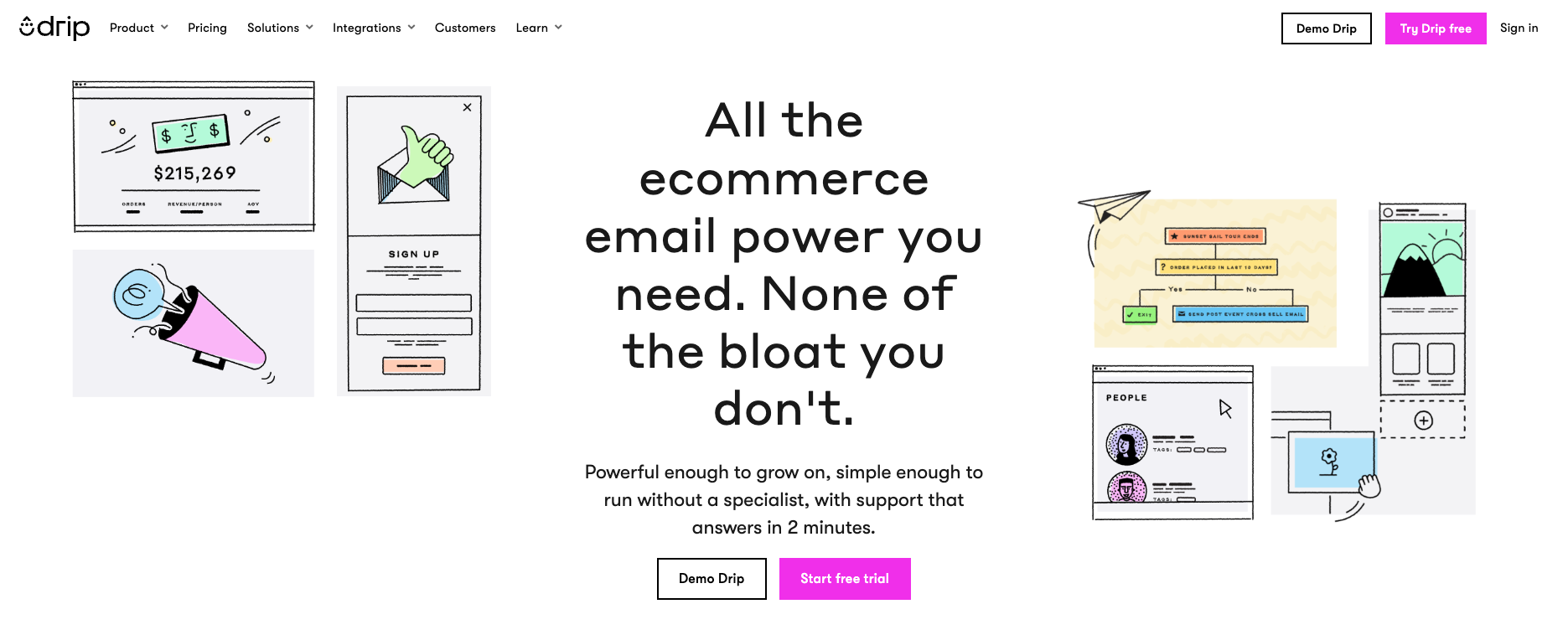
Here’s the core difference. MailerLite reports who opened your email. Drip reports how much revenue that email made.
Every workflow, segment, and campaign ties back to Revenue Per Person, so you can see exactly what’s driving sales instead of guessing from open rates. That’s a fundamentally different way to run email, and it’s the reason growing stores make the switch.
The automation goes deep too. Drip’s visual workflow builder handles branching logic, Goals, and split tests, with pre-built Playbooks for abandoned cart, browse abandonment, welcome series, and win-back. Goals matter more than they sound. If someone buys after the first cart reminder, they never get the pushy follow-ups.
Then there’s the store connection. Drip syncs in real time with Shopify, WooCommerce, and BigCommerce, pulling your full customer list, order history, and product catalog. So your automations always fire on fresh data, not yesterday’s export.
Segmentation updates in real time too. The moment a shopper crosses a spending threshold or views a product twice, they move into the right segment automatically. No manual list wrangling required.
And onsite popups, powered by Drip’s Sleeknote acquisition, come included on every plan with no session limits. That means you can grow your list with exit-intent offers, spin-to-win wheels, and quizzes, then feed those signups straight into a workflow.
Pricing is refreshingly honest, as well. Every plan includes the same features, so you’re never blocked from automation because you’re on a lower tier. And Drip offers free, hands-on migration for larger accounts, which takes the pain out of switching.
The results show up in real numbers. Nifty Gifts saw a 77% revenue increase in its first two months on Drip, with a 46% open rate on its abandoned cart workflow. Spring Copenhagen lifted average order value by 32.24% and nearly doubled newsletter click-through rates. And Mythologie Candles pulled in over $1 million in sales within nine months, with 60 to 80% of that revenue attributed to email.
Where Drip Falls Short
Drip isn’t the cheapest option here. It starts at $39 a month, so if you just need to send an occasional newsletter, a freemium tool will feel lighter on the wallet.
Who Should Choose Drip
Drip is for ecommerce brands that are done treating email as an afterthought. If you’re on Shopify, WooCommerce, or BigCommerce and you want automation tied directly to revenue, this is your platform. It’s especially strong for stores ready to graduate from “blast the whole list” to personalized, behavior-driven marketing.
2. Klaviyo: Best for Enterprise Data Teams
Klaviyo is Drip’s most direct competitor in the ecommerce space. It’s a powerful, data-heavy platform with deep Shopify integration and strong predictive analytics.
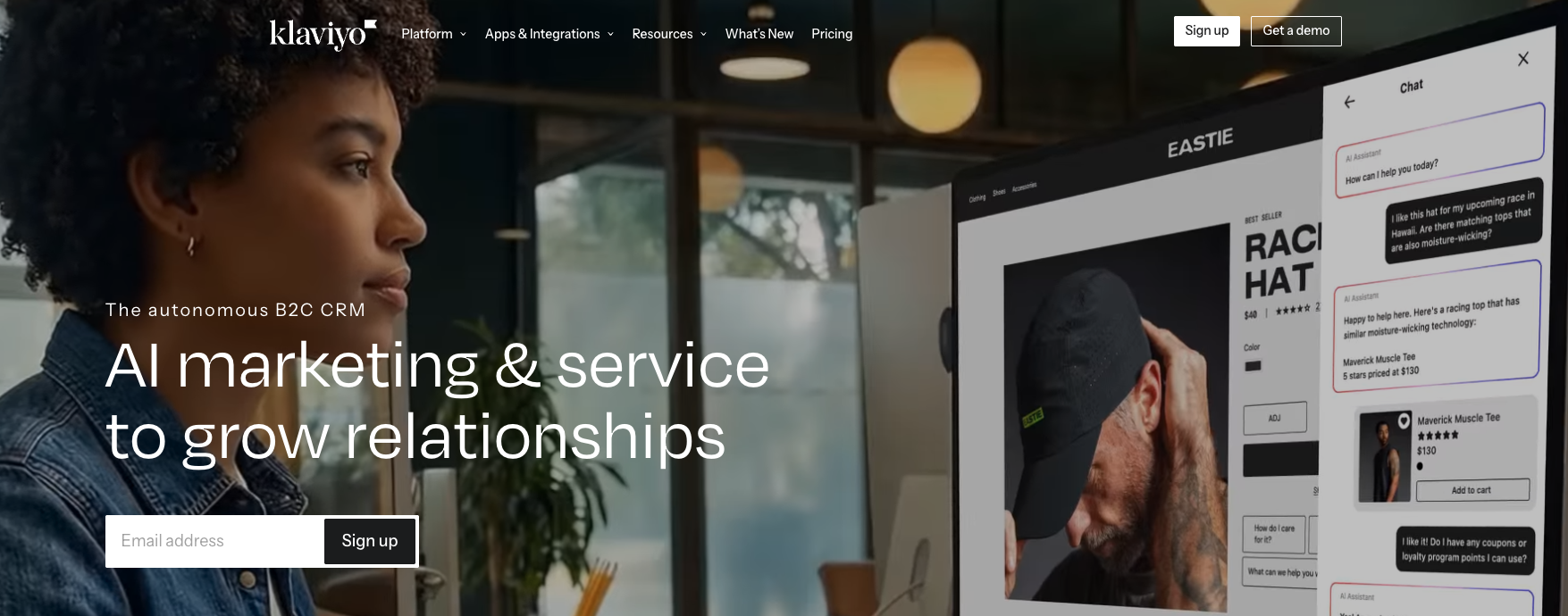 If you have a dedicated data or dev resource, Klaviyo gives you a lot to work with. Its segmentation and reporting are genuinely excellent, and it scales to very large sending volumes.
But that power comes with two catches. First, the learning curve is steep, and teams without technical help often feel overwhelmed. Second, the pricing climbs fast. Email-only starts around $30 a month at 1,000 profiles and reaches roughly $150 at 10,000, with add-ons stacking on top.
The overlap with Drip is real, so the deciding factor usually comes down to fit. Klaviyo rewards teams that want to live inside the data. Drip rewards teams that want revenue-grade results without a dedicated analyst. Several Drip customers, including Box2, switched from Klaviyo specifically because they found Drip easier to master.
Who Should Choose Klaviyo
Klaviyo is a strong fit for larger ecommerce operations with the in-house expertise to run it and the budget to match. If you love digging into complex data models and have someone to own the platform, it delivers.
3. Mailchimp: Best for All-in-One Small Business
Mailchimp is the name most people know. It’s a generalist marketing platform with email, landing pages, basic CRM features, and a famously friendly onboarding.
 For a small business sending newsletters and running light campaigns, Mailchimp covers the basics well. Its template library is huge and its brand is reassuringly familiar.
The problem is depth. Mailchimp was built for newsletters, not stores, so its ecommerce automation and revenue attribution lag behind purpose-built tools. Pricing also scales steeply once your list grows, with automation features gated behind higher tiers. At 10,000 contacts on the Standard plan, you’re looking at around $110 a month for capabilities a specialized platform includes by default.
There’s also the feature-gating frustration. The moment you want serious automation, you’re nudged into a pricier plan. For a store watching margins, that pattern gets old fast.
Who Should Choose Mailchimp
Mailchimp works for small businesses and non-ecommerce brands that want an easy, all-in-one tool and aren’t relying on sophisticated, revenue-tracked automation to grow.
4. Omnisend: Best for Email + SMS Bundles
Omnisend is built for ecommerce, and it leans hard into combining email and SMS in a single flow. That’s its signature strength.
 If multichannel messaging is your priority, Omnisend makes it simple to bundle text and email into the same automation. It integrates cleanly with major store platforms and includes revenue reporting, which puts it ahead of MailerLite for online sellers.
That said, its free plan is tight, covering just 250 contacts and 500 emails a month. And while its automation is capable, some users find the workflow flexibility and personalization depth more limited than Drip’s branching logic and Liquid templating. Standard pricing starts at $16 a month for 1,000 contacts and climbs to around $132 at 10,000.
SMS is the real draw, though. If texting customers is central to your strategy, Omnisend’s bundled credits and prebuilt flows make it easy to start without stitching together a separate tool.
Who Should Choose Omnisend
Omnisend is a good pick for smaller ecommerce stores that want email and SMS working together out of the box, without a lot of setup.
5. Brevo: Best for Volume-Based Pricing
Brevo, formerly Sendinblue, stands out because it charges by email volume rather than contact count. Store unlimited contacts, pay only for what you send.
 For businesses with big lists but modest sending needs, that model can save real money. Brevo also bundles in transactional email, SMS, and a basic CRM, and its free tier allows 300 emails a day. Paid plans start around $9 a month.
But Brevo is a broad tool rather than a deep ecommerce one. Its store integrations and automation don’t match the catalog-level personalization and revenue attribution that product-based retailers need. And the editor, while functional, feels less polished than the leaders here.
The volume-based model cuts both ways, too. It’s a bargain if you send rarely. But if you email your list often, as most ecommerce brands should, those send counts add up and the math shifts.
Who Should Choose Brevo
Brevo suits budget-conscious businesses with large contact lists and lower send frequency, especially those that value transactional email and SMS in one affordable package.
6. Kit: Best for Creators
Kit, formerly ConvertKit, is built for creators. Think bloggers, course sellers, newsletter writers, and coaches who sell digital products to an audience.
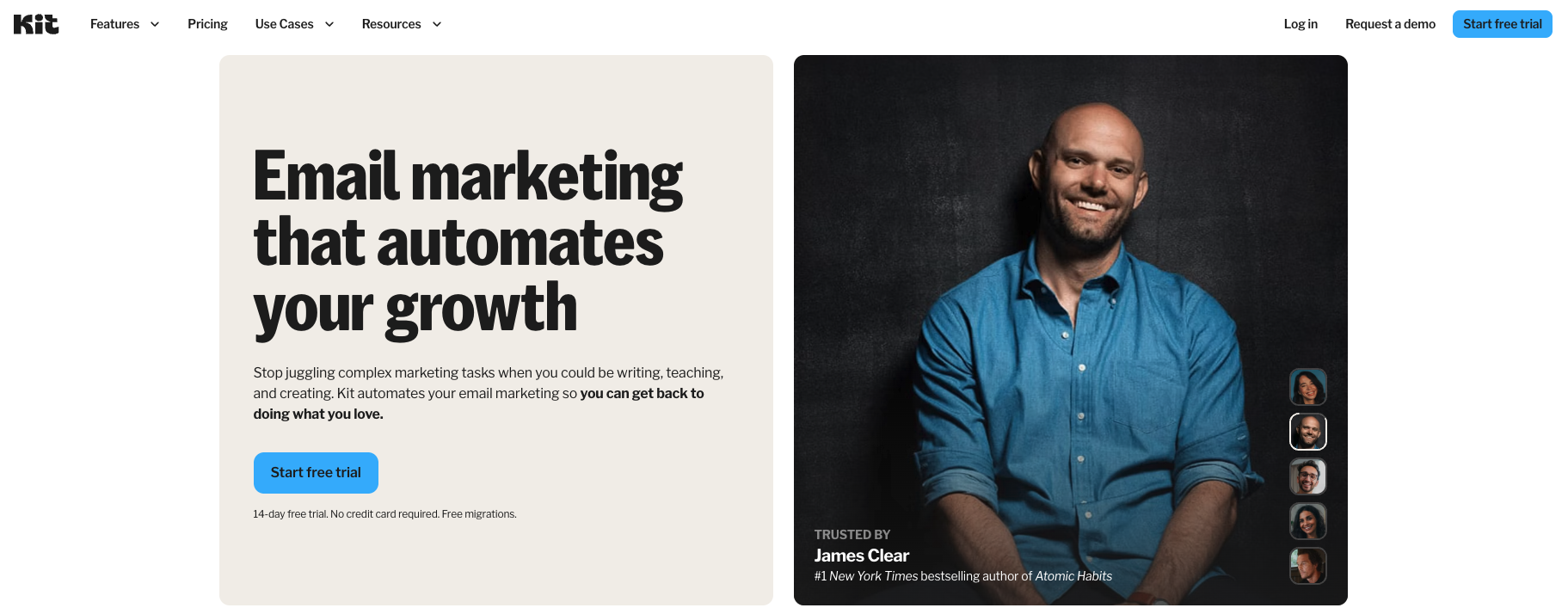 Its strength is simplicity for the creator use case. Tag-based subscriber management, clean automation for content sequences, and built-in tools for selling digital products and subscriptions. The free plan is generous, covering up to 10,000 subscribers, though with feature limits like a single automation and Kit branding.
Where Kit falls short is ecommerce. It isn’t designed for product catalogs, abandoned cart recovery, or revenue attribution across a store. So if you sell physical products, you’ll quickly outgrow it.
That focus is a feature, not a bug. Kit does one job well and doesn’t pretend otherwise. Just know that “creator email” and “store email” are different sports, and Kit is only playing one of them.
Who Should Choose Kit
Kit is ideal for creators and content businesses monetizing an audience through courses, memberships, and digital downloads, not for stores selling physical goods.
7. ActiveCampaign: Best for B2B Automation
ActiveCampaign is an automation powerhouse with a strong CRM. It’s especially popular with B2B teams and service businesses that need to manage leads and long sales cycles.
 Its automation engine is genuinely flexible, with lead scoring, pipeline management, and deep conditional logic. Pricing starts at $15 a month for 1,000 contacts on the Starter plan, though most teams need the Plus tier for CRM and lead scoring.
The catch for online sellers is focus. ActiveCampaign serves a broad, largely B2B audience, so its ecommerce integrations aren’t as deep as a purpose-built retail platform. You get automation muscle, but not the same dynamic product blocks, catalog sync, and revenue reporting a store depends on.
It can also feel like a lot. The sheer number of options is a gift for power users and a maze for everyone else. If your team is small, you may spend more time configuring than sending.
Who Should Choose ActiveCampaign
ActiveCampaign is a smart choice for B2B companies, agencies, and service providers that need sophisticated automation and a built-in CRM more than store-specific features.
Constant Contact is one of the oldest names in email marketing, and it has leaned into being approachable for beginners and local businesses.
 If you want something straightforward with reliable deliverability and helpful support, it fits. It also includes event management and social tools that some small businesses find handy. Plans start at $12 a month for Lite, and the phone support is a genuine comfort if you’re not a full-time marketer.
But simplicity is also its ceiling. Constant Contact’s automation is basic, and it lacks the behavioral triggering and revenue tracking ecommerce brands need to grow. Pricing can also creep up as your list expands, with Standard around $75 a month in the mid tiers.
Who Should Choose Constant Contact
Constant Contact works for small and local businesses, nonprofits, and event organizers that value ease of use and support over advanced automation.
9. GetResponse: Best for Webinars + Funnels
GetResponse is a marketing suite that bundles email with landing pages, sales funnels, and, distinctively, built-in webinar hosting.
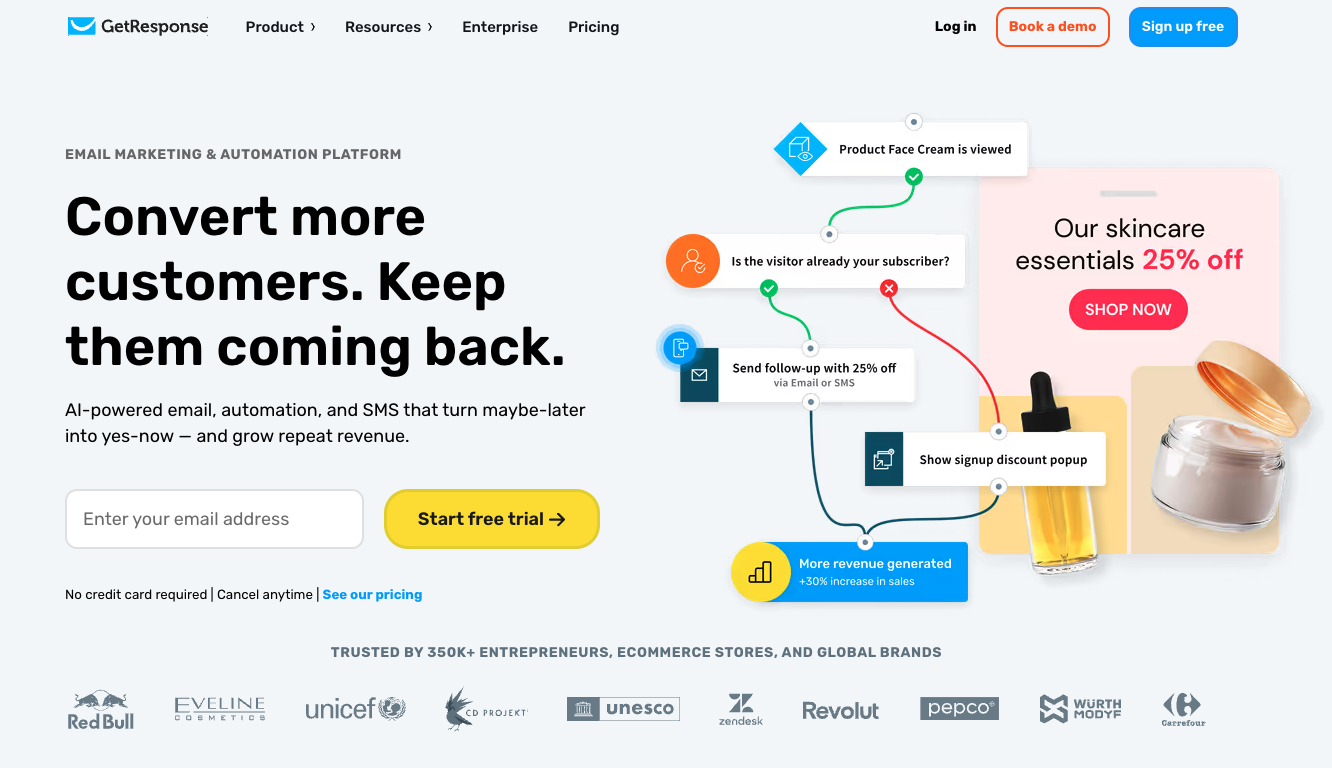 That webinar feature is a real differentiator. If your marketing relies on live events and lead-gen funnels, having it all in one tool is convenient. GetResponse also offers solid automation and a free plan up to 500 contacts, with paid plans starting at $19 a month.
For pure ecommerce, though, it’s a jack-of-all-trades. Its store integrations and product-level personalization are lighter than a dedicated retail platform, and revenue attribution isn’t its focus. You trade depth for breadth.
So the value really depends on your model. If webinars drive your sales, bundling them with email is a genuine win. If they don’t, you’re paying for a headline feature you’ll never open.
Who Should Choose GetResponse
GetResponse fits businesses that run webinars and funnel-based campaigns and want email, landing pages, and events under one roof.
10. HubSpot: Best for Full CRM Suites
HubSpot is an enterprise-grade platform that spans marketing, sales, and service. Email is just one piece of a much larger ecosystem.
If you want a single source of truth across your whole customer operation, HubSpot is hard to beat. Its CRM is excellent and its reporting is deep, including revenue attribution on higher tiers. There’s even a free CRM tier to start.
The cost is the story here. Marketing Hub Starter runs $20 a month, but the automation most teams actually want lives in Professional, which jumps to around $890 a month, often with onboarding fees on top. For a growing store, that’s a heavy lift compared to platforms built specifically for ecommerce.
You’re also paying for breadth you may not use. HubSpot shines when you’re running sales, service, and marketing together. But if email-driven revenue is your main goal, most of that suite sits idle while you foot the bill.
Who Should Choose HubSpot
HubSpot is best for larger companies that need a unified marketing, sales, and service platform and have the budget to invest in it fully.
How I Evaluated These MailerLite Alternatives
I ranked each platform on how deeply it connects to your store’s data, how sophisticated its automation is, and whether it tracks actual revenue instead of just opens and clicks. Pricing transparency and ease of use for non-technical marketers weighed heavily too, because the most powerful tool is useless if your team can’t run it.
I also looked at the switching experience. Migrating an email program is a hassle, so free migration support and honest, all-in pricing can matter as much as any single feature. And I weighed each tool against the job it’s actually built for, since the “best” platform for a creator is rarely the best for a Shopify store.
Every option here beats MailerLite on at least one of those fronts. So the right pick comes down to what you sell and how you plan to grow.
The Bottom Line
Here’s the honest truth. You didn’t outgrow MailerLite because it sends bad emails. You outgrew it because your store started generating data it couldn’t act on.
So the real question isn’t “which tool sends the nicest newsletter?” It’s “which tool turns a browse, a cart, and a first purchase into the next sale, automatically?”
Match the tool to the job and the list sorts itself out. Kit for creators. ActiveCampaign for B2B pipelines. HubSpot if you need a full sales and service suite and have the budget to feed it.
But if you sell products online, the answer keeps landing in the same place. Drip connects to your store in real time, automates around what customers actually do, and reports in revenue instead of opens. That’s the difference between a brand like Nifty Gifts posting a 77% revenue lift in two months and a brand still guessing which email worked.
MailerLite got you started. Drip is built to help you scale.
Ready to see the difference? Try Drip free for 14 days. No credit card required.