Touchpoint Goal Silos: 26 Bad CX Metrics Practices to Stop in 2026 (Part 7 of 9)

Customer experience goals lift or limit business results — due to natural consequences of unsiloed or siloed thinking. A recent example is CX AI.
“Too many companies are using AI to cut costs, not solve [customers’] problems,” said Isabelle Zdatny, author of the Qualtrics 2026 Consumer Experience Trends Report.1
Their study discovered: “Nearly one in five consumers who have used AI for customer service saw no benefits from the experience. That’s a failure rate almost four times higher than for AI use in general.”1
“32% of U.S. hiring managers said they eliminated a role primarily due to AI and later rehired for the same or a similar position,” according to data from consulting company Robert Half.2
One-sided goals limit business results (frustrating UX, more complexity instead of less, lay-offs, rehiring, and high costs remain), instead of lifting everyone’s outcomes.
Goals shape how people think.
And that spurs how they behave.
So, proceed with caution.
Re-think win-win-win to prevent goal silos.
A silo in business is anything that should be connected, but is not.
Outline:
A) Across Touchpoints
B) Beyond Touchpoints
C) CX Vision
D) How Things Work
E) Solution to Touchpoint Goal Silos
A) Across Touchpoints
a) Failing to ensure seamless end-to-end customer journeys.
Touchpoint functions are primarily Marketing, Sales, Customer Success, and Customer Support.
“Commercial operations are increasingly out of sync with the customer journey they support,” said Stephen Diorio, in summarizing CX conference panel discussions.3
“The articulated goal of customer-centricity is far out in front of the operational practice of Customer Success,” continues Diorio.3
“Far out in front” means customer-centricity is a farce in current Customer Success practices. Significant unsilo-ing is required before customer-centricity is realistic via Customer Success.
“[Touchpoint goal silos] fragmented functional leadership and customer data, engagement channels, systems, operations, and revenue teams,” explains Diorio.
“Every function that touches the customer has a different idea of what it means to ‘score a goal’ [like a team sport],” he reports. They lack common incentives, objectives, and KPIs.
“About 65% of customers feel their post-sales needs are only being moderately addressed or worse,” according to Bain’s 2024 Technology Report.4

“It turns out a huge disconnect exists between how customers want to be served and what vendors think they need,” explained the Bain researchers.4
“Additionally, many vendors silo the customer success function and miss the opportunity of a streamlined post-sales package with cohesion across tech support, customer success, and professional services.”4
“Net revenue retention (NRR) rates …decreased for 75% … in a recent Bain survey — even as nearly 60% increased customer success spending.”4

Yes, touchpoint goal silos are definitely limiting business value.
B) Beyond Touchpoints
b) Customers do not experience only touchpoints.
Listen to Support calls: only a fraction of customers’ pain points can be solved by touchpoint roles.
Non-customer-facing roles are primary deciders of most of what’s experienced:
product quality and functionality, costs and pricing, policies and processes, partners and suppliers, environs, strategies and incentives, and attitudes and handoffs.

Customers experience the outcomes of every role’s decisions, combined enterprise-wide.5
Interactions as the definition of customer experience is grossly inaccurate.
This myth perpetuates goal silos that are plaguing our profession as well as business growth.
Truth: CX is customers’ view of goodness.
CX = customers’ realities ÷ their expectations.
It’s relative to what they’re pursuing in their life or business via your solution.
Understand what they’re pursuing as first step.
CXM = proactive and reactive management of CX.
Reactive is Customer Support and Customer Success.
Human-centered design should prevent need for most of CS.
Proactive is embedding CX criteria in decisions and performance standards.
— senior leaders and managers of all types.
— for prevention of CX gaps.
— for ongoing new value creation.
— for both internal customers and external customers.
— integrating customer, employee, and partner experience data and practices.
C) CX Vision
c) CX managers do not grasp (a) nor (b).
Are you alarmed to see this poll from last month?6
Experience Design does not solve touchpoint goal silos!
This vision for CX Leadership is a goal silo itself.
It completely ignores all non-customer-facing forces on CX.
It falls short of syncing organizational objectives, incentives, etc.
It does nothing to prevent product defects, shrinkflation, etc.
Also alarming ideas for ideal CX role:
“There is no executive with authority to align teams, operations and processes along the entire revenue cycle,” summarized Diorio about the CX conference discussions. “All of the executives I spoke with were actively reconfiguring the many systems that support the customer journey with the goal of simplifying the seller experience (in the contact center) and simplifying user experience (in digital channels) which both translate directly to a better customer experience.”3
Why it’s not ideal:
— COO, CRO, and CCO revenue-focus robs bandwidth for driving customer-centered decisions enterprise-wide.
— A command-and-control empire ignores non-customer-facing roles.
— Innovation is better than DX or contact center sales for enterprise revenue growth.
It’s impossible for touchpoint goals to guarantee CX excellence.
— All cited sources failed to consider the CX necessity of roles beyond touchpoints.
— Touchpoints are a small portion of what customers experience in total.
D) How Things Work
Customers see one experience.
— They just want to move forward in their life or business.
— They don’t separate pre-purchase and post-purchase, etc.
— Their quality of life diminishes with every negative surprise.
— They choose the path of least resistance: fewest unwanted surprises.
Touchpoint roles are mostly buffers for upstream mis-steps, out-of-sync with customers’ needs.
— You say so when you explain what’s not possible:
“That’s handled by another part of the company.”
“Legal requires it.” … “A partner’s in charge of that.”
And so on.
— The thorniest CX issues are caused by non-customer-facing roles.
— Right the first time is needed from all enterprise roles.
Here’s your actual experience management team:

Your CX progress is getting erased if you’re not influencing the non-customer-facing roles to get in-sync with customers’ priorities.
For example, customers bubble-over in enthusiasm about retailer Bucc-ee’s. But, Legal is outraging customers, repelling them. In an ambitious quest to protect their brand mascot from copycats, they’re filing lawsuits to any brands with a smiling animal mascot: alligators, bears, etc. In this example, a tiny mini-mart in Beaver Creek Ohio faces a lawsuit from Bucc-ee’s.7

What else erases your CX progress?
Sneakflation, skimpflation, shrinkflation, inflation.
I’ve never seen a LinkedIn post addressing this.
It seems to be off the radar of touchpoint managers.
Yet, customers are outraged by it, and changing their buying, accordingly.8

Customer experience management is doing the whole job.
Not just what’s in your job description.
Re-writing it to address the full scope of realities.
This is what we expect of Human Resources, IT, every function.
Not just touchpoint management.
Do the whole job, completely.
So, we must change how we treat customer experience management.
Urgently.
E) Solution to Touchpoint Goal Silos
A key purpose of customer experience management is ironic, considering that most people inaccurately think of it as precisely Marketing, Sales, Success, and Support.
a) CXM’s purpose is prevention of buffer situations.
— Absence of buffer situations means seamless CX, minimal waste, maximum growth.
— Pre-requisite is shared prevention across every functional area and every managerial level.
— Extend this to your suppliers, alliances, and channels for optimal results.9
Preventing negative surprises is high-profit, high-growth management.
— Chronic issues divert resources from value creation.
— Stopping root causes frees resources for new value.
This multiplies growth: costs stopped + new value.
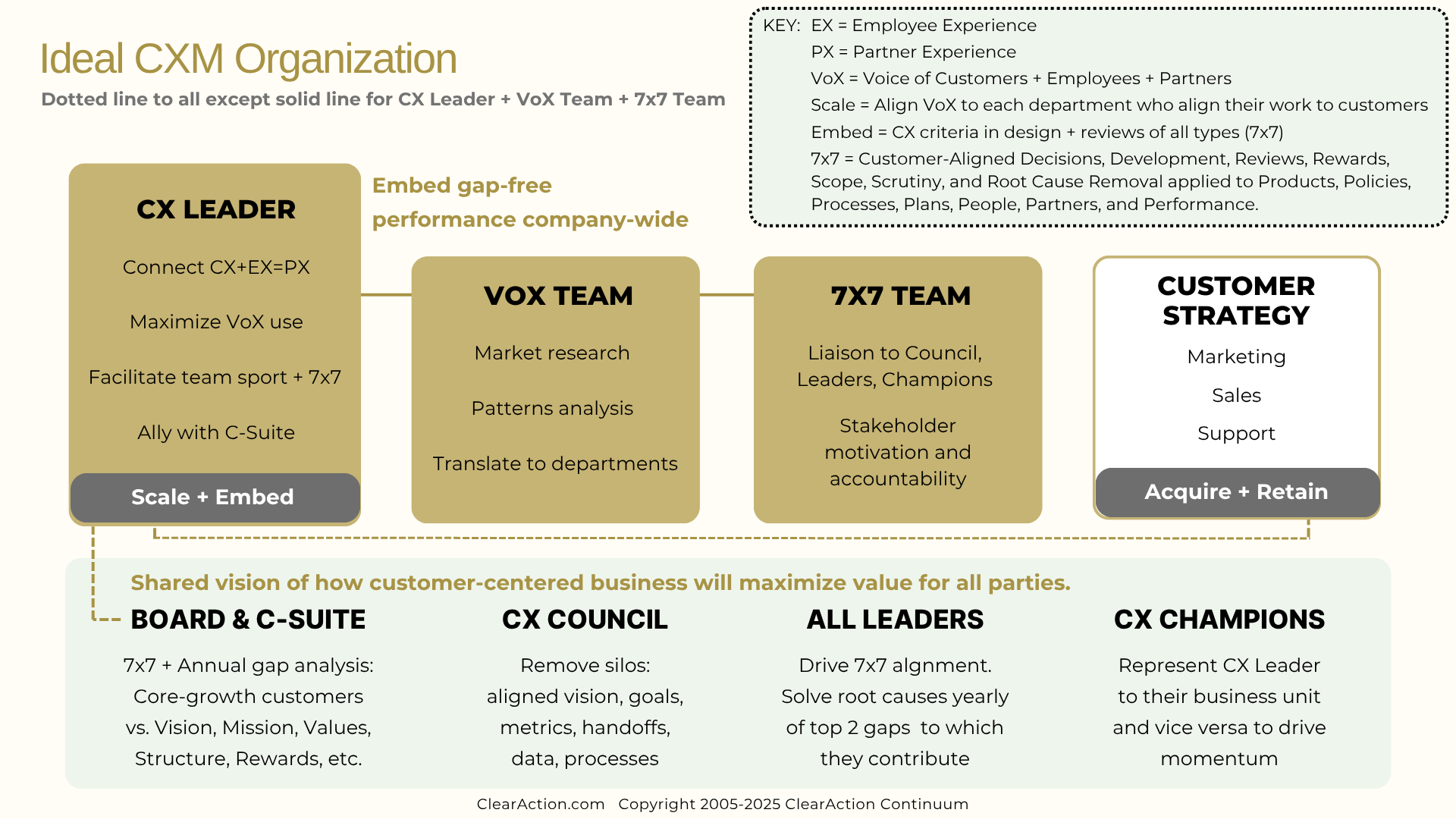
An umbrella role dedicated to embedding gap-free performance company-wide is CX Leadership, in contrast to the touchpoint roles. Although touchpoint organizations interact with customers, their metrics are about value to the company, rather than value to customers. CX Leadership drives customer-centered management of the enterprise as shared vision among all senior leadership team members and the board.

Here’s how the CX Leader prevents touchpoint silos, in dotted line relationship with the touchpoint functional areas.
b) Experience-led growth is a game-changer in corporate strategy.

Here’s advice from my friend, Christine Crandell, former CMO at Ariba, and recognized as one of Silicon Valley’s Most Influential Women.
“We tend to view experience in isolation, … but experience is like a pebble dropped into a puddle, and you see the rings coming out,” explains Christine Crandell, “[Experience] is not a separate goal; … it is baked into all of the goals and all of the objectives.”10
“Intentionally plan experience across the entire organization and throughout all stakeholders’ lifecycles.In each goal,[say] what you’re going to do about integrating experience into it.”11
“[For example,] BMW wanted to bring experience into the manufacturing process, so one of the business objectives was to ship each customer a video of their actual car being built. What was the result of that? Manufacturing quality went up, customers ordered more extras, and employee pride soared. A total win-win.”11
c) Value to customers drives value to employees, investors, etc.
Christine described Experience Management similar to the way numerous companies deployed it during the 1990s, per Malcolm Baldrige National Quality Award criteria, before touchpoint tech derailed corporate strategy’s clear connection to what our stakeholders experience.
The first job in my career was in Corporate Strategic Planning at global packaging manufacturer, Sonoco. I interviewed customers to collect customer intelligence as a key ingredient to our corporate strategy, and to the strategy of each business unit and account team.
When I led company-wide CX alignment at semiconductor equipment maker Applied Materials, we used customer intelligence to shape strategy and culture, and to engage all departments enterprise-wide to solve their CX gaps and continually create new value to customers.
This is missing in 99% of enterprises today, as shown in this diagram. The gray sections are absolutely essential for preventing silos and aligning cross-functionally to customers’ priorities.

In my article, Voice of Customer Maturity: Ultimate Guide, I explain how to conduct expectations research with customers, employees, and/or partners. This is essential for planning intentional experience. Canadian telecom Telus shared an excellent example of intentional experience as enterprise North Star.
As shown here, nearly all touchpoint goals are inward-oriented (about value to the company) instead of outside-in-oriented (about value to the customer).

What would be better?
Focus foremost on value to customers, and then the value to your company will grow accordingly.
In my article, Executives’ Guide to Customer Experience Value Metrics, I recommend monitoring:
— customers’ time, effort, money and opportunities (lost or gained) surrounding your solution.
— their risk, worry, and stress.
— their time to value, their view of time well spent.
— their trust in you.
— the degree to which you contributed to their goals.
In my article, 3 Customer Experience P&L Methods, I recommend ways to monitor and report value to customers as a profit and loss statement. This is an excellent way to drive clarity and accountability enterprise-wide for experience excellence.

In the Leading Indicators issue of this article series, 26 Bad CX Metrics Practices to Stop in 2026, I recommend monitoring internal root causes that lead to customer behaviors and financial consquences.

d) Strategic alignment drives growth.

Here’s advice from my friend, Laura Patterson, former Marketing Director at Motorola, and she is recognized as an ISBM Practice Fellow by Penn State’s Institute for the Study of Business Markets.
“When priorities drift apart across functions, random acts of work multiply, and initiatives are launched with good intent — but without shared context, alignment, or accountability,” explains Laura Patterson.12
“Alignment isn’t a soft skill,” continues Patterson. “It’s a measurable, strategic capability. When leadership unites around a shared purpose, common outcomes, and consistent execution, the entire organization gains speed, clarity, and resilience.”13
- “Every initiative links back to creating value for customers and, by extension, shareholders.”13
- “Teams collaborate around shared goals instead of competing priorities.”13
- “Make it clear how and why decisions are made—and who is accountable for outcomes. Transparency accelerates trust and execution.”14
- “As a leader, your role is to equip your teams with the structure, tools, and frameworks that keep strategy connected to action. That’s how alignment becomes embedded in the DNA of your organization.”14
Conclusion
Touchpoint goal silos limit business value.
The Marketing Science Institute discovered:
- 10% improvement in organizational competence will drive an increase in firm value of over 5%.
- Organizational competence is defined as the (a) generation of, (b) dissemination of, and (c) responsiveness to marketing intelligence across the company.15
Driving marketing intelligence across the enterprise is the role of the CX Leader as dotted-line reporting umbrella over all the touchpoint functions and non-customer-facing functions, alike.
Every enterprise needs a CX Leader stepping up to this.
Apart from touchpoint leaders.
It may seem ironic, yet it’s what works.
By unsilo-ing, you can lift value for everyone.
Start deploying the solutions recommended to thrive in experience management among all stakeholders: customers, employees, partners, investors, and the greater community of your country and humankind’s quality of life.
References:
1 AI-Powered Customer Service Fails at Four Times the Rate of Other Tasks, Qualtrics, October 7, 2025.
2 Employers Who Laid Off Workers Citing AI are Already Starting to Regret It, CNBC, by Justina Lee, July 1, 2026.
3Delivering a Superior Customer Experience is a Team Sport, Forbes, by Stephen Diorio, March 2024.
4 Why Software Companies’ Customer Success Is Failing, Bain, by Matt Eldridge et al, September 25, 2024.
5 Why Customer Experience is Not Interactions, CustomerThink, by Lynn Hunsaker, December 2024.
6 What Should CX’s Role Be in the Age of AI?, LinkedIn, by Aurelia Pollet, July 2026.
7 David vs Goliath: Bucc-ee’s Sues Small Ohio Store Over Mascot, NBC Today Show, August 6, 2026.
8 Shoppers Are Spotting Sneakflation and Changing Their Habits, NBC Today Show, July 16, 2025.
9 Customer Experience Goal Silos Are Gotchas, CustomerThink, by Lynn Hunsaker, September 15, 2016.
10 Decode Customer Desires: Mastering Content Connection with Christine Crandell, Ingeniux.
11 Welcome to the Age of Experience-Led Growth with Christine Crandell, Breadcrumbs Hot Takes Live, August 7, 2023.
12 The Destiny of Siloed Priorities is Random Acts, VisionEdge Marketing, by Laura Patterson.
13 Strategic Alignment is the Proven Ingredient for High-Performing Teams, VisionEdge Marketing, by Laura Patterson.
14 How Strategic Clarity Drives Growth, Profitability, and Customer Value, VisionEdge Marketing, by Laura Patterson.
15 Empirical Generalizations About Marketing Impact, by Dominique M. Hanssens, 2015.
This is the seventh of an 9-part series: 26 Bad CX Metrics Practices to Stop in 2026.
Part 1: Insults repel customers: the opposite of your goals.
1) Requesting a Score: disrespects customers’ truth.
2) Automating Interactions: makes CX hard in unique situations.
3) Upselling After CX Fail: is self-serving, not good CX.
Part 2: GIGO Metrics: misleads managers.
4) Bias: shows your self-centicity.
5) Inconsistent Interpretation: leads to shaming customers.
6) Population Misrepresentation: makes CX data irrelevant.
Part 3) GIGO Benchmarking: misdirects management.
7) External Benchmarks: deceptive, slippery slope.
8) Internal Benchmarks: comparing apples to oranges.
Part 4) Prioritization: sets a faulty trajectory.
9) Prioritization: random approaches yield weak outcomes.
Part 5) Business Value: is no different from customers’ value.
10) Outcomes: boomerang effect for both investors and customers.
11) Customer Value: metrics about you don’t prove value to them.
12) Budget Expansion: DX and layoffs don’t expand growth budgets.
Part 6: Leading Indicators: to-date are a mirage.
13) Bonuses: based on scores hurts CX, EX, and growth.
14) Root Causes: to-date are symptoms with deeper roots.
15) X & O: puts bandages on dysfunction.
16) VoC Dashboards: have no leading indicators.
Part 7: 17) Touchpoint Goal Silos
Coming Soon:
Part 8) Loyalty Goal Silos
Part 9) Metric Silos
Image licensed to ClearAction Continuum by Shutterstock.