Competitive intelligence at most agencies is already happening. It just is not always happening as a system.
Social teams notice competitor campaigns, content shifts, audience reactions, positioning changes, launches, and pricing updates all the time. But those signals often remain scattered across tabs, notes, chats, screenshots, and individual team members.
That becomes a problem when a client asks what competitors have changed, why it matters, or what the team should do differently. At that point, scattered observations have to become a useful recommendation.
A weekly competitive intelligence workflow solves that problem by turning recurring competitor signals into four outputs: what changed, what it means, what the team recommends, and who owns the next decision.
Key takeaways
- Competitive intelligence works best as a recurring loop: collect, monitor, analyze, report, and decide.
- The biggest bottleneck is usually not finding competitor information. It is interpreting that information and deciding whether to act.
- Competitor social activity is especially useful because it is public, dated, and continuously updated.
- Every meaningful signal should include an interpretation, an implication, and a possible action.
- A competitive intelligence report becomes useful when it has a named owner, a next-step date, and a KPI the program is expected to influence.
What is competitive intelligence?
Competitive intelligence is the systematic process of collecting and analyzing public information about competitors so a team can make better strategic or tactical decisions.
A typical competitive intelligence process has four core stages:
- Gather: collect relevant competitor and market information.
- Monitor: track new signals and changes over time.
- Analyze: determine what changed, why it matters, and whether it is significant.
- Disseminate: share the findings with the people responsible for making decisions.
Collection alone is competitor monitoring. Competitive intelligence starts when those observations are interpreted and connected to a decision.
How do you run competitive intelligence as a weekly workflow?
A practical weekly competitive intelligence workflow has six steps.
1. Set the baseline
Record your own performance, priority competitors, and the KPI the program should influence.
A point of comparison
2. Collect signals
Review internal notes, competitor websites, social channels, public mentions, and call recordings.
Dated observations
3. Compare changes
Look for changes in posting activity, engagement, positioning, pricing, launches, or sentiment.
Meaningful deviations
4. Interpret the signal
Explain why the change matters and which client, account, pitch, or campaign it could affect.
Business context
5. Report the recommendation
Summarize what changed, what it means, and what the team recommends doing.
Weekly digest
6. Assign the decision
Name the owner and the date by which the recommendation will be accepted, rejected, or revisited.
Action or documented no-action decision
What to do
Record your own performance, priority competitors, and the KPI the program should influence.
Output
A point of comparison
What to do
Review internal notes, competitor websites, social channels, public mentions, and call recordings.
Output
Dated observations
What to do
Look for changes in posting activity, engagement, positioning, pricing, launches, or sentiment.
Output
Meaningful deviations
What to do
Explain why the change matters and which client, account, pitch, or campaign it could affect.
What to do
Summarize what changed, what it means, and what the team recommends doing.
What to do
Name the owner and the date by which the recommendation will be accepted, rejected, or revisited.
Output
Action or documented no-action decision
The goal is not to archive everything competitors do. The goal is to identify the few changes that could affect a decision your team is already responsible for making.
What are the main types of competitive intelligence?
The two main types of competitive intelligence are strategic intelligence and tactical intelligence. The main difference is the decision horizon.
Strategic competitive intelligence
Strategic intelligence looks at longer-term changes, such as:
- a competitor entering a client’s category
- a major positioning shift
- changes in the competitive landscape
- broader market moves that could affect future strategy
These signals usually influence decisions over months or quarters.
Tactical competitive intelligence
Tactical intelligence focuses on changes a team may need to respond to now, such as:
- a competitor launching a new offer
- a pricing change
- a new product claim
- a shift in social content or campaign activity
For agency teams running a weekly competitive intelligence process, tactical intelligence is usually the more immediate priority.
What is the difference between market intelligence and competitive intelligence?
The practical difference is the level of the question being answered.
Market intelligence focuses on changes across a market, including category demand, buyer behavior, and where spending is moving.
Competitive intelligence focuses more directly on competitors and the implications of what they are doing.
Market intelligence
What is changing across the market?
Is category demand growing?
Competitive intelligence
What is a specific competitor doing, and what could it mean for us?
Did a named competitor change its positioning, pricing, or campaign strategy?
Core question
What is changing across the market?
Example
Is category demand growing?
Core question
What is a specific competitor doing, and what could it mean for us?
Example
Did a named competitor change its positioning, pricing, or campaign strategy?
In practice, the two disciplines overlap. The useful distinction is whether the team needs to understand a broad market movement or make sense of a specific competitor’s behavior.
Why do competitive intelligence programs stall after collection?
Competitive intelligence programs often stall because gathering information is easier than deciding what that information means.
Competitor websites, social posts, launches, pricing changes, and mentions are relatively easy to collect. Analysis requires someone to judge whether the signal matters, connect it to an active business decision, and recommend a response.
That gap becomes more important as competitive pressure increases. Crayon’s annual State of Competitive Intelligence report found that seven in ten teams say at least half of their sales opportunities are competitive, while average rep readiness for those deals is 6.3 out of 10.
In the same survey, 57.5% of teams said a larger share of their deals was competitive than a year earlier, compared with 16% who said competition had eased.
For agencies, competitive pressure can also be concentrated around a relatively small set of rivals.
Across Planable deals between January 2025 and September 2026 where the sales team recorded the prospect’s existing tool, agencies named a dedicated social media management tool in 49% of recorded cases.
Fourteen competing tools appeared across those deals, but two accounted for nearly half of the recorded mentions.
The implication is simple: collecting more competitor names does not necessarily create better intelligence. Teams need to identify the competitors that appear repeatedly, understand what those competitors are changing, and decide whether the change requires a response.
How do you turn a competitor signal into useful intelligence?
Every meaningful competitor signal should answer three questions.
- Interpretation: What changed, and why might the change matter?
- Implication: Which client, account, campaign, pitch, or decision could it affect?
- Action: Who should respond, and what should they consider doing next?
For example, a screenshot showing that a competitor published fewer posts is only an observation.
It becomes useful intelligence when the team can say that posting volume has fallen for several weeks, engagement per post has increased, the pattern affects a client competing for the same audience, and the account lead should decide whether to test fewer, higher-production posts.
Without interpretation, implication, and action, competitive monitoring creates an archive. With them, it becomes a decision-making process.
How do you gather competitive intelligence?
Start with a small set of repeatable sources instead of trying to monitor everything.
Crayon’s 2026 State of Competitive Intelligence survey found that 54% of teams draw on internal data, 48% read competitor websites, 46% use call-recording tools, and 36% work from win/loss insights.
For an agency workflow, the following sources provide a practical starting point.
1. Start with your own numbers
Competitor performance has little meaning without a baseline.
Record where each client’s accounts stand today and what a normal month looks like. That makes it easier to distinguish a meaningful change from routine variation.
Planable’s social media benchmarks can provide category-level context and Planable Analytics can provide the per-page and cross-channel view of your own accounts.
Analytics is a paid add-on, so confirm that the workspace includes it before relying on it for the workflow.
2. Monitor internal competitive signals
Your own team can surface information that public monitoring cannot.
Useful inputs include:
- what account leads heard during recent pitches
- win/loss notes
- recorded reasons a buyer chose your team or a competitor
- call recordings where prospects name competing tools or agencies
These signals help connect public competitor activity to actual buying decisions.
3. Review competitor websites
Monitor pages where strategic changes tend to become visible, including:
- pricing pages
- product pages
- feature pages
- positioning and messaging
- launch announcements
The important question is not simply whether the page changed. It is whether the change affects a comparison, objection, pitch, or client recommendation your team currently manages.
4. Track competitor social activity
Social feeds provide a continuous, dated record of what competitors are publishing.
Track posting volume, engagement patterns, content formats, campaign themes, and the posts that outperform the competitor’s normal baseline.
5. Monitor public mentions
Forums, video platforms, and social networks can reveal unprompted discussion about a competitor.
Look for changes in:
- mention volume
- share of conversation
- recurring topics
- positive, neutral, or negative sentiment
Use these signals as direction rather than proof. A spike tells you something changed; the underlying mentions tell you what deserves investigation.
How do you track a competitor’s social performance?
Track the same four measures every week: follower count, posting volume, average engagement per post, and top-performing posts.
Consistency matters more than collecting a large number of metrics.
Which competitor social metrics are worth tracking?
- Follower count: Use follower growth as a slow-moving trend. It is more useful across months than from one week to the next.
- Posting volume: Record the number of posts published per week and per channel. A sustained change can indicate a shift in resources, campaign planning, or content strategy, but it should be treated as a signal to investigate rather than proof of the cause.
- Average engagement: Calculate the engagement rate for each post using its interactions and follower count at the time of publication, then average those post-level rates across the period.
- Top-performing posts: Identify the posts that beat the account’s own typical performance. These provide a better indication of what that competitor’s audience responded to than raw engagement totals alone.
A useful rule is to compare competitors against their own normal performance before comparing them against one another. Otherwise, larger accounts or accounts that publish more frequently can distort the comparison.
A weekly interval is useful because individual weeks can be noisy, while repeated changes across several weeks are easier to treat as a pattern.
For a deeper channel-specific audit, see the social media competitor analysis walkthrough.
How do you write a competitive intelligence report people actually use?
A useful competitive intelligence report answers four questions in order:
- What changed?
- What does it mean for us?
- What do we recommend?
- Who owns the next step?
Keep the structure identical each week so readers know where to find the decision-relevant information.
What should a competitive intelligence report include?
- What changed: State the signal with a date and source. For example, a competitor’s posting volume has been down for three consecutive weeks, or its pricing page changed on Tuesday.
- What it means for us: Connect the signal to a specific account, pitch, campaign, or gap in your own activity.
- What we recommend: Propose one action that can reasonably be tested or completed within the next working cycle. When useful, mention the alternative the team considered but rejected.
- Who owns the next step: Name the person responsible and the date by which the decision should be made. Without an owner and a date, the report risks becoming informational rather than operational.
Add a short executive summary above those four sections for readers who need the conclusion before the detail.
The Competitive Intelligence Alliance’s trends report highlighted several common delivery formats:
- central self-serve hubs: 65.15%
- battlecards: 62.12%
- in-person briefings: 45.45%
The format matters less than consistency. Teams should know where the latest intelligence lives and where to find previous decisions.
How often should you send a competitive intelligence report?
Weekly is a useful default for teams that regularly encounter the same competitors, but cadence should match the frequency of competitive decisions.
- Weekly: Use this when a large share of pitches involve the same small group of competitors. Send the report on a fixed day, including during quiet weeks.
- Every two weeks: Use this when competitive deals occur several times a quarter and one person owns the analysis. Keep a separate channel for changes that cannot wait.
- Monthly: Use this when direct competitive encounters are uncommon. Major launches or material changes should still receive a separate update when they happen.
The principle is to make the cadence predictable enough that the team expects the intelligence before it needs to ask for it.
Who should review a competitive intelligence report?
Nothing intended for a client should go out without a second review.
Draft the report somewhere reviewers can comment directly beside the relevant claim. In Planable, for example, internal comments can remain attached to the content while staying hidden from the client.
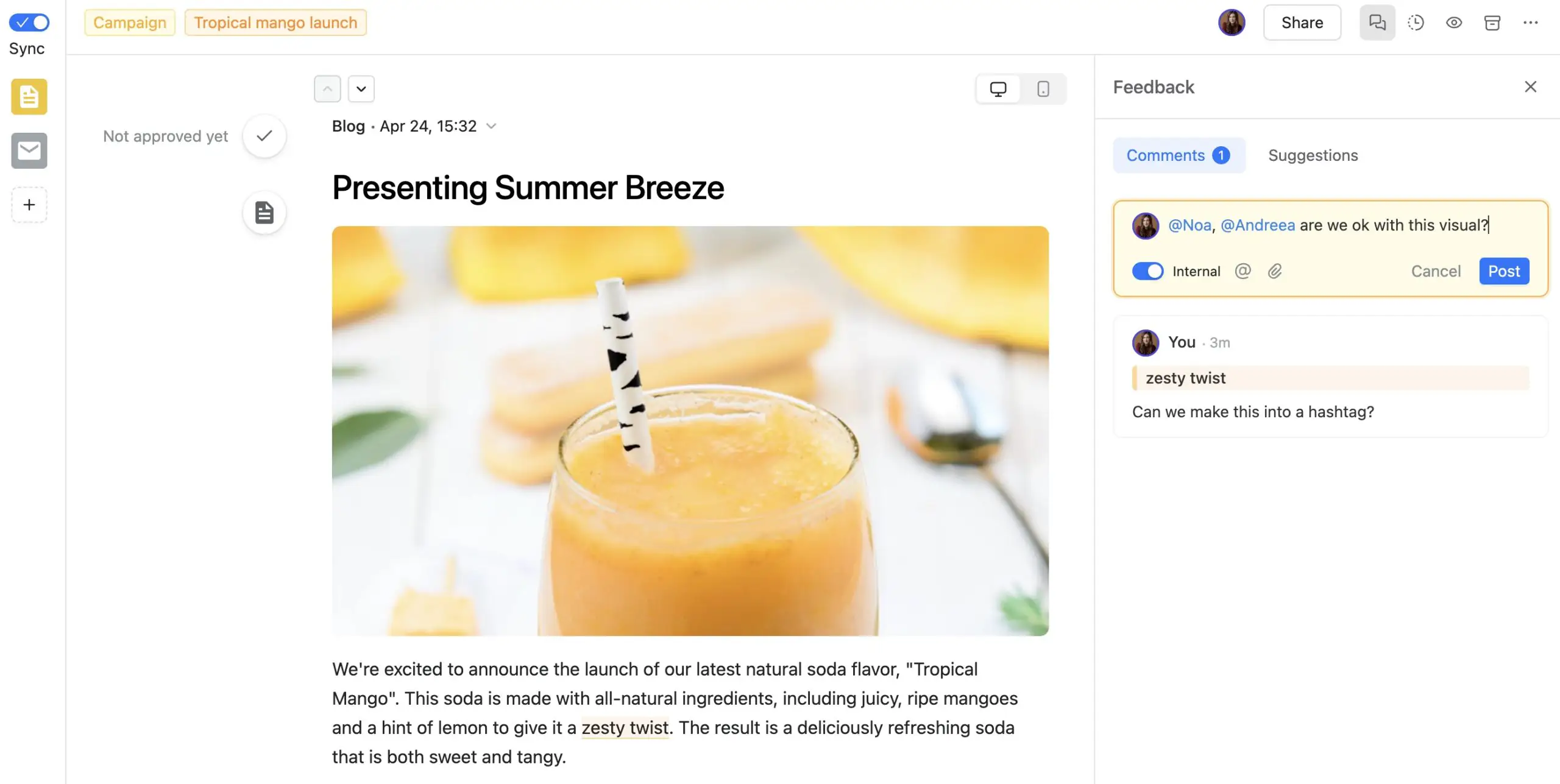
Team members review and comment on a campaign post in Planable
The account lead can then approve the digest, creating a record that someone other than the author reviewed the recommendation.
Version history is also useful when a client later asks why a recommendation changed.
When a report includes social performance data, Planable’s customizable reports can be used to build a report from configurable sections and share it through a public link or PDF.
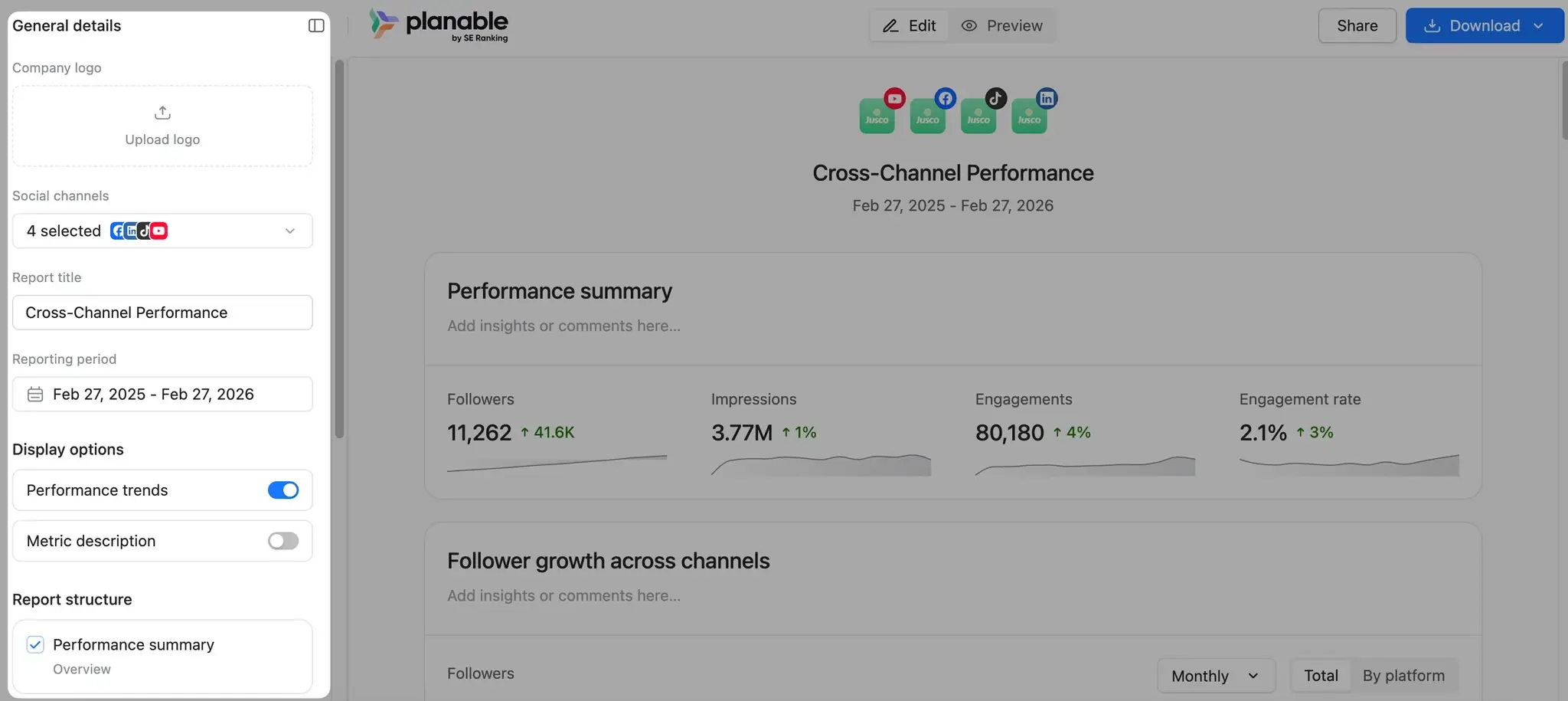
Customize cross-channel social media reports in Planable with performance metrics, trends, and reporting options
The social media report guide explains the reporting workflow in more detail.
A competitive intelligence process becomes fragile when review and approval feel optional. A defined reviewer makes the workflow repeatable.
How do you turn a competitive intelligence report into a decision?
A competitive intelligence report produces a decision when a named owner accepts, rejects, or revisits a recommendation by a stated date.
In Crayon’s 2026 survey, teams with all three of the following maturity markers drove revenue at 3.6 times the rate of teams with none of them:
- a KPI used to judge the program
- a dedicated platform where competitive intelligence is stored
- an executive sponsor in sales
Crayon presents these factors as characteristics associated with more mature programs rather than proof that the three factors directly cause higher revenue.
Choose a KPI before the next report goes out
The metric is easy to skip because the weekly workflow can appear useful without one.
Choose the outcome the program is intended to influence. For example, a team repeatedly meeting the same competitor in pitches might track its win rate against that competitor.
Match ownership to the decision
At an agency, ownership can map to the people already responsible for the relevant decision.
The account lead may approve what appears in a client deck, while an operations lead owns the reporting cadence behind it.
Record no-action decisions too
Not every competitive signal requires a response.
“No action; competitor pricing unchanged” is still a decision when it has an owner and a date.
Silence is different. If reports repeatedly ship without anyone accepting, rejecting, or revisiting the recommendation, reconsider what the team is monitoring before increasing the reporting frequency.
What does competitive intelligence look like in practice?
A useful competitive intelligence workflow carries one observable signal through to a decision within the same working cycle.
The following examples are illustrative agency scenarios.
Example 1: A competitor reduces posting frequency
Signal: A competitor publishes substantially fewer Instagram posts than in the previous month. The lower cadence continues for three weeks while engagement per post rises.
Interpretation: The competitor may be concentrating production on fewer, higher-impact posts. The data does not prove the reason for the change, but the pattern is worth testing against.
Decision: Keep the client’s current overall cadence rather than increasing posting frequency. Test one higher-production post each week and review the result after six weeks.
Example 2: A competitor shifts from static posts to vertical video
Signal: A competitor’s strongest Facebook and Instagram posts shift from static product imagery to short vertical video, and the pattern continues for a month.
Interpretation: The format change appears sustained rather than isolated. That makes it useful as an input to the client’s own format testing.
Decision: Run a two-month test of one vertical video per location per week, with the social lead responsible for delivery.
Example 3: Negative mentions rise after a competitor launch
Signal: Mentions of a hospitality competitor increase on Reddit and X after the competitor relaunches its booking app. Many of the mentions concern difficulty finding existing reservations.
Interpretation: Reliability has become a visible point of audience frustration during the post-launch period.
Decision: Bring forward an already planned reliability message, run it for two weeks, and review the next weekly mention pull before deciding whether to continue.
These examples show the distinction between monitoring and intelligence. The signal is only the starting point. The useful output is the decision connected to it.
What can competitor mentions and sentiment tell you?
Competitor mentions answer questions that account-level metrics cannot: who is talking about a competitor, what they are talking about, and in what tone.
Share of conversation is a competitor’s portion of all mentions inside a tracked topic.
Sentiment classifies those mentions as positive, neutral, or negative.
Both are most useful as directional measures rather than standalone judgments.
For example:
- a sharp increase in mention volume suggests something happened
- worsening sentiment after a launch can reveal the specific promise or experience causing frustration
- repeated discussion of the same issue can surface a positioning or campaign opportunity
Raw mention counts tend to favor larger brands, so compare trends and changes over time rather than treating the largest absolute number as the most important signal.
Social listening adds another layer to competitive intelligence by tracking what people are saying about competitors, not just what competitors publish themselves.
Planable’s Social Listening can monitor competitor names across X, YouTube, Reddit, TikTok, Facebook, Instagram, LinkedIn, and the open web. It brings those mentions into one feed, automatically classifies sentiment as positive, neutral, or negative, and shows how conversation volume changes over time.
Teams can then filter the results or export them for deeper analysis.
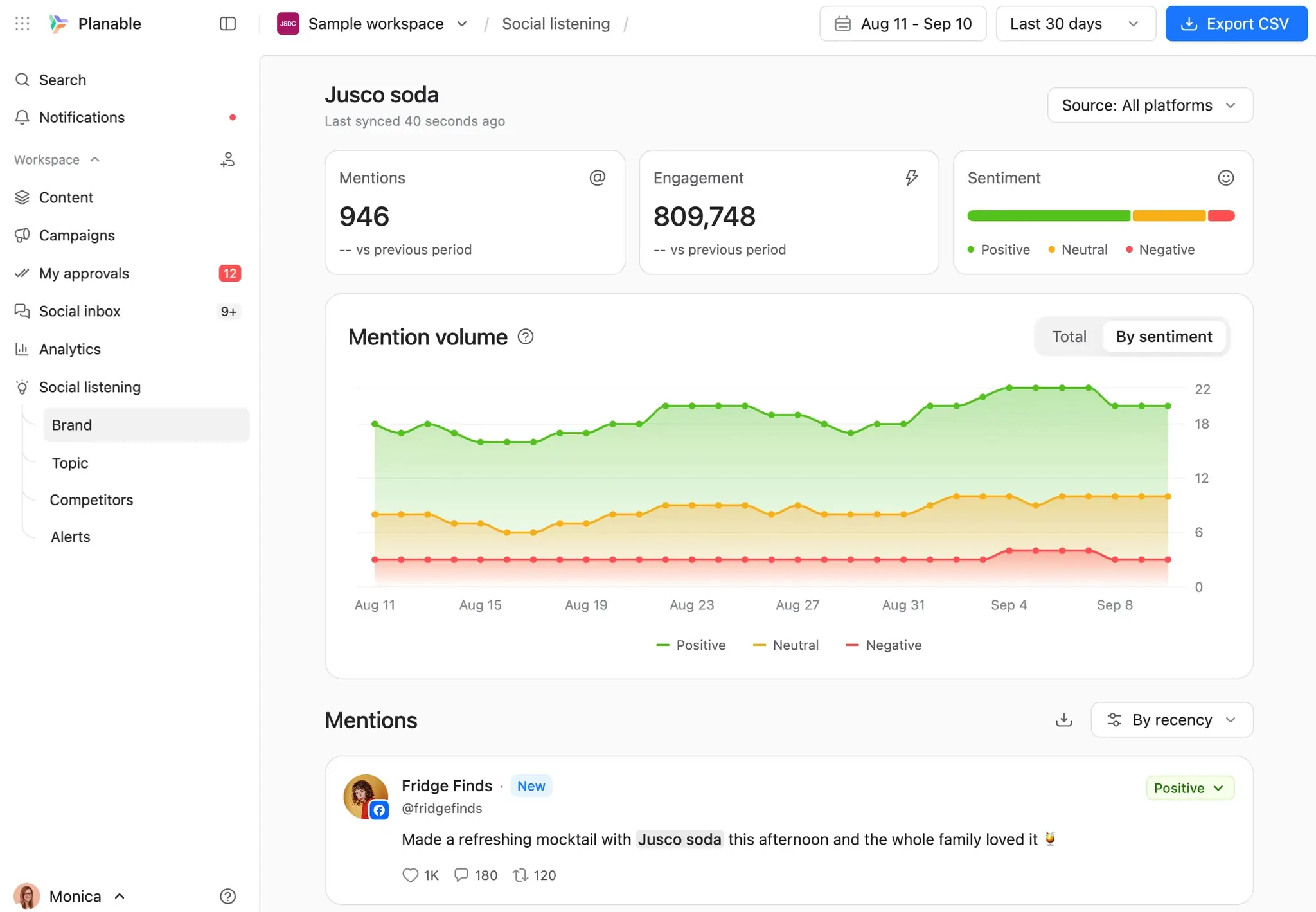
Track brand mentions, engagement, sentiment, and conversation trends with Planable’s social listening dashboard
Weekly competitive intelligence checklist
A weekly competitive intelligence review should be able to answer these questions before it closes:
- Which competitors are we actively monitoring?
- What changed since the previous review?
- Is the change isolated, or has it persisted?
- What evidence supports the observation?
- Which client, campaign, pitch, or account could it affect?
- What is our interpretation of the change?
- What action are we recommending, if any?
- Who owns the decision?
- By what date should the decision be made?
- Which KPI will tell us whether the intelligence was useful?
If the workflow consistently answers those questions, competitive intelligence stops being a collection of competitor screenshots and becomes an operating process for making better decisions.
Tracking a competitor’s page in Planable
Add a competitor’s social profile in Planable’s Competitors tab (inside Analytics) and you’ll see their followers, posting volume and average engagement next to your own page.
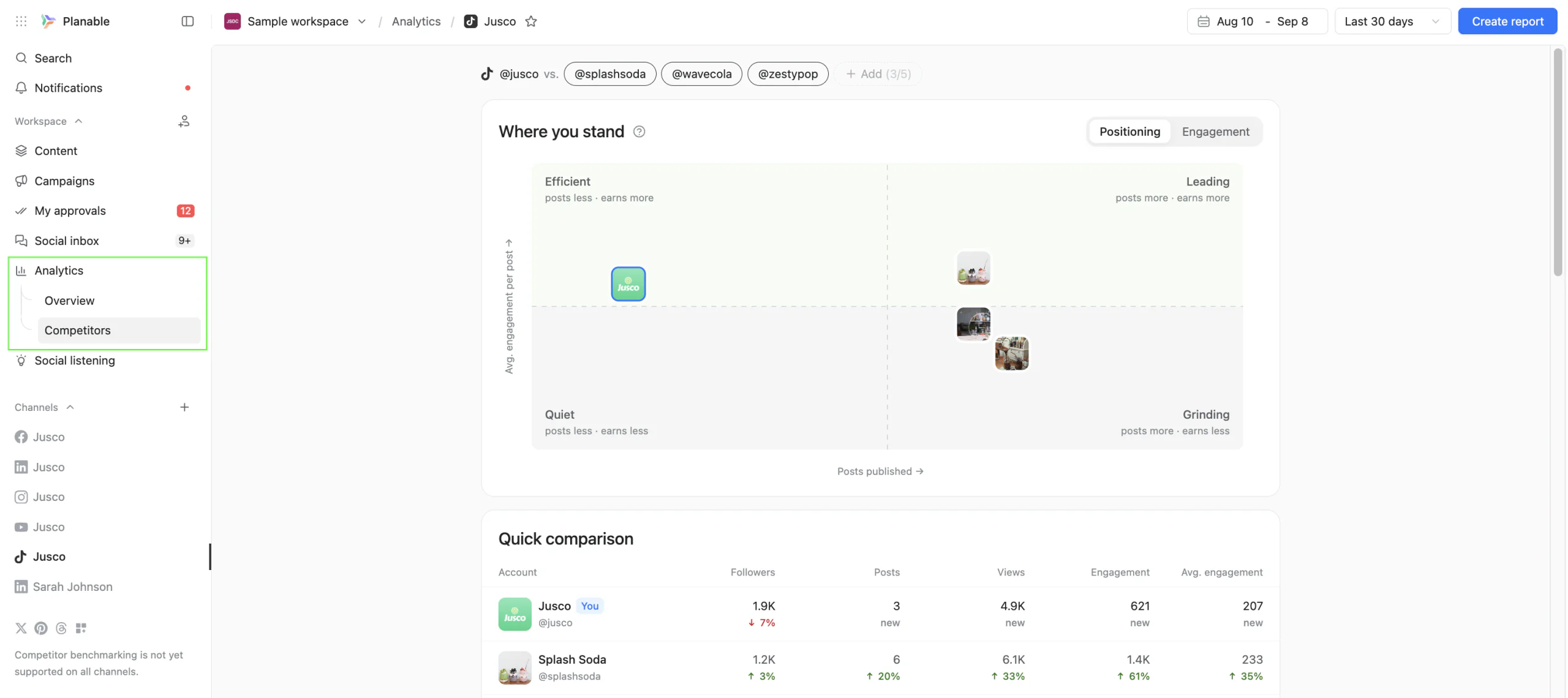
Compare competitor performance and positioning across key TikTok metrics with Planable’s competitor analytics
If you’d rather not start from a blank slate, Planable can suggest up to five real competitors for the page you’re viewing, built from that profile’s own public details (name, handle, bio, category and location) and narrowed to actual businesses in the same space.
A few things about Planable’s Competitor Analytics are worth knowing before you build your list:
- All five major networks are covered: Instagram, Facebook, YouTube, TikTok and LinkedIn.
- Data refreshes once a day, at around 04:00 UTC. Nothing here is live, and this morning’s number describes yesterday.
- Each page holds five competitors, so the shortlist is a deliberate decision.
- The workspace needs the Analytics add-on active, so it isn’t on by default.
- Trend charts and period-over-period deltas need two days of snapshots before there is a line to read.
- A profile that fails to sync three times is marked unavailable, so a handle change on their side needs a re-add on yours.
Adding or removing competitors is an Owner, Admin or Editor action; anyone with analytics access can read the tab.
Instagram and Facebook figures come from the public Meta Graph API, so they count what anyone could count by hand. YouTube, TikTok and LinkedIn use different sourcing. Either way, the competitor never knows they’re being tracked.
Competitive intelligence FAQs
How do you conduct a competitor analysis?
A competitor analysis is the one-off version: you pick three to five rivals, record where they stand today, and write up the gaps. Competitive intelligence runs that same audit on a repeating clock so the picture stays current.
What are the goals of competitive intelligence?
Competitive intelligence helps teams make better decisions with less guesswork. Most programs serve three goals: reducing strategic risk by spotting competitor moves early, identifying opportunities while market or positioning gaps are still open, and improving competitive readiness before teams enter a competitive deal.
If an activity doesn’t support one of those goals, it risks becoming monitoring for its own sake.
How is marketing research different from competitive marketing intelligence?
Marketing research answers one question with a project you commission, like a survey or a round of buyer interviews, and it ends when the question is answered. Competitive marketing intelligence runs continuously and stays pointed at named rivals, so the picture updates every week instead of once per study.
Where to start next week
Pick the cadence your deal pressure justifies. If competitive pitches are rare, a monthly digest is honest work. If half your pitches run against the same two agencies, put the loop on a weekly clock.
Before you add another source, settle two things: who owns the decision the report asks for, and the one metric the program gets judged on.
Then make the collect step mechanical. Put the competitor’s social profiles in Planable’s Competitors tab and their followers, posting volume, where you stand, and average engagement line up beside your own page, refreshed once a day.
Start with the rival you meet most often in pitches!
As a senior product marketer, Monica leads product marketing campaigns, drives competitive intelligence initiatives, and contributes to Planable’s growth strategy through extensive user research and data analysis.