SMS Marketing Use Cases: 15 Ecommerce Examples (2026)
Key takeaways
Organize SMS campaigns by customer lifecycle stage to deliver more relevant, higher-converting messages
Use automated SMS for abandoned carts, shipping updates, win-back campaigns, and more
The article provides ready-to-use SMS templates and workflow guidance
Fresh SMS marketing use cases are worth exploring in 2026 as brands adopt an omnichannel marketing model, helping them build stronger customer relationships and improve engagement rates.
Our article explores 15 real-world SMS marketing use cases across the entire customer lifecycle, each one showing an SMS example of how to capture consumer attention, start conversations, and build lasting customer relationships.
Unlike emails, SMS messages are short, straight to the point, and focused on immediately communicating important information about order confirmations, shipping status changes, loyalty rewards, or promotions.
Plus, SMS marketing offers a unique way to communicate with your customers in a much more personal way. It supports your overall marketing strategy by delivering the right message to the right customer at the right stage.
Build fully automated SMS marketing flows with Omnisend
Quick sign up | No credit card required
Overview of SMS marketing use cases across the customer lifecycle
Structuring your SMS marketing strategy around a flat, numbered list of SMS message types doesn’t reflect how modern ecommerce marketers actually think about their audience. Today, many successful brands organize their campaigns by customer lifecycle stage to tailor text messages to where their shoppers are in the buyer’s journey.
A lifecycle-based approach allows you to systematically move subscribers from curiosity to checkout. The table below shows how lifecycle stages connect specific SMS use cases to customer behaviors that trigger them.
| Lifecycle stage | SMS use case | Trigger |
|---|---|---|
| Pre-purchase (acquisition) | Welcome offer and lead capture | Customer signs up via website popup |
| Conversion | Abandoned cart reminder | Items left in cart for one hour |
| Post-purchase (engagement) | Shipping and delivery updates | Package is dispatched from the warehouse |
| Post-purchase (engagement) | Customer review request | 14 days after delivery confirmation |
| Retention (Re-engagement) | Win-back campaign | Customer has not made a purchase within 60 days |
| Retention (Re-engagement) | Birthday special | Customer’s birthday (based on profile data) |
Why SMS delivers great ROI in 2026
With Omnisend’s updated international rates, your text message campaigns start at just $0.007 per SMS. Additionally, automated SMS campaigns generate an average of $0.74 per send and contribute to an overall marketing ROI of $79 for every $1 spent.
Experience exceptional performance and intuitive automation without the premium price tag
Quick sign up | No credit card required
Pre-purchase: Building awareness and capturing intent
The pre-purchase stage focuses on capturing customer attention, building product desire, and driving first-time website visits. In 2026, brands planning for long-term benefits are updating their standard text-only promotions into rich, interactive experiences using Rich Communication Services (RCS).
RCS has three to seven times higher click-through rates than traditional SMS. It offers verified brand profiles, rich-media carousels, and in-thread quick-reply action buttons directly in the native inbox, making it more attractive to receivers.
Additionally, instead of adding minimalistic or sometimes vague hyperlinks, RCS messages include a swipeable catalog with an instant Shop Now button right in the conversation thread.
Welcome messages
The welcome message is the first touchpoint with consumers, so timing and wording play a major role. The message should be sent within minutes of a subscriber opting in, and it should use an overall warm tone that aligns with your brand tone of voice and identity.
But aside from welcoming new subscribers, the welcome series is crucial for introducing opt-in processes and clear opt-out options, all of which should adhere to local messaging regulations.
Version A
Hi! It’s [brand name].
Reply YES to confirm your SMS subscription for X% off on [product]!
Msg & data rates may apply. Msg freq varies.
Reply STOP to opt out.
HELP for help.
Terms & Privacy
Copy text
Version B
Welcome to [brand name] [recipient name]!
Reply YES to confirm your subscription and get X% off on [product].
Msg & data rates may apply. Msg freq varies.
Text STOP to opt out, HELP for help.
Terms & Privacy
Copy text
The templates above clearly state the brand identity, deliver immediate value, and include mandatory compliance information.
But keep in mind that these are just templates — consider adding personalized elements, such as naming your subscribers. Data shows that using personalization elements can make 65% of users more open to engaging with messages.
Flash sales and limited-time offers
To date, urgency-driven SMS heavily outperforms email for time-sensitive promotions because text notifications are typically read within minutes of being received.
While recipients’ email inboxes may be bursting with multiple limited-time offers, SMS marketing is more targeted and expected by consumers, leading to higher open rates.
[Brand name]: FLASH SALE! [emoji placement]
The next X hours only. Take X% off all duffels with code FLASHX at checkout: [Link]
Reply STOP to opt out.
Copy text
Adding a countdown element can create immediate psychological urgency, making it particularly effective for midday or early evening slumps when shoppers are active on their mobile devices.
Product launch announcements
Building anticipation for a new product drop works best as a coordinated two-message sequence. Send a teaser text 48 hours before the release, followed by an immediate launch announcement with a direct link when the products go live.
The wait is over.
The [brand and product name] is officially live!
Quantities are strictly limited for this run.
Claim yours now: https://www.omnisend.com/blog/sms-marketing-use-cases/
Reply STOP to opt out.
Copy text
Product launch SMS messages are simple and direct, and, if done well, invite immediate action from recipients while also rewarding subscribers with real-time access to exclusive products.
Back-in-stock alerts
It’s an incredibly high-intent SMS marketing use case because subscribers have explicitly asked to be notified about a specific product. In other words, recipients are fully aware and lookforward to back-in-stock notifications with a genuine intent to purchase again.
Good news!
The [brand and product name] is back in stock.
We held one for you, but inventory is moving fast.
Grab it here: https://www.omnisend.com/blog/sms-marketing-use-cases/
Reply STOP to opt out.
Copy text
For these types of alerts, it’s important for brands to have seamless ecommerce platform integrations. This ensures that as soon as inventory updates in your store system, the text notification fires instantly without manual intervention.
Browse abandonment nudges
A browse abandonment nudge targets a subscriber who looked at a specific product page but left without adding anything to their cart. It acts as a gentle, relevant reminder that should be distinct from a cart recovery sequence. The key here is to offer additional and relevant information without pushing recipients to buy.
Still thinking about the [brand and product name]?
It’s one of our top-rated organizers this season.
Check out the reviews and specs here: https://www.omnisend.com/blog/sms-marketing-use-cases/
Reply STOP to opt out.
Copy text
A browse-abandonment SMS message provides a low-friction way to your webstore by highlighting product value rather than offering an immediate discount.
Purchase conversion: Closing the sale
The purchase conversion stage is all about nurturing relationships with subscribers who’ve previously shown clear buying signals but haven’t completed their transactions.
The goal of purchase conversion is to provide consumers with highly targeted, relevant information based on their browsing behavior to remove purchase hesitation — all while strategically using urgency to prompt action.
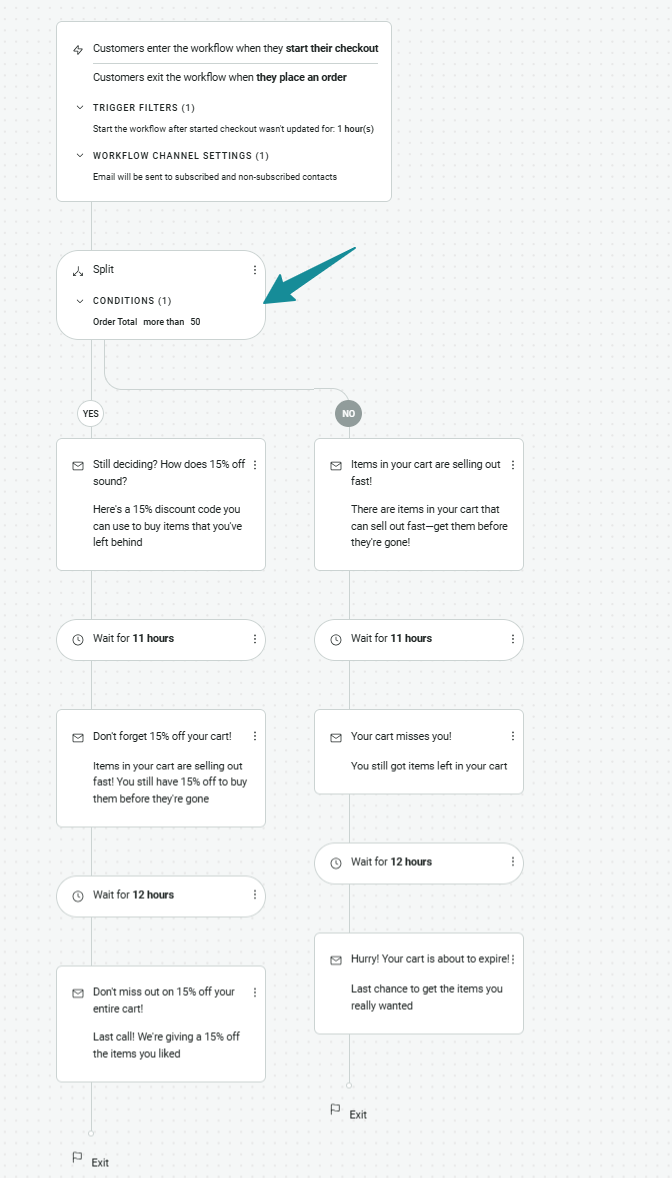
Abandoned cart recovery
As the single highest-converting SMS automation in ecommerce, a structured abandoned cart workflow is vital for recovering lost revenue. According to the data provided in our 2026 ecommerce marketing report, SMS click rates more than doubled YoY in 2025, and push automation conversion rates climbed up to 22.9%.
Furthermore, SMS-based abandoned cart recovery yields an average return of $0.74 per send, compared to $0.15 per send for campaigns. Based on this, businesses should send the first text exactly one hour after abandonment, including the product name and a direct checkout link.
Hi [recipient name], we noticed you left your [brand product name] behind.
Click here to jump right back into your checkout and complete your order: [Link]
Reply STOP to opt out.
Copy text
VIP and early access campaigns
Rewarding your top customers with exclusive access creates a strong sense of community and brand advocacy. Segment your audience by total spend or lifetime purchase frequency to identify your true VIPs.
[Brand name] VIP Alert
Our Black Friday collection opens to the public tomorrow, but your early access is active right now.
Shop the catalog first: https://www.omnisend.com/blog/sms-marketing-use-cases/
Reply STOP to opt out.
Copy text
This SMS message template shows how to use exclusivity instead of relying on margin-cutting discounts to drive high-value conversions from your most loyal segment.
Limited-time discount reminders
If a shopper has received an active discount code but hasn’t used it yet, the next step is to send a final reminder text to nudge them over the finish line before the discount expires.
Generally, a single follow-up SMS sent 24-48 hours later adds urgency without feeling pushy, but it’s best to limit these messages to one discount per product to avoid weakening the intended effect of your discount.
Final notice: Your X% welcome discount expires at midnight tonight.
Don’t let your savings slip away!
Apply it automatically here: https://www.omnisend.com/blog/sms-marketing-use-cases/
Reply STOP to opt out.
Copy text
The template above shows how to set a clear, definitive deadline that encourages immediate action. At the same time, brands should limit this to a single reminder to protect the customer experience.
Post-purchase: Building loyalty after the sale
The customer relationship doesn’t end when checkout is complete. The post-purchase window is your golden opportunity to reaffirm the buying decision, deliver clear transactional transparency, and encourage customers to move towards their next purchase.
To take it up a notch, modern platforms go beyond basic outbound texting with advanced helpdesk integrations.
For example, the Omnisend and Gorgias integration converts incoming customer text replies directly into support tickets, so service agents can respond through a single helpdesk dashboard.
Moreover, customer satisfaction scores can be synced as custom properties, such as Gorgias_latest_satisfaction_survey_score, to trigger automated flows. Hence, if a customer submits a negative one-star or two-star rating, it automatically triggers a targeted SMS workflow with a unique recovery discount, ultimately turning a poor experience into a retention victory on autopilot.
Order and shipping updates (transactional SMS)
Transactional text messaging is a strong trust-building tool that keeps customers informed without forcing them to check their email inbox constantly. You can include light, non-intrusive brand marketing elements within these updates.
Order confirmed template
Order confirmed!
Your [brand name] adventure starts now.
We’re packing your order [#X].
Track your progress here: https://www.omnisend.com/blog/sms-marketing-use-cases/
Reply STOP to opt out.
Copy text
Order shipped template
Great news!
Your [brand name] order has shipped. It’s officially on its way.
Track your delivery in real-time: https://www.omnisend.com/blog/sms-marketing-use-cases/
Check out new arrivals while you wait: https://www.omnisend.com/blog/sms-marketing-use-cases/
Reply STOP to opt out.
Copy text
Order delivered template
Delivered! Your package has arrived at your doorstep.
We hope you love your new [product]!
Check out our [unique] tips: https://www.omnisend.com/blog/sms-marketing-use-cases/
Reply STOP to opt out.
Copy text
Cross-sell and upsell messages
Recommending relevant products based on a customer’s purchase history can significantly increase lifetime value when timed appropriately. Post-purchase SMS recommending complementary products is most effective 24-48 hours after delivery.
We hope you’re enjoying your new [product name]!
Complete the look/set/combo with our [product recommendation].
Shop now: https://www.omnisend.com/blog/sms-marketing-use-cases/
Reply STOP to opt out.
Copy text
A cross-sell message is brief yet informative enough to pique the buyer’s interest. The point to emphasize here is to provide concrete recommendations and craft the message to show how a new product would benefit your shoppers.
Review and feedback requests
Gathering genuine customer feedback is essential for building social proof, but you must time the request so the customer has had enough time to test the product.
The general rule of thumb is to request a review after delivery is confirmed, which typically is somewhere between seven and 14 days.
Hi [recipient name]!
How is your new [brand and product name] treating you?
Tap the short link below to leave a quick review and share your thoughts: https://www.omnisend.com/blog/sms-marketing-use-cases/
Reply STOP to opt out.
Copy text
This message works well because it includes a clean, short link to minimize text clutter while making the review process easy to follow on mobile devices.
Retention and re-engagement: Winning back and keeping subscribers
Long-term customer retention requires consistent, personalized nurturing that rewards loyalty and actively steps in to prevent churn before subscribers become completely inactive.
Birthday messages, win-back sequences, and loyalty updates all have a unique attribute that helps to maintain engagement without the brand communication feeling transactional.
Birthday and anniversary messages
Celebrating your subscribers’ special moments or milestones with personal rewards builds an emotional connection. It offers a great opportunity to cleverly use stored customer..
For example, collecting birthday data during your initial popup opt-in allows you to trigger thoughtful, high-converting milestone texts like this:
Happy Birthday from [brand name]!
Let’s celebrate with a special gift.
Use code BDAYX for $X off your next order this month: https://www.omnisend.com/blog/sms-marketing-use-cases/
Reply STOP to opt out.
Copy text
Win-back sequences
When a customer hasn’t interacted or made a purchase within a typical 60-to-90-day window, a two-message win-back sequence can be an effective way to get their attention again.
The first message should be framed in a more emotional tone, using a friendlier, check-in style. And if this first message doesn’t prompt a response, the second message can then be sent with a real discount or special offer with a defined offer duration.
Win-back (soft) SMS 1
We’ve missed you around here!
[Brand name] has some new updates while you’ve been away.
Come see what’s new: https://www.omnisend.com/blog/sms-marketing-use-cases/
Reply STOP to opt out.
Copy text
Win-back (discount) SMS 2
It’s been a while since your last visit to [brand name].
To welcome you back, enjoy [discount, e.g., 15% off] your next purchase.
Just use code [discount code] at checkout.
Explore what’s new: https://www.omnisend.com/blog/sms-marketing-use-cases/
Reply STOP to opt out.
Copy text
The first text takes a soft, curiosity-led reengagement approach, while the second steps up the value with a stronger incentive. If there is no response after the second message, sunset logic should remove them from the active list to protect deliverability.
Loyalty program updates and rewards
Text messaging is the ideal method for loyalty program communication because notifications about points, tiers, and rewards feel urgent and highly personal. Especially since customers are incentivized to act on a loyalty reward, even if it’s from a brand they don’t remember.
In a way, loyalty update SMS messages can even be used to support win-back sequences.
[Brand name] Rewards: You just entered Gold Tier status!
Enjoy permanent free shipping and early access to all upcoming drops: https://www.omnisend.com/blog/sms-marketing-use-cases/
Reply STOP to opt out.
Copy text
Real-time notifications keep your loyalty program top-of-mind and encourage repeat purchases to maintain status-level benefits.
Subscriber surveys and polls
Similar to requesting feedback, sending surveys and polls is among the top methods for gathering customer-specific data, and if compiled well, can also provide unique insight into how customers perceive your brand and products/services.
[Brand name] Poll: What’s your favorite [product]? Reply:
1 for [product 1]2 for [product 2]3 for [product 3]
Reply STOP to opt out.
Copy text
Despite being short SMS messages, these surveys and polls can feel interactive rather than invasive. Plus, customer replies feed directly into your segmentation engine to customize future content.
SMS use cases by ecommerce vertical
Running SMS marketing campaigns depends on individual businesses and the products or services they sell. Every message has to be customized to fit the unique needs, questions, and requirements.
In practice, this could look like a back-in-stock message for a fast-fashion brand that requires instant trend-driven urgency, while a skincare brand must prioritize routine education and precise usage lifecycles.
Here’s a quick comparison showing how SMS use cases can be applied to different industries:
| Ecommerce vertical | Priority use case | Vertical-specific focus |
|---|---|---|
| Fashion and apparel | New drop and size alerts | Visual carousels, urgency around limited sizing, and style curation. |
| Beauty and skincare | Replenishment reminders | Lifecycle replenishment cycles, routine tips, ingredient education. |
| Food, beverage, and DTC | Subscription management | Renewal reminders, swap options, flash seasonal flavor releases. |
| Home goods | Complete the look texts, cross-sells | Design inspiration, project ideas, high-value visual aesthetics. |
Fashion and apparel
In the fashion sector, inventory moves quickly, and visual trends are usually the single most important factor attracting customers and leading them to purchase. This is why it’s common for brands to lean on creating the right amount of urgency to pair with striking branded visuals.
In 2026, RCS is particularly important for fashion as it can allow brands to include a swipeable product carousel of new arrivals with Shop Now buttons directly in the SMS thread:
- New drop alerts: Use instant notifications with swipeable product images when a limited seasonal apparel collection goes live
- Back in stock: Send highly targeted alerts to subscribers who previously selected a sold-out size or colorway
- Seasonal clearance: Direct text links pointing shoppers straight to localized markdown sections during end-of-season events
Beauty and skincare
Beauty marketing thrives on customer routine consistency. That’s why text message use cases in this vertical should focus on consumption cycles and helpful education.
For example, if a customer consistently buys a favorite serum, they could benefit from targeted automated replenishment SMS messages around days 25 to 28:
- Product replenishment reminders: Use automated texts timed perfectly to send SMS messages based on the typical lifespan of the buyer’s preferred product
- Usage and routine guidance: Include text links to interactive morning or evening routine video guides right after a product delivery
- Ingredient launches: Create informative texts showcasing the specific benefits of a newly introduced ingredient formulation
- VIP early access: Add messages that signal special offers, like New serum drops Friday — VIP gets 24-hour early access. Buy now
Food, beverage, and DTC subscriptions
For direct-to-consumer (DTC) businesses and brands built on recurring consumption or subscription models, text messaging can be the primary channel for communicating operational and transactional information on a consistent basis.
In particular, seasonal limited editions, such as holiday coffee blends, summer cocktail ingredients, and other products, sell incredibly well thanks to teaser SMS sequences:
- Subscription renewal alerts: Write helpful heads-up text letting subscribers easily modify, delay, or add items to their upcoming monthly order before it ships
- Limited flavor releases: Provide rich media messages giving active club members first access to small-batch or seasonal product flavors
- Flash delivery offers: Focus on localized evening texts offering quick discounts on orders completed within a tight two-hour window
Home goods
Home furniture and decor typically involve longer consideration phases and higher average order values. Text positioning should emphasize design inspiration and curated ensembles. Which is why seasonal promotions, such as spring redecorating, holiday hosting, and lifestyle-driven cross-sells, perform well:
- Complete the room upsells: Utilize tailored recommendations for matching shams, throw pillows, or hardware following a major furniture purchase
- Care and installation inspiration: Add video texts walking customers through the process of setting up, styling, or maintaining their new household items
- Seasonal aesthetic changes: Use curated style guides to help homeowners refresh their home spaces for upcoming seasonal shifts
- DIY inspiration: Consider messaging that drives action for the benefit of the recipient, like How to style small spaces — here’s our compact furniture guide: [URL]
How SMS fits into omnichannel automation workflows
SMS marketing really shines when used together with other channels, or in other words, as part of an omnichannel approach.
In fact, SMS messages achieve their highest ROI when used together with coordinated email and SMS automation workflows.
 |
When boutique travel accessories brand Vagari Bags integrated targeted SMS campaigns directly alongside their existing automated email workflows, they unlocked incredible customer engagement.
By running both channels cohesively out of a single marketing platform, they achieved 6% to 7% click-through rates and generated an astonishing 1:121 return on investment on their coordinated text message campaigns. Read the full Vagari Bags success story. |
Welcome series: Email + SMS combined
According to our Omnichannel marketing in the US report, omnichannel marketing that uses email, SMS, and push messages increased the conversion rate by nearly 500% in the US in 2024. And in marketing, the welcome series communication is crucial for kickstarting the first stage of the customer lifecycle.
Example flow:
| Day | Channel | Trigger | Message goal | Conditional |
|---|---|---|---|---|
| Day 0 | Opt-in | Welcome + discount intro | None | |
| Day 1 | SMS | Time-based | Reinforce brand, remind code | If day 0 email not opened within 4 hours → send earlier |
| Day 3 | Time-based | Social proof, bestsellers | None |
Abandoned cart: The multi-touch recovery flow
An abandoned cart automation maximizes recovery rates while also minimizing message fatigue by adjusting channels based on customer behavior. Moreover, automated abandoned cart flows consistently outperform one-off campaigns.
To support this, Omnisend’s 2026 Ecommerce marketing report found that in 2025, automated messages generated 16 times more revenue per send than scheduled campaigns. On top of that, SMS and automated push notifications delivered significantly higher click-to-conversion rates. All of this goes to show that using emails and SMS in combination can bring substantial benefits.
Example flow:
| Time | Channel | Trigger | Message goal | Conditional |
|---|---|---|---|---|
| 30 min | Light incentive | Product image, link | None | |
| One hour | SMS | Urgency + incentive | Discount code, direct link | If email not opened |
| Day 2 | Stronger incentive | Higher discount, testimonial | None |
Post-purchase: From confirmation to re-engagement
Post-purchase sequences are centered around transactional messaging, informing recipients of important updates about their purchase. A common example of how SMS and email can be applied in this sequence is to send immediate confirmations and change-related order information via SMS, then layer them with more informative emails.
Example flow:
| Day | Channel | Event | Content type | Goal |
|---|---|---|---|---|
| Day 0 | SMS | Order confirmed | Transactional (order #, tracking) | Reassure + inform |
| Day 2 | Shipped | Care tips, product education | Deepen connection | |
| Day 5 | SMS | Delivered + cross-sell | Transactional + complementary product | Increase AOV |
| Day 10 | Review request | Ask for feedback + testimonial | Build social proof |
Conclusion
In 2026, SMS marketing remains one of the highest ROI channels for ecommerce brands. Mapping out your SMS marketing use cases across the customer lifecycle – pre-purchase, purchase, post-purchase, retention – allows your business to tailor every single message to fit different stages and customer segments. Moreover, sending relevant and timely information via SMS texts builds trust and loyalty.
In the case of abandoned carts or routine-building post-purchase updates, SMS messages are best used to drive immediate action, whereas with emails, the information delivery time is typically slower across the board.
However, our research in the Omnisend 2026 ecommerce marketing report shows that using SMS (now starting at $0.007 per message) and emails together as part of a broader omnichannel strategy brings the best results.
Launch your automated SMS marketing campaigns with Omnisend
Quick sign up | No credit card required
Frequently asked questions
What are some uses of SMS?
In ecommerce, the main use cases for SMS marketing focus on transactional updates and promotional campaigns. Transactional SMS includes real-time order confirmations, shipping notices, and delivery alerts. Promotional communication involves flash sales, back-in-stock alerts, welcome offers, and abandoned cart sequences.
Which is safer, SMS or RCS?
In general, neither is safer than the other if done well. While SMS messages convey minimal information, Rich Communication Services (RCS) include stricter carrier verification processes. This increases customer trust and protects them from phishing and spoofing.
How do I text 100 people at once?
To send text messages to 100 or more people at once while complying with SMS regulations, brands should use dedicated mass texting services or marketing platforms like Omnisend. To send bulk messages to US shoppers, you must register a 10DLC (10-Digit Long Code) with carriers to avoid filtering that drops delivery rates to 60-70% and adhere to TCPA.
Under TCPA rules, you must:
- Obtain prior express written consent (via double opt-in)
- Display your clear brand name at the start
- Include a direct ‘STOP’ opt-out in every promotional text
- Limit sending to quiet hours (8 AM – 9 PM recipient’s local time)
What is the best use case for SMS marketing in ecommerce?
Abandoned cart recovery is by far the most effective use case in ecommerce marketing. Since SMS messages may yield higher open rates, brands can send automated cart reminders within the first hour after cart abandonment, potentially boosting ROI.
How do SMS and email marketing work together?
SMS and email are both crucial channels for virtually all ecommerce businesses. But when combined, these two channels can form the basis of an omnichannel approach, with SMS messaging communicating time-sensitive information and emails providing relevant context.
What industries benefit most from SMS marketing?
Most industries can benefit from SMS marketing, but fashion and apparel, health and beauty, food and beverage, and direct-to-consumer (DTC) especially. Apart from these industries, any business that relies on seasonal trends or repeat product use can use SMS marketing.